Schedule Outboard Maintenance
Dockside service across St. Pete, Clearwater, Tampa, Tierra Verde, and Gulfport.
The Yamaha outboard maintenance schedule runs on five stops: a 20-hour break-in service, then 100, 300, 500, and 1,000 hours, with each stop adding parts to the one before it. There's also a sixth item most boaters never hear about until a fuel problem strands them, and it comes due every 50 hours.
Nobody bought a center console to spend a Saturday decoding a maintenance chart, so we did it for you. Below is what Yamaha asks for at each stop, where the engine families split, and where Tampa Bay salt water makes us run a tighter outboard maintenance program than the factory minimum.
First, the fine print. This covers Yamaha four-strokes. Two-stroke and HPDI engines run a different schedule, and older four-strokes used different intervals too.
Our summary comes from Yamaha's four-stroke dealer maintenance schedule and its Maintenance Matters owner chart. Yamaha updates owner's manual schedules over time, so the manual for your serial number has the final say. Want the brand-agnostic version? Start with our complete outboard maintenance schedule.
Yamaha Outboard Service Intervals at a Glance
Each interval has two triggers, engine hours or months on the calendar, and the earlier one wins: 20 hours or three months for the break-in, then 100 hours or one year, 300 hours or three years, and 500 hours or five years, plus a short list at 1,000 hours. Here's the Yamaha 4-stroke maintenance schedule in one table. "Inspect" means inspect and replace if needed.
| Interval | What Gets Added |
|---|---|
| 20 hours / three months (once) | Change engine oil and gear oil. Inspect the primary fuel filter, fuel lines, battery, prop, trim and tilt, water inlet, and pilot water stream. Grease the fittings. |
| Every 50 hours (max) | Replace the boat-mounted 10-micron fuel-water separating filter. |
| 100 hours / one year | Everything at 20 hours, plus the oil filter. Inspect spark plugs, thermostats, impeller and water pump housing, anodes, timing belt, and throttle and shift linkage. |
| 300 hours / three years | Replace the impeller and water pump housing. Inspect intermediate fuel filters and diaphragm-style fuel pumps. |
| 500 hours / five years | Inspect and adjust valve clearance (dealer item). Service the vapor separator tank fuel filter. Clean the oil control valve filter on models that have one. |
| 1,000 hours | Replace the timing belt. Inspect the exhaust guide and manifold, plus the belt tensioner on F150, V6, and V8 models. |
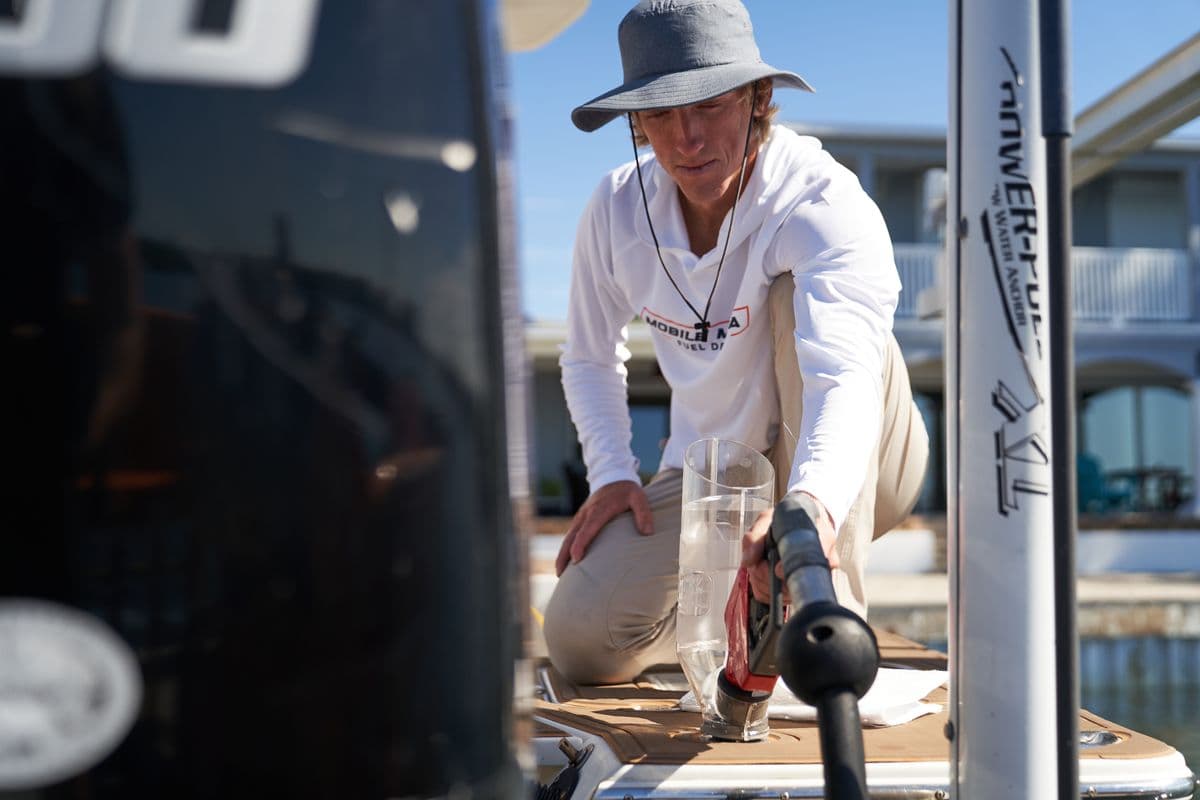
That 50-hour filter row is the one boaters miss most. It's half the main service interval, it sits on the boat instead of the engine, and on a Florida boat burning E10 (10% ethanol) gas it's the cheapest insurance on the whole list.
The 20-Hour Break-In Service
A new engine sheds fine metal into its factory oil while the piston rings seat. The 20-hour service drains that oil before it does any harm. Yamaha calls for engine oil and gear oil changes here, along with checks of the battery, fuel lines, prop and cotter pin, trim and tilt, water inlet, and the pilot water stream. The owner chart also marks the oil filter at this first stop, while the dealer schedule starts it at 100, so your manual breaks the tie.
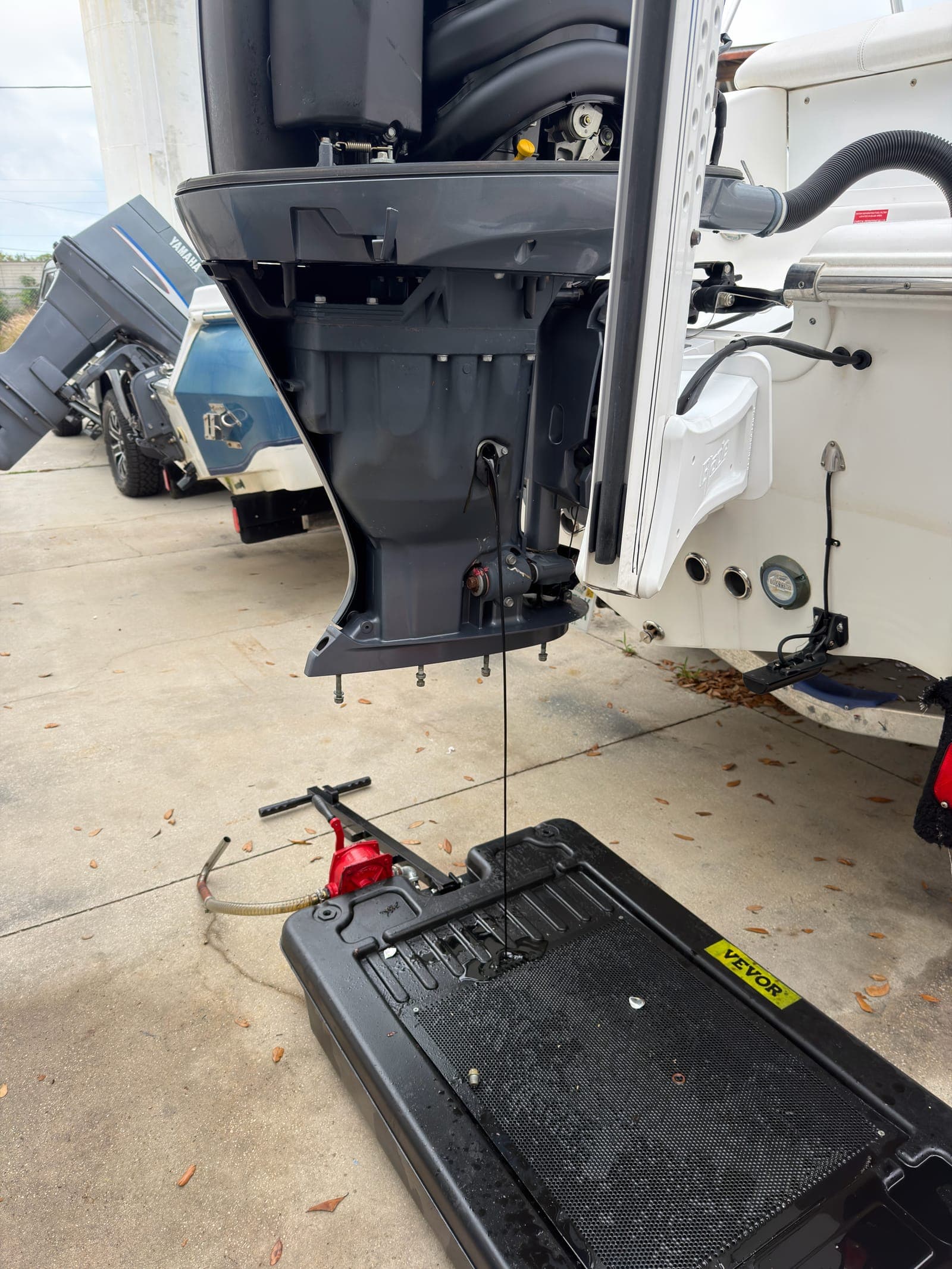
We watch the first gear oil drain closely. Break-in debris and early water intrusion show up on the lower unit's magnetic drain plug before anywhere else. Whatever's on that magnet at 20 hours is the yardstick for every drain after it. Our 100-hour service breakdown shows what a healthy drain looks like and what a problem drain looks like.
This visit also starts the engine's paperwork. A warranty reviewer or a future buyer will ask for that first-service record. Run most weekends after a spring purchase and you'll be at 20 hours by early summer.
The 100-Hour Service: Yamaha's List vs. Ours
The 100-hour or annual service is the one you'll see every year you own the engine. On top of the 20-hour work, the factory list calls for:
- Engine oil and filter — replaced. Yamaha pairs this with Yamalube 4M FC-W. Whatever goes in should meet the spec in your manual.
- Gear oil — replaced.
- Spark plugs — inspected, adjusted, or replaced as necessary.
- Anodes — inspected and replaced as necessary. There are internal anodes too, reachable with minor disassembly.
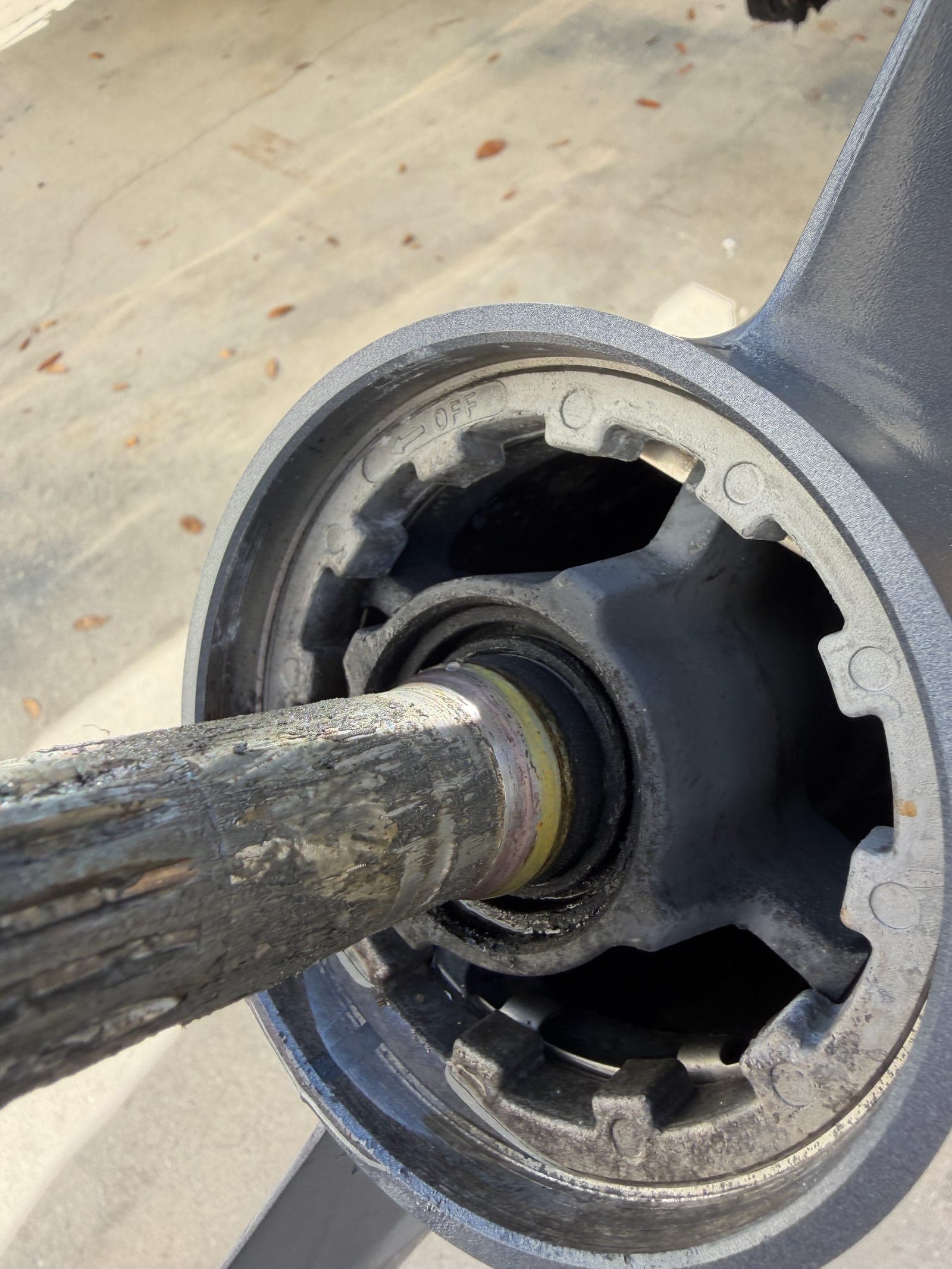
- Impeller and water pump housing — inspected and replaced as necessary.
- Thermostats and pressure control valve — inspected.
- Timing belt — inspected. Look for cracks, wear, and oil contamination.
- Linkage, cowling clamps, wiring, switches, and gauges — inspected and adjusted.
That's a lot of "inspect." It has to be, because one chart covers every Yamaha sold, whether it lives on a freshwater lake or behind a dock in Gulfport. Our program doesn't have to. In Tampa Bay, salt water wears out those parts too often to leave them for next year, so our 100-hour service replaces them:
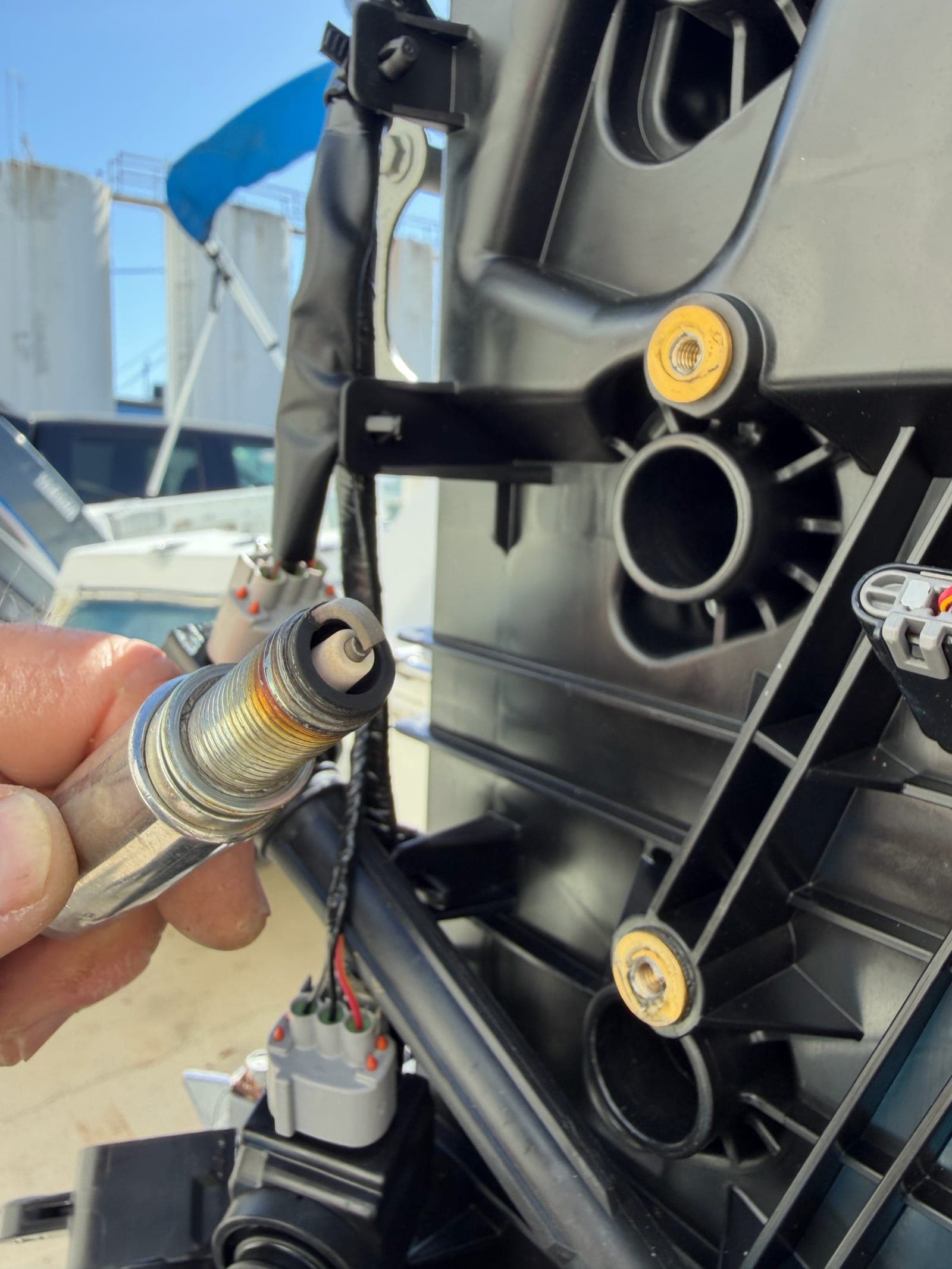
- Spark plugs — replaced. Salt air speeds up electrode wear and deposits, and new plugs cost far less than chasing a misfire in July.
- Anodes — replaced. Salt water, shore power, and a crowded marina full of mixed metals wear them down fast, so we swap the full set every time instead of measuring and hoping.
- Water pump — full assembly replaced. Housing, impeller, and wear plate, not just the impeller. Yamaha's own 100-Hour Service Kit for the F115, F150, F200, and F300 includes a water pump, plugs, and anodes, so this is closer to Yamaha's thinking than it looks.
- Everything else — included. A new gearcase drain gasket, a wipe-down inside the cowling to remove salt, CRC corrosion blocker sprayed on the electrical connections, and a written report when we finish.
Before anyone picks up a wrench, our certified technicians connect the Yamaha Diagnostic System (YDS) to read stored fault codes and runtime data. An intermittent alarm you never saw can still be sitting in the engine's memory.
We price the 100-hour the same whatever the brand: $1,150–$1,300 for a single 150–200-hp engine, $1,300–$1,450 for a single 225–300-hp, and $2,300–$2,900 for twins, before tax. Triples are quoted. Dealer quotes Tampa Bay boaters have shared with us run about $300–$600 and usually stop at fluids and filters. Our price adds new plugs, a full anode set, a new pump assembly, and a written report, all done dockside.
The Yamaha 300-Hour Service
At 300 hours or three years, the Yamaha outboard maintenance schedule stops asking "does it look okay?" and starts replacing parts. Here's how a Yamaha 300-hour service plays out with us:
- Impeller — replaced. The factory calls for the impeller and pump housing at this stop. If we ran your 100-hour services, the housing and wear plate were replaced with the full assembly then, so we inspect those and confirm they're in spec. Boaters coming to us for the first time at 300 usually get the full assembly, because there's no history showing how the old housing held up.
- Spark plugs and anodes — replaced. Same as every 100-hour service we run.
- Intermediate fuel filters — inspected and replaced as necessary. Boats without a boat-mounted 10-micron filter may need these more often.
- Diaphragm-style fuel pumps — inspected. Heat and fuel chemistry age them, not just hours.
- Thermostats and timing belt — inspected again.
Two things are not on the factory's 300-hour line: valve clearance and timing belt replacement. Valves come due at 500 hours and the belt at 1,000. If a 300-hour quote includes a new belt, ask why.
A cracked or oil-soaked belt found on inspection is a good reason, and so is an original belt on an older engine, since rubber ages in Florida heat even when the hours are low. A healthy belt on a young engine isn't a good reason.
Our 300-hour service breakdown walks through the invoice line by line. With us, a 300-hour service on a single 150–300-hp outboard typically runs $1,450–$1,850 before tax, and twin 150–250-hp outboards $3,000–$3,500. We quote each job, because the engines and what the inspection finds move the number.
Expert Marine Maintenance
From routine service to major repairs, our team of expert marine technicians handles it all. Full project management so you can enjoy your boat.
Expert Technicians
Certified marine specialists
500 and 1,000 Hours: Valves, Fuel Filters, and the Timing Belt
Most recreational boats here won't see 500 hours for years, but the five-year side of the clock still runs, and this is where the internal work lives.
At 500 hours or five years, valve clearance gets inspected and adjusted, which Yamaha marks as dealer work. Valves that drift out of spec cause hard starting and a rough idle, and the problem only gets worse. The vapor separator tank filter, the one buried inside the engine's fuel system, gets serviced at the same visit, and models with oil control valves (the chart lists the F250 and V8) get that filter cleaned. Internal anodes are worth replacing whenever major disassembly exposes them.
At 1,000 hours the timing belt is replaced, even though it has been inspected at every 100-hour service along the way. Any belt showing cracks, wear, or oil contamination before then should come off early. The belt tensioner gets inspected on F150, V6, and V8 models, and so do the exhaust guide and manifold, which salt water corrodes from the inside.
Plan these as longer visits. Valve adjustment and belt replacement can need shop time when access is tight, and we flag that in your report before any work is scheduled.
F150 vs. V6 vs. V8 vs. Smaller Yamahas
"It's a Yamaha" doesn't tell a technician much. The hour steps stay the same across the lineup, but the parts list at each step changes with the engine family.
| Engine | What's Different |
|---|---|
| F150 (inline four) | Standard 20/100/300/500/1,000 chart. Belt inspected every 100 hours and replaced at 1,000, tensioner inspected at 1,000. Yamaha sells a dedicated 100-Hour Service Kit for it. |
| Midrange (F25–F115) | Same hour steps, but parts vary by model. Some small engines use an oil screen that gets cleaned or replaced instead of a cartridge filter. |
| V6 (F200–F300 range) | Standard chart plus the belt tensioner at 1,000 hours. Oil control valve filter service at 500 hours on the F250. The F200 has been built as both an inline four and a V6, so confirm which one you have. |
| Original 5.3-liter V8 F350 | Yamaha's dealer schedule recommends dealer-only oil and filter changes on V8 models, plus oil control valve service at 500 hours and a tensioner check at 1,000. |
| Current 4.3-liter V6 F350, XTO, and V MAX SHO | Newer platforms with their own manuals. Don't assume an older chart applies. Go line by line through yours. |
A quote for "a Yamaha 300-hour" should name the exact model. The right scope for an F150 isn't the right scope for an F350, and the two engines Yamaha has sold as the F350 aren't even the same design.
What Tampa Bay Salt Water Changes
Yamaha writes its intervals for "typical" use: varied speeds, proper warm-up and cool-down, light-to-medium loads, and cruising around 3,000–4,000 rpm. Run outside that and Yamaha says to service more often, especially engine oil and gear oil. Its examples are long idling or trolling, heavy loads, frequent starts and stops, and long stretches at wide-open throttle. Changing fuel formulations can also mean more frequent fuel filter changes.
Now picture a normal week here. A slow no-wake run down the Intracoastal or through the canals off Snell Isle, a morning drifting the grass flats near Shell Key, and E10 sitting in a hot tank until the next weekend. That's not typical use. We run it tighter:
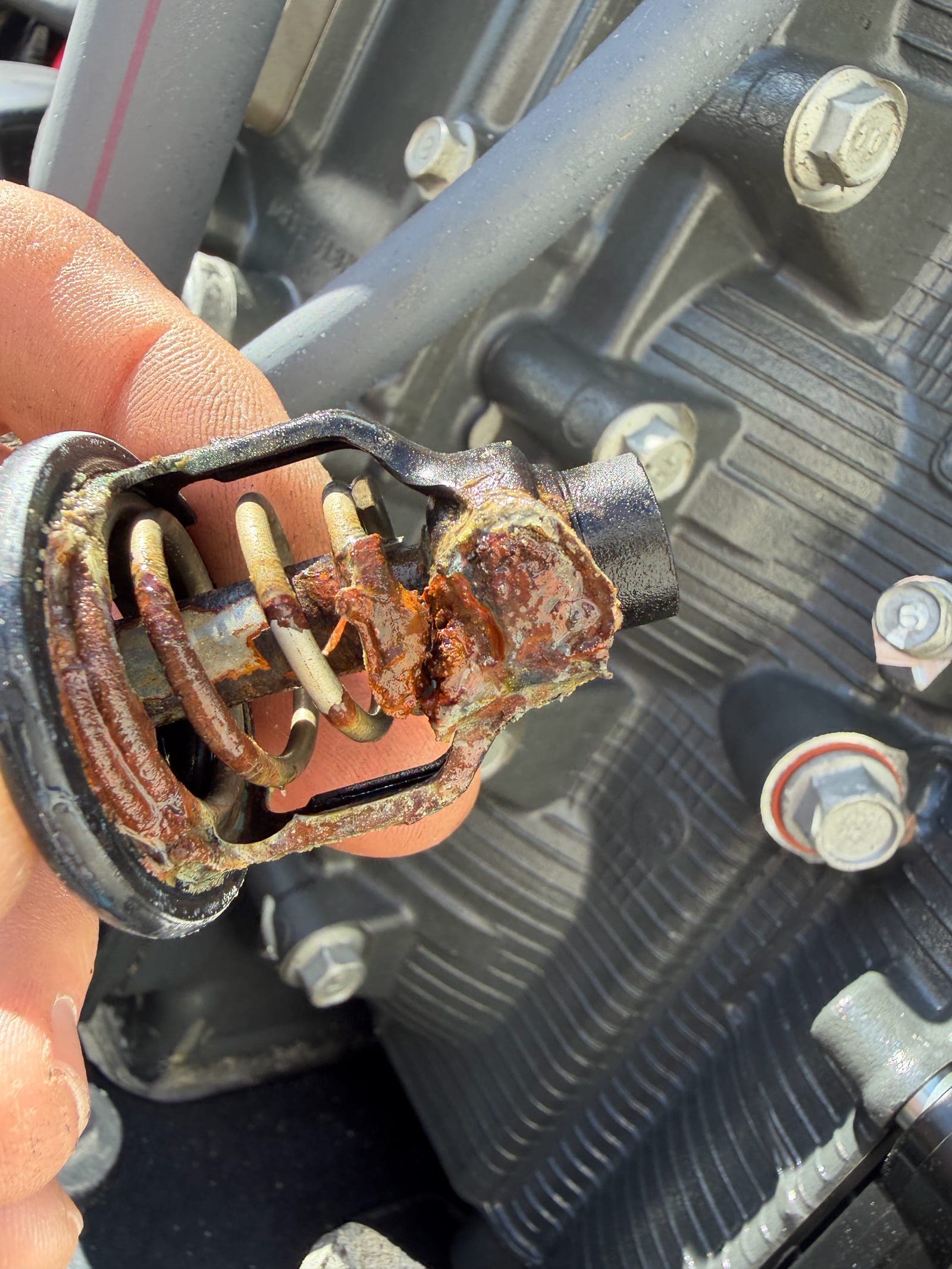
- Flush after every trip. Yamaha says to flush after each use in salt or brackish water. No other habit does more to slow salt buildup in the cooling passages, which is what kills thermostats.
- Anodes every 100 hours. Bay water stays warm most of the year, and corrosion runs faster in warm salt water. Boats kept up the Alafia or Manatee rivers in brackish water still need the same schedule.
- Fuel filters every six months. Ethanol pulls moisture out of humid air, and given time that leads to phase separation. Yamaha lists fuel stabilizer for continuous use, not just storage. For boats that sit, ethanol-free REC 90 takes most of that risk off the table.
- Water pump at 100, not 300. This is the one we won't budge on. Running the flats stirs up sand that grinds rubber vanes, and a boat that sits for weeks between trips leaves its impeller bent in one position. A pump that looks fine at inspection can still fail a few months later, and an overheat costs far more than the pump.
Which clock hits first depends on how you boat. In our experience, weekend boaters in Tampa Bay log 50–80 hours a year, so the calendar usually comes due before the hours do. Frequent boaters logging 100–200 hours a year hit the hour marks first.
Then there are boats that barely run. Snowbirds and part-time residents often leave a boat in its slip or on a lift from late spring through fall, exactly when Florida heat is hardest on fuel and rubber. Low hours don't pause the one-year clock.
Yamaha's lay-up list covers an oil and filter change, fuel filters, gear lube, fuel stabilizer, fogging oil, and Yamashield corrosion protectant. Have that done before you head north, not after you get back in November.
Tracking Hours and Keeping Records
The Yamaha outboard maintenance schedule only works if you know the hours. Most Yamaha digital gauges show them, and YDS reads each engine's own hour and fault history during any visit. On twin and triple rigs, the engines rarely read the same, because one idles longer or gets started first, so each engine keeps its own service clock.
Log the date, engine hours, and parts replaced at every service, one line per engine. That log is the first thing a surveyor or buyer asks for, and our written report after each visit gives you that line.
Keeping two clocks per engine straight is easy to let slide. Our vessel management program logs engine hours at every monthly inspection, and we coordinate service before it comes due.

$99
per month
Starting price for vessels under 25ft
Never Worry About Your Boat Again
Monthly inspections by USCG-certified captains keep your boat ready to go whenever you are.
Monthly Inspections
Full systems checks every month
Full Diagnostics
Engine, electrical, and navigation systems
Coordination
We schedule and manage all maintenance
Peace of Mind
Your boat is always ready when you are
Frequently Asked Questions
The Bottom Line
Expensive outboard trouble usually starts small: a 10-micron filter left at 150 hours instead of 50, or an annual service skipped because the hour meter barely moved. Keep both clocks honest, give salt water the extra replacements it demands, and the big intervals stay routine. Call (727) 607-1050 or request a free maintenance estimate, and we'll keep you on the water.
Related: Outboard Maintenance | Scheduled Engine Service | Complete Outboard Maintenance Schedule | Mercury Outboard Maintenance Schedule