Schedule your 300 hour service
Dockside service across St. Pete, Clearwater, Tampa, Tierra Verde, and Gulfport.
You just opened a quote for your 300-hour outboard service and the number made you do a double-take. Maybe it's $1,500, maybe it's north of $2,000. Either way, it's a big jump from the relatively straightforward 100-hour you knocked out last season. Before you start Googling whether that outboard service cost is legit or whether your mechanic is padding the bill, take a breath. That quote probably covers a lot more work than you think, and understanding what's actually on that line-item list is the difference between feeling ripped off and knowing you just protected a serious investment.
If you read our breakdown of the 100-hour service, you already know the basics — oil, filters, lower unit fluid, and the full water pump assembly we pull forward into the 100 because Tampa Bay saltwater chews up impellers ahead of OEM schedule. The standard hit list, plus a couple of items most shops defer. The 300-hour goes deeper. This is the interval where your technician gets into the fuel system, the cooling circuit, the spark plugs, the anodes, and a handful of wear items that don't show up on the shorter-interval checklist. It's the service where small problems get caught before they strand you somewhere between Clearwater and Tierra Verde on a Saturday afternoon. At Mobile Marina, we coordinate these services for boaters across Tampa Bay, and we see what happens when this interval gets skipped. It's never pretty, and it's never cheap.
What Makes the 300-Hour Service Different from the 100-Hour
If you've been keeping up with your 100-hour services — oil changes, filter swaps, basic inspections — you're already ahead of most boaters in Tampa Bay. But the 300-hour service is a different animal. This is where your technician stops topping things off and starts replacing the wear items that actually fail under sustained marine load. It's the difference between maintenance and prevention.
At the 100-hour mark, our full-scope 100-hour service runs $1,150–$1,300 for a single 150–200-hp outboard and $1,300–$1,450 for a single 225–300-hp (twins run $2,300–$2,900), before tax. That's an aggressive package — we replace the full water pump assembly (housing, impeller, and wear plate together) and a complete anode set at 100 because Tampa Bay's saltwater wears both faster than OEM charts assume. Most dealer shops only touch that scope at 300. Across Tampa Bay shops, the 300-hour interval typically lands anywhere from $900 to $2,000 depending on your engine and what shows up during inspection, and that outboard service cost increase isn't padding. It's parts and labor that the 100-hour simply doesn't touch — valve adjustments, fuel-system depth, and the wear items that only surface at this milestone.
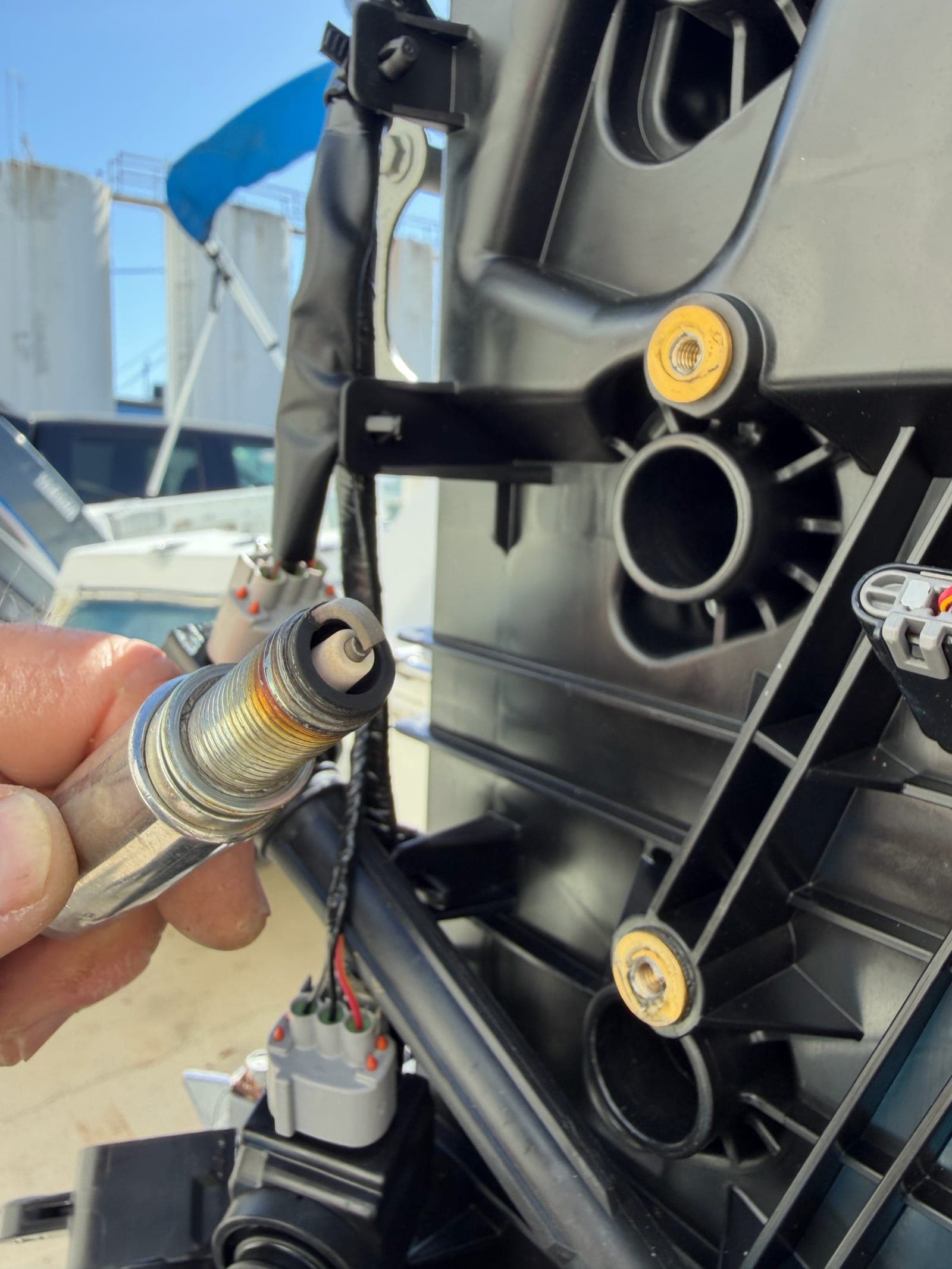
- Spark plugs — Always replaced. Some factory charts only call for inspection at this point, but in salt air we replace them, because worn plugs mean rough idle and a measurable drop in fuel efficiency.
- Water pump impeller and wear plate — Replaced per manufacturer interval. Tampa Bay's warm, shallow water is hard on impellers, and a failed one means an overheated powerhead. The wear plate inside the housing gets inspected for scoring and replaced if grooved, because a scored plate means the new impeller can't seal properly.
- Fuel line inspection — Checked for rubber degradation, cracking, and soft spots. Salt air and ethanol eat through fuel lines faster than most people expect.
- Thermostat — Replaced if it's past four years.
- Timing belt inspection — Particularly critical on Yamaha F150, F200, and F250 four-strokes. A snapped timing belt kills the engine. There's no gentle version of that failure.
- Valve clearance check — on engines whose manual calls for it by this point. Yamaha's four-stroke chart lists it at 500 hours, and Mercury's current V6 and V8 FourStrokes have no scheduled adjustment, so check the chart for your powerhead. Tight valves burn, loose valves clatter, and neither is cheap to fix after the fact.
- Lower unit seals — Inspected for weepage. Catching a slow seal leak here saves you a full gear case rebuild later.
- Complete diagnostic scan — Stored fault codes get pulled and reviewed, even if the engine seems to be running fine.
Line-by-Line: What's Actually in a 300-Hour Service
If you've ever stared at a service invoice and wondered what half the line items actually mean, you're not alone. A 300-hour service covers a lot of ground, and every item on the list is there for a reason. What follows is a thorough 300-hour service broken down by system, with notes on why each piece matters for boaters running in Tampa Bay's saltwater environment.
Powerhead
This is the heart of the motor. At 300 hours, you're looking at an engine oil and filter change, a valve clearance check on engines whose manual calls for one by this interval, and lubrication of the throttle and shift linkages. A good tech will also inspect belt tension and condition. Valve clearance that's drifted out of spec causes hard starting and rough idle, two things that'll ruin a morning run from St. Pete to Egmont Key. Compression testing is optional at 300 hours but becomes mandatory at 1,000, so some shops will baseline it now for comparison later.
Fuel System
Your fuel filter and water separator get replaced, no exceptions. In our humid Tampa Bay climate, water accumulation in fuel systems is just a fact of life. The tech inspects fuel lines for rubber hardening and cracking, which accelerates in Florida heat. On EFI motors, the injector spray pattern gets checked and the vapor separator tank gets inspected (a common trouble spot on Yamaha and Mercury EFI models). Two-stroke owners get a carburetor service instead. If your fuel lines are original and your boat is more than a few years old, this is where problems tend to show up first.
Ignition and Cooling
- Spark plugs — always replaced at 300 hours, no matter how they look
- Plug wires — inspected for arcing or insulation damage
- Ignition coil resistance — tested to confirm they're within spec
- Water pump impeller — replaced; impellers degrade whether you run the boat or not. If we ran your 100-hour service, your housing and wear plate were swapped together as a full assembly back then, so at 300 we inspect both and confirm they're still in spec rather than replacing them again. First-time customers at 300 hours typically get the full assembly because there's no service history showing how the older housing held up.
- Wear plate — inspected inside the water pump housing for scoring
- Thermostat — inspected and replaced if it's been more than four years
- Telltale stream — verified for consistent flow
- Cooling passages — checked for salt buildup or blockage
The impeller replacement alone is one of the most important items on this list. A failed impeller in the middle of summer on Tampa Bay means an overheat, and an overheat means you're calling for a tow. Saltwater boaters in Clearwater and Tierra Verde tend to see impeller degradation faster than manufacturer maintenance schedules suggest, so waiting past 300 hours is a gamble.
Lower Unit, Electrical, and Steering
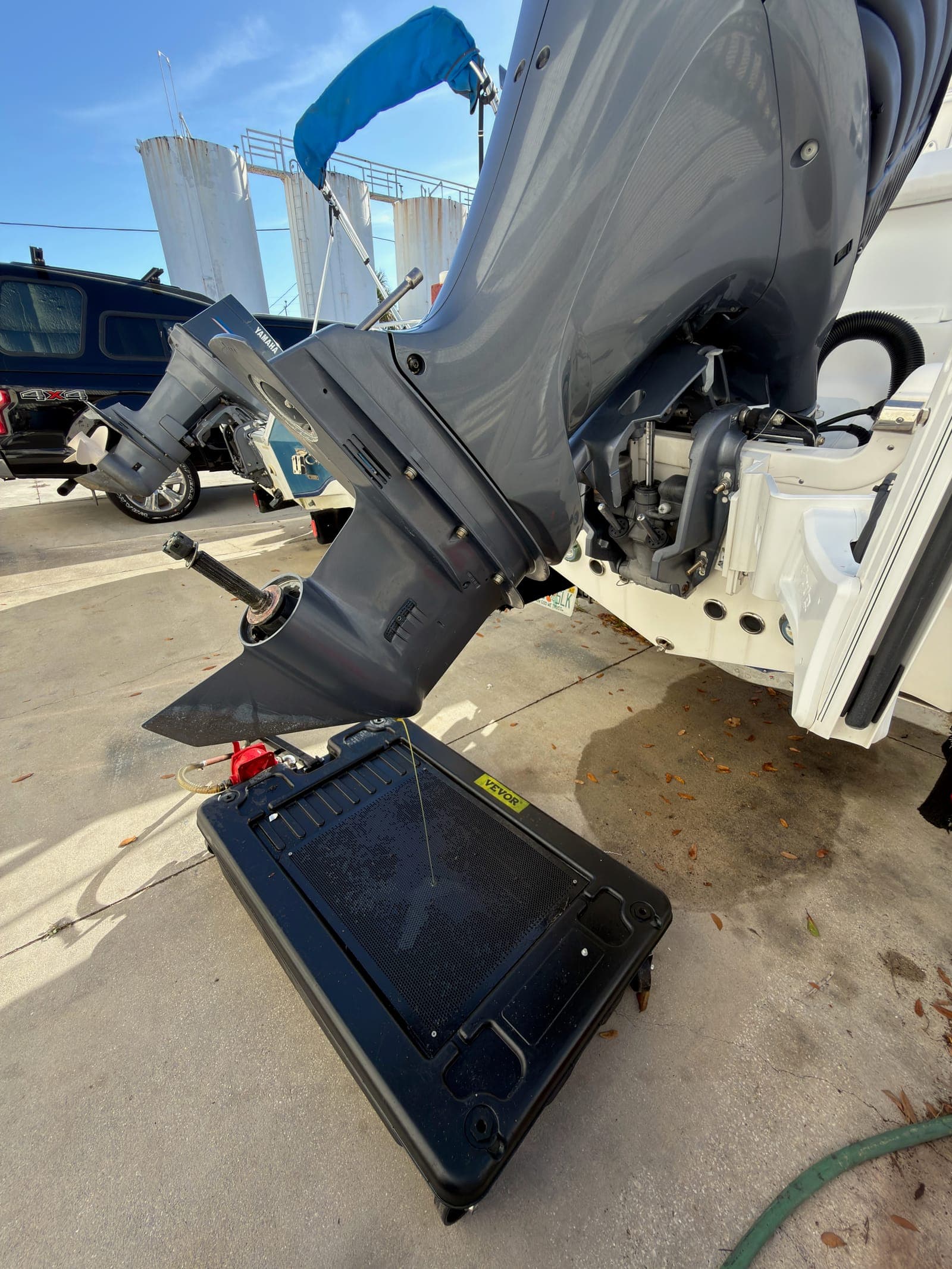
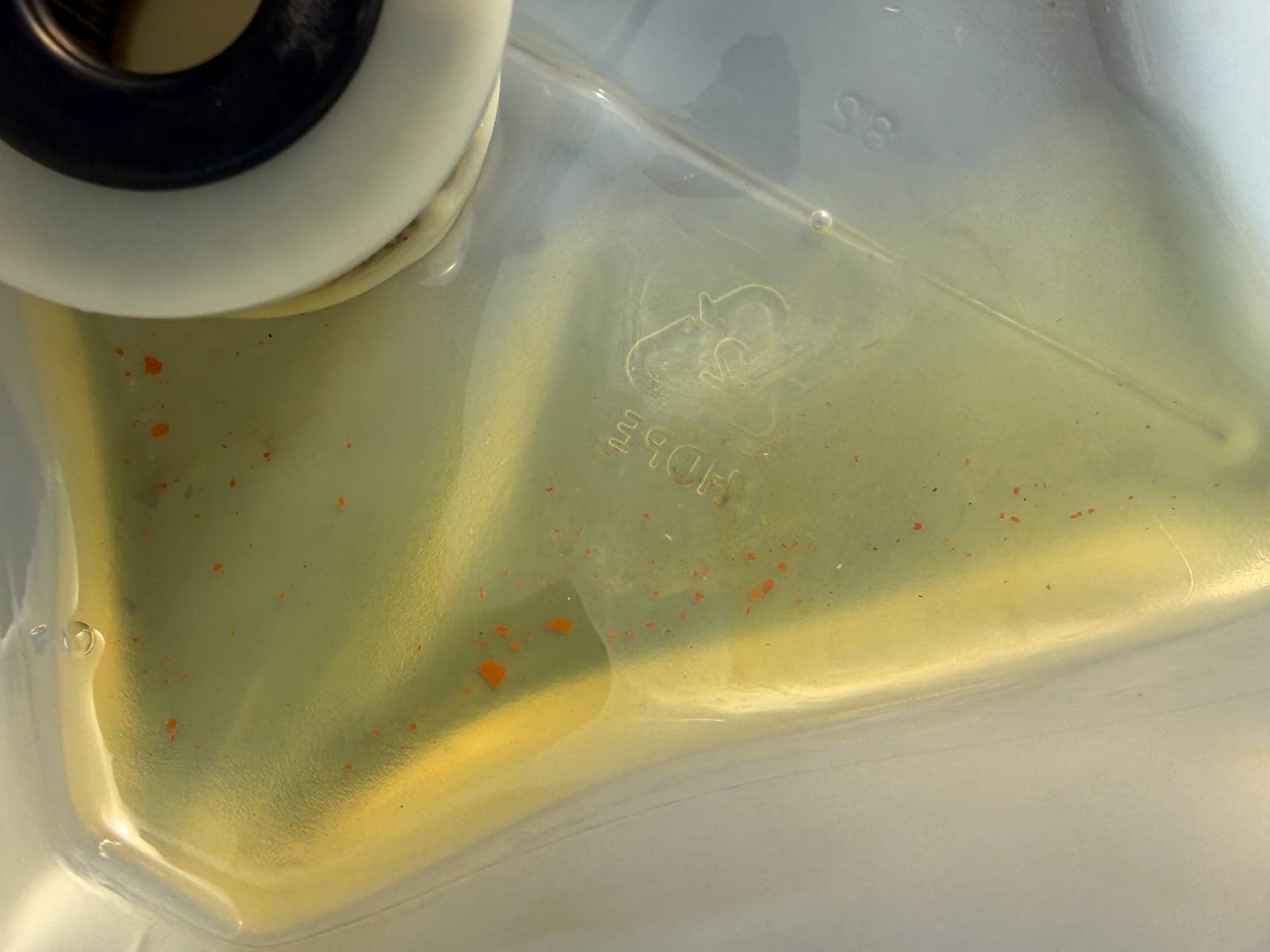
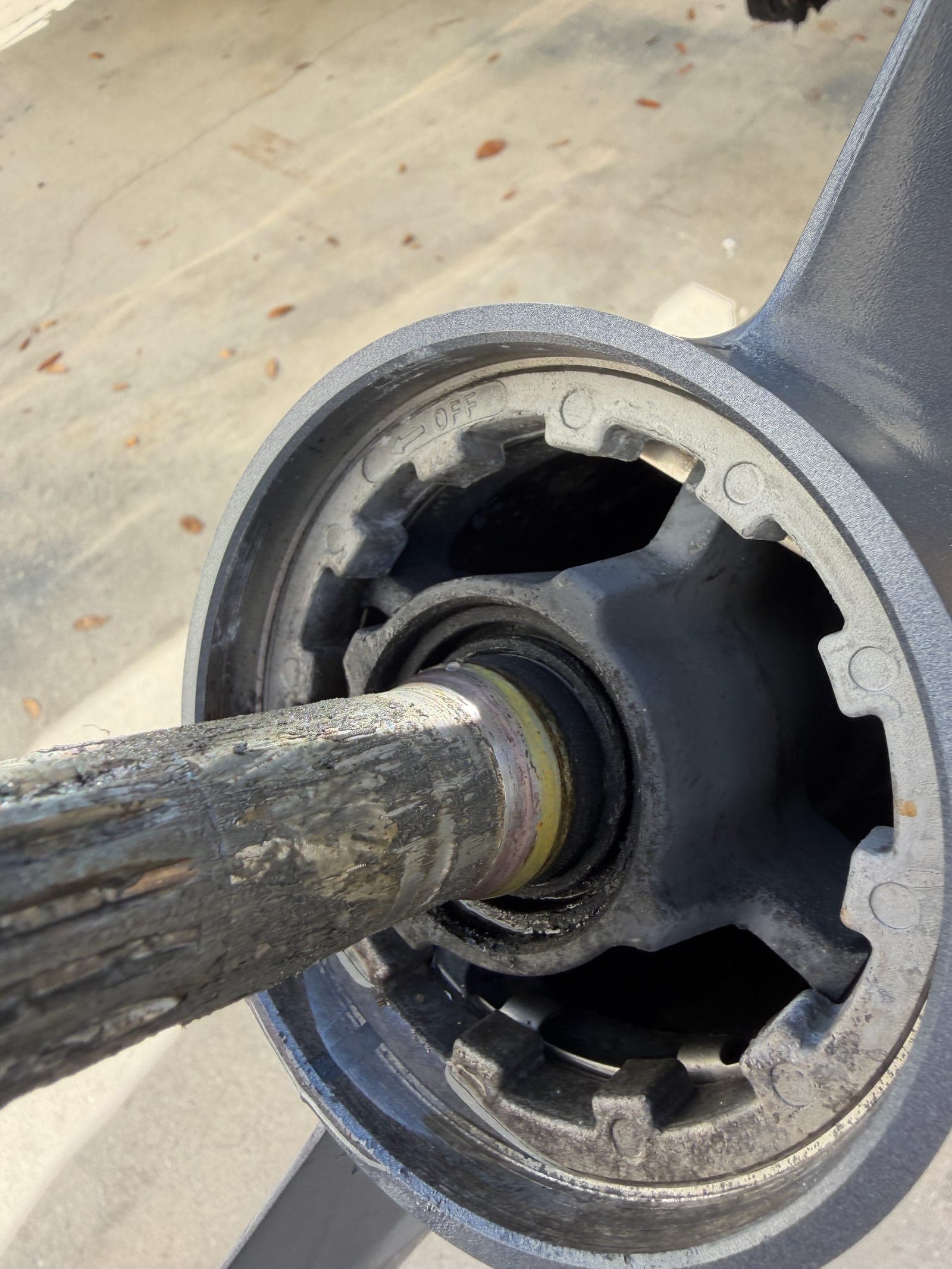
The lower unit gets a full gear lube drain and refill. The magnetic drain plug tells a story: metal shavings on the magnet indicate bearing wear that needs attention before it becomes a major repair. Prop shaft seals get checked for oil weep, and the skeg, prop, and anti-ventilation plate all get a once-over.
On the electrical side, every sacrificial anode gets inspected and typically replaced as a full set for saltwater use. Battery terminals and cables get cleaned and checked, and the tech runs a diagnostic scan to pull any stored fault codes, even if nothing's currently throwing an alarm. The charging system output gets tested too, because a weak alternator won't show symptoms until it leaves you with a dead battery at the ramp in Gulfport.
Steering and trim round out the service: trim/tilt fluid gets checked (discolored fluid means moisture intrusion), steering cables get lubed, and trim rams get inspected for leaks. The whole job wraps up with a warm-up test on muffs and, if the boat's in the water, a test run at speed to verify everything under load.
A shop that charges $900 but skips the diagnostic scan isn't cheaper than one that charges $1,400 and catches a failing coil. Compare the full scope of work, not just the total at the bottom of the invoice.
Real 300-Hour Cost Ranges by Brand (2026)
This is the part of the article where most boaters either nod along or spit out their coffee. The 300-hour service isn't cheap, but the range is wide enough that it's worth knowing what drives the number before you see the invoice. The biggest variables are your engine brand, whether you're running a two-stroke or four-stroke, and what add-ons your specific model needs at this interval.
These are typical 2026 Tampa Bay market ranges (not Mobile Marina's price list) for a single 150–250-hp outboard, parts and labor included:
| Brand | All-In Range | What Makes It Different |
|---|---|---|
| Yamaha F150 / F200 / F250 | $900–$1,800 | OEM service kits run $280–$450 based on current pricing as of Q1 2026, depending on displacement. Timing belt isn't due until 1,000 hours — don't let anyone upsell you at 300. See the full Yamaha 300-hour service and maintenance schedule. |
| Mercury Verado | $1,100–$2,000 | Supercharger oil change is required at 300 hours on all supercharged Verado models, which adds time and cost. |
| Older Mercury OptiMax Pro XS (two-stroke) | $700–$1,200 | No valve adjustment needed — simpler service overall. This is the budget-friendly end of the spectrum. |
| Suzuki DF Series | $900–$1,700 | Uses a timing chain instead of a belt, so no belt replacement down the road. Chain inspection happens here. |
| Honda BF Series | $1,000–$1,800 | Similar to Yamaha on the belt schedule — 1,000 hours for that, not 300. Honda lands in the mid-range for parts and labor. |
A big chunk of that bill is labor. A proper 300-hour service takes 5–8 hours of tech time depending on the engine and what the inspection turns up. In Tampa Bay, marine labor rates typically run $120–$150 per hour based on published rates from marine service providers in Pinellas and Hillsborough counties, so that's $600–$1,200 in labor alone before a single filter or spark plug hits the bench. Parts kits are the smaller piece: a Yamaha F150 OEM kit runs $280–$340 as of Q1 2026, while a larger F300 kit is $380–$450.
What a 300-hour service costs with us
We quote every 300-hour job, because engine count, size, and what the inspection turns up all move the number. Based on the 300-hour services we've completed this year:
- Single outboard (150–300 hp): typically $1,450–$1,850 before tax
- Twin outboards (150–250 hp each): typically $3,000–$3,500 before tax
- Triples, quads, and 300-plus-hp Verado or XTO engines: quoted after inspection
That covers the parts and labor on the manufacturer's 300-hour list for your engine, including the water pump kit, gear lube, spark plugs, filters, and thermostats where the schedule calls for them. If your boat can only be reached from the water, a barge fee applies, and any repair the inspection uncovers is quoted and approved before we do it.
To put it in perspective against the rest of the maintenance cycle: our full-scope 100-hour service runs $1,150–$1,450 for a single engine, depending on size, because we pull the water pump assembly and full anode set into that interval — items most shops defer until 300. Across Tampa Bay, a 300-hour service for a single 150–250-hp engine typically lands in the $900–$2,000 range and adds deeper fuel-system inspection, timing-belt evaluation on belt-equipped models, and valve clearance checks on engines whose manual calls for them by this point. The 500-hour cost depends heavily on the brand: on a Yamaha, it's where valve clearance and the vapor separator tank filter come due. The real wallet hit after the 300 is the 1,000-hour at $1,800–$3,500, driven mostly by timing belt replacement on belt-equipped engines.
If you're keeping a boat in St. Pete, Clearwater, or anywhere in Tampa Bay, these numbers should be in your annual budget. Boaters who plan for it don't flinch when the bill arrives.
Why Skipping the 300-Hour Is the Most Expensive Mistake You Can Make
We get it. Nobody loves writing a check for scheduled maintenance. But we see it all the time working with boaters across Tampa Bay: they skip the 300-hour service to save $1,500, then end up spending five or ten times that fixing what went wrong because of it. Every single item on that 300-hour checklist exists to catch a problem while it's still cheap. Once you blow past the window, the costs stop being maintenance costs and start being repair costs.
Deferred maintenance adds up fast. Each item below is an independent failure mode, and not all of them will happen on the same engine. But any two or three of these hitting at once will easily exceed the cost of the service that would have caught them:
| Service Item Skipped | What Happens | Repair Cost If It Fails |
|---|---|---|
| Spark plugs | Gradual misfire, noticeable fuel economy loss | Worn plugs cause measurable fuel efficiency loss and rough running that compounds over time |
| Water pump impeller | Overheat shutdown under load, possible housing damage | $300–$600 for pump assembly; $1,500–$3,000 if fragments reach the heat exchanger |
| Valve adjustment | Cumulative valve train wear, exhaust valve burning | Top-end rebuild: $3,000–$6,000 depending on engine size and extent of damage |
| Gear lube change | Moisture buildup destroys lower unit bearings | Lower unit rebuild: $2,500–$5,000 depending on brand and damage |
| Anodes | Galvanic corrosion on engine block, trim rams, lower unit | $500–$2,500 in corrosion repair |
| Fuel filter | Water and contamination pass straight to injectors | Injector replacement: $2,000–$4,000 |
A complete 300-hour service often lands around $1,500 at Tampa Bay shops. The single most common failure we see from skipped services — an impeller blowout leading to heat exchanger damage — can cost $3,000 alone. That's just the math.
The impeller is the one that gets people around here the most, and frankly it drives us a little nuts because it's so preventable. You're running full throttle across the bay heading back from Egmont Key. The impeller gives out, and now you're coasting with an overheat alarm screaming at you. If you're lucky, you shut down fast enough to save the pump housing. If you're not — and we've seen this more times than we can count on boats running out of Clearwater Pass and the Tierra Verde ramps — those shredded impeller fragments work their way into the heat exchanger passages and fuse to the walls. Now you're not replacing a $40 impeller. You're pulling the powerhead to get at a heat exchanger that's packed with rubber debris, and the bill just jumped to $3,000. We had one boat last summer where the owner was 50 hours past his service window. Fifty hours. The impeller looked like confetti when we pulled it.
The maintenance cost question always comes down to this: do you want to pay on your schedule, or pay on the engine's schedule? Saltwater doesn't negotiate, especially in our warm Tampa Bay waters where corrosion and heat work faster than they do up north. Anodes corrode. Gear lube absorbs moisture. Fuel filters collect contamination. None of those things pause because you decided to push it another season.
Expert Marine Maintenance
From routine service to major repairs, our team of expert marine technicians handles it all. Full project management so you can enjoy your boat.
Expert Technicians
Certified marine specialists
DIY vs. Pro: What You Can Do Yourself at 300 Hours
Not every task on the 300-hour checklist requires a certified technician, and we're not going to pretend otherwise. Some of this work is straightforward wrench-turning that any mechanically inclined boater can handle in their driveway or at the dock. But some of it will absolutely bite you if you don't have the right tools and experience, and a few items should never leave a pro's hands.
The breakdown below covers a typical four-stroke outboard in the 200–300-hp range:
What You Can Tackle Yourself
- Oil and filter change — same basic process as a car. Drain, swap the filter, refill with the manufacturer-specified oil (don't substitute a "close enough" weight — your engine manual is specific for a reason)
- Gear lube drain and refill — messy but simple. Buy the correct manufacturer gear lube, drain from the bottom plug, fill from the bottom until it comes out the top vent
- Anode replacement — unbolt the old ones, bolt on new ones. If you can use a socket wrench, you can do this
- Fuel filter and air filter replacement — quick swaps that don't require any special skills
- Spark plug installation — if the plugs are already out and you have the correct gap spec, threading new ones in is easy enough
Where It Gets Risky
- Water pump impeller replacement — this is doable if you're careful and methodical, but if a piece of the old impeller breaks off and you miss a fragment stuck in the housing, you'll destroy the new impeller on the next run. We see this happen more often than you'd think, especially on engines that sit in Tampa Bay's warm saltwater all season
- Spark plug removal on saltwater engines — pulling plugs that have been exposed to salt air for hundreds of hours is a different game than fresh installs. A seized plug can strip the threads right out of the cylinder head, and you're looking at a machine-shop thread repair to fix it. If the plugs feel stuck, stop and call a tech
Pro-Only Territory
- Valve clearance check and adjustment — requires specific feeler gauge specs and shims on some models. Get this wrong and you're looking at real engine damage
- Timing belt replacement — Yamaha F150s, for example, have a specific crank-position procedure that has to be followed exactly
- Compression and leak-down testing — specialized gauges and the knowledge to interpret the readings
- Manufacturer diagnostic scans — Yamaha YDS, Mercury CDS, Suzuki SDS. These tools cost thousands and require training to read properly
- Injector work or ignition coil replacement — leave these to someone with the diagnostic equipment to verify the fix
The Real Math on Outboard Service Cost
Side by side for a 300-hp Yamaha four-stroke:
| DIY | Professional | |
|---|---|---|
| Parts cost | $280–$340 | Included in service price |
| Labor | 4–6 hours of your time | Handled by the tech |
| Diagnostic scan | Not available (unless you own the tool) | Included |
| All-in cost | $280–$340 + your Saturday | $900–$1,800 (Tampa Bay market range) |
| Valve / timing / compression work | Can't do it yourself | Included in full service |
If your time is worth $40 an hour or more, or you don't own manufacturer diagnostic tools, the professional service is usually the better value. You're not just paying for the wrench time. You're paying for the scan data, the compression numbers, and the trained eye that catches the thing you didn't know to look for.
For boaters across St. Pete, Clearwater, and Tierra Verde, our team coordinates 300-hour services with certified marine technicians right at your slip. No hauling the boat to a shop, no waiting in a service queue. Call us at (727) 607-1050 or open the app to get on the calendar.
How Tampa Bay Year-Round Use Compresses Your 300-Hour Interval
Most factory service schedules are written for boats up north, the ones that get winterized in October and don't splash again until May. In our experience coordinating maintenance for Tampa Bay boaters, active recreational boaters who fish and cruise regularly in our area log 100–200 hours per year, roughly 1.5 to two times what a seasonal northern boat sees. At 150 hours a year, you're hitting that 300-hour service interval in two years, not three. The factory schedule assumed three.
That alone should change how you think about budgeting for maintenance. You're compressing the same service intervals into a shorter calendar window, which means those big-ticket services come around faster than you'd expect.
It's Not Just Hours — It's What Tampa Bay Does to Your Engine
Hours on the meter only tell part of the story. Salt exposure in the waters around St. Pete, Clearwater, and Tierra Verde eats anodes regardless of how often you run the boat. In saltwater, you should be replacing anodes roughly every 100 hours, and if the boat sits for a month without running, the corrosion doesn't pause. Florida heat makes things worse in ways that aren't obvious. Engine compartments get well above 100°F during summer, and that kind of heat cycling ages rubber fuel lines and gaskets faster than the same components on a boat stored in a climate-controlled barn.
Then there's the fuel. E10 ethanol blends break down faster in our heat and humidity, which means your fuel filters need replacing at roughly the six-month mark regardless of hours logged. We see plenty of boats come through where the owner was tracking hours religiously but forgot that calendar-based wear doesn't care about the hour meter.
- Anodes — replace every ~100 hours in saltwater, regardless of engine hours
- Fuel filters — swap at six months in Florida heat, even if hour count is low
- Rubber fuel lines — inspect more frequently due to high engine compartment temps
- Overall 300-hour interval — expect to hit it in two years, not the factory-assumed three
If you want the full breakdown of how each maintenance milestone builds on the last, our complete outboard maintenance schedule walks through every interval from first oil change to the 300-hour service.
How Dockside 300-Hour Service Works
Most boaters are surprised to learn that the vast majority of a 300-hour service doesn't require hauling your boat anywhere. We show up at your slip with a full service kit pre-staged and knock out 80–90% of the checklist right there at the dock. Oil and filter, gear lube, anodes, spark plugs, fuel filter, water pump impeller, thermostat, trim and tilt fluid check, a full diagnostic scan — all of it gets handled without you ever leaving your slip. For boaters across St. Pete, Clearwater, Tampa, Tierra Verde, and Gulfport, that's a big deal. No trailer, no yard fees, no burning a weekend hauling your boat across town.
A typical dockside 300-hour visit runs about 5–7 hours on-site. That sounds like a long day, and it is. But consider what's getting done in that window. The work splits between dockside and shop like this:
| Task | Dockside? | Notes |
|---|---|---|
| Oil & filter change | Yes | Standard on all outboards |
| Gear lube replacement | Yes | Lower unit drain and fill |
| Anode inspection/replacement | Yes | Critical in Tampa Bay's saltwater |
| Spark plug replacement | Yes | Checked against spec |
| Fuel filter replacement | Yes | Includes water separator |
| Water pump impeller | Yes | Replaced preventively at 300 hours |
| Thermostat replacement | Yes | Tested and swapped if needed |
| Diagnostic scan | Yes | Full ECU readout |
| Trim/tilt fluid check | Yes | Topped off or flushed |
| Timing belt replacement | Shop | Tight engine-bay access on some models |
| Valve clearance adjustment | Shop | Only if shims are out of spec |
| Lower unit seal service | Shop | If weepage is found during inspection |
| Compression/leak-down testing | Shop | Needs a controlled environment |
The shop-only items aren't needed on every 300-hour service. They come up based on what we find during the inspection. If your valve clearances check out and the lower unit seals are dry, you may not need yard time at all. When something does need shop work, we flag it in your written report so you know exactly what's happening and why before any additional work gets scheduled.
That written report is a big part of what separates a real 300-hour service from someone just changing the oil and calling it done. Every dockside visit ends with a full rundown of what was done, what was found, and any follow-up items. If your impeller looked marginal or your anodes were more eaten up than expected for the interval, that's documented. It keeps you ahead of problems instead of reacting to them, and it gives you a real maintenance history if you ever sell the boat. For anything that falls outside the 300-hour checklist — corrosion issues, wiring concerns, stuff we spot while we're in there — our on-water repair crew can usually handle it on a follow-up visit without a yard trip.
Get Fuel Delivered to Your Slip
Download the Mobile Marina app to schedule dockside fuel delivery, manage your vessel, and access all our services from your phone.

Frequently Asked Questions
The Bottom Line
A 300-hour service isn't just an oil change with extra steps. It's the interval where your outboard's most critical wear items get inspected, replaced, or adjusted before they turn into breakdowns. Skipping it doesn't save money. It moves the cost somewhere more expensive and less convenient, usually in the middle of a trip.
If you're approaching that 300-hour mark on your outboard, don't put it off. Our team works with boaters across St. Petersburg, Clearwater, Tampa, and throughout Tampa Bay to keep engines running right and catch problems while they're still small. Contact us for a free maintenance estimate — call (727) 607-1050 or visit mobilemarina.co to get started.
Related: Scheduled Engine Service | Outboard Maintenance | On-Water Repairs | Service Areas | Outboard Motor Maintenance The Complete Schedule For Yamaha Mercury Suzuki