Schedule Outboard Maintenance
Dockside service across St. Pete, Clearwater, Tampa, Tierra Verde, and Gulfport.
Mercury publishes an hour-by-hour maintenance chart for every engine it sells, and almost nobody reads it until something breaks. The bigger problem with the Mercury outboard maintenance schedule is that there isn't one — there are half a dozen. A 150 FourStroke, a supercharged Verado, and a Pro XS follow different charts, and every one of them assumes an "average" boat that doesn't live in year-round Tampa Bay salt water.
This article opens Mercury's rulebook all the way: what the factory actually asks for at 20, 100, and 300 hours, and where our service work across St. Pete, Clearwater, Tampa, Tierra Verde, and Gulfport says those intervals need tightening.
One caveat before the charts. Your owner's manual for your serial number is the final authority — Mercury revises intervals between model years, and our brand-by-brand comparison covers why no blog table replaces it. Use this article to know what should be on your service quote and when. Running a Yamaha too? See our Yamaha outboard maintenance schedule.
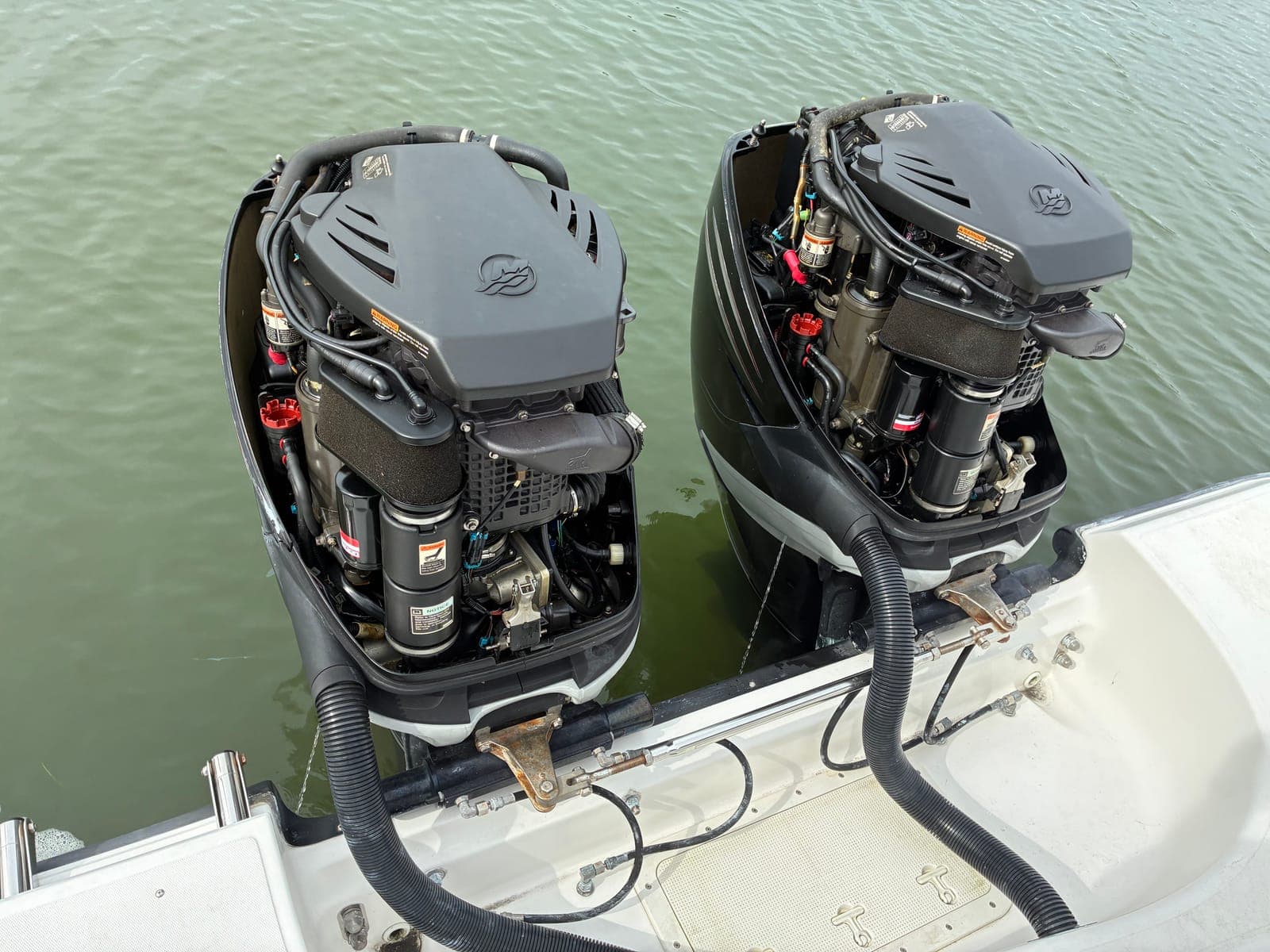
The 20/100/300 Rule
Strip away the model-specific footnotes and Mercury's maintenance charts follow a three-tier rhythm. Every interval is written as engine hours or calendar time, whichever comes first. That second clause matters more in Florida than anywhere else, and we'll come back to it.
- 20 hours — break-in service. One-time. The engine's first oil and inspection milestone after the break-in period.
- Every 100 hours or once a year — routine service. Oil and filter, gear lube, fuel filters, greasing, and a long inspection list. This is the interval that repeats for the life of the engine.
- Every 300 hours or three years — major service. Everything in the 100-hour service, plus the wear items that actually fail under sustained load: water pump impeller, spark plugs, thermostats.
Some models add longer milestones on top; belt and valve items vary by powerhead, and the V12 Verado runs its own book entirely. But if you remember 20, 100, 300, you understand how Mercury thinks.
The calendar side trips people up. A boat that logs 40 hours a year still owes Mercury an annual service, because oil degrades, gear lube absorbs moisture, and rubber ages whether the engine runs or not. In Tampa Bay, frequent boaters usually hit the hour marks first, while weekend boaters usually hit the calendar first. Either way, one of the two clocks is always running.
The 20-Hour Break-In Service
During break-in, piston rings seat against cylinder walls for the first time, and that process sheds fine metal particles into the factory oil. The 20-hour service exists to get that oil out. We've written about what break-in debris looks like in our 100-hour service breakdown — the "glitter" in a first oil drain is real, and you want it out of circulation before it runs through bearings for another 80 hours.
The 20-hour stop is also where your engine's paper trail starts. Mercury's warranty coverage leans on documented maintenance at specified intervals, and a new engine with no record of its break-in service raises the first question a warranty adjuster or a future buyer will ask. If you bought the boat new this spring and you're running most weekends, you'll hit 20 hours in a month or two. Get it on the books.
One more thing worth doing at 20 hours: drain the gearcase for the first time. Break-in debris and any early moisture intrusion show up in the lower unit before they show up anywhere else, and a clean first drain gives every later service a baseline to compare against.
Mercury's 100-Hour List vs. the One We Run
Mercury's published 100-hour/annual chart for FourStroke models centers on a familiar list: change the engine oil and filter, change the gear lube, replace fuel filters, inspect the spark plugs, grease the fittings, check the anodes, and pull the prop to grease the shaft. Inspection items run alongside: fuel lines, battery connections, throttle and shift linkage, the telltale stream.
Notice how much of that list says inspect or check. Mercury's anode guidance is a good example: inspect, and replace once consumption crosses the threshold in your manual — otherwise keep running them. That logic works for the average of every boat Mercury sells, from a freshwater lake in Michigan to a canal in Gulfport. It's not how we run the interval here.
Our 100-hour service converts most of Mercury's inspect-items into replace-items, because Tampa Bay salt water keeps failing the inspection anyway:
- Spark plugs — replaced, not inspected. Salt-air electrode wear and deposit buildup make plugs at 100 hours cheap insurance. We're already in there.
- Anodes — replaced every 100 hours. Boats on shore power in the marinas on our routes routinely show 40–60% consumption by the first service. Once an anode shows visible depletion, you're running with reduced protection.
- Water pump — full assembly replaced. Mercury's chart holds the impeller until 300 hours. We pull the whole assembly forward to 100 because we've seen too many "passed inspection" impellers fail before 200. More on that below.
- Plus the items no factory chart includes: engine wipe-down and salt removal, CRC corrosion blocker on every electrical connection, and a written service report you can hand a warranty adjuster or a buyer.
The diagnostic scan matters more on Mercury than on most brands. Our technicians connect through Mercury's CDS/SmartCraft diagnostics before any wrenches come out, pulling stored fault codes and runtime data. A code the engine logged and cleared three months ago still tells a story.
Our 100-hour pricing is the same across brands: $1,150–$1,300 for a single 150–200-hp engine, $1,300–$1,450 for a single 225–300-hp, and $2,300–$2,900 for twins, before tax; triples are quoted. That's more than a dealer's base 100-hour quote, and the difference is scope. A low-end quote typically covers oil, filters, and gear lube; ours replaces the plugs, anodes, and pump assembly listed above and ends with a written report at your slip.
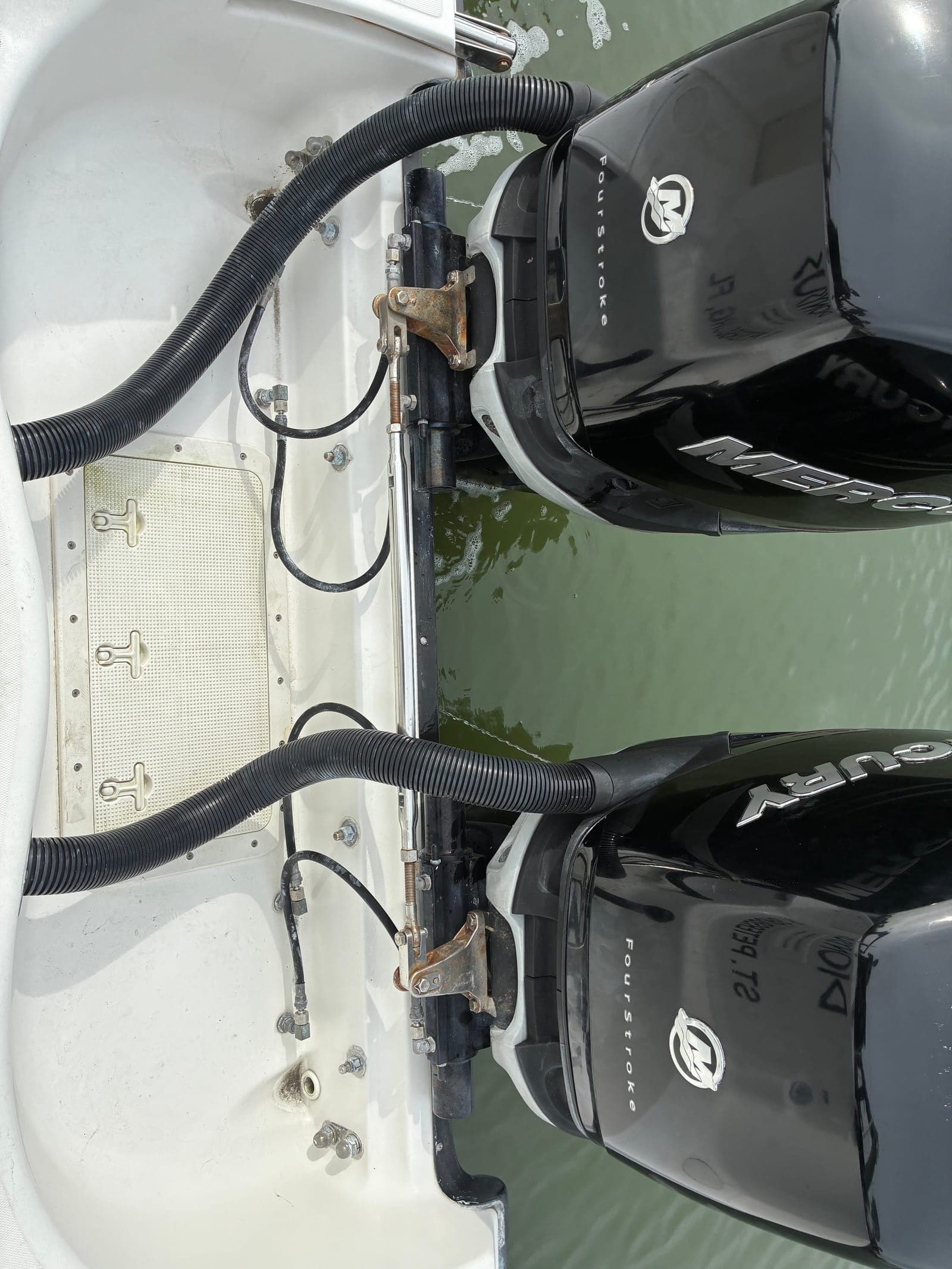
The 300-Hour Service
At 300 hours, Mercury's chart stops topping things off and starts replacing what wears. This is the interval that protects the powerhead:
- Water pump impeller — replaced. The factory's preventive interval for the part that keeps the engine from cooking itself. If we ran your 100-hour service, the full assembly was replaced then, so at 300 we inspect it and confirm it's in spec instead of billing you for it twice.
- Spark plugs — replaced on the factory chart (we've already handled this at each 100).
- All fuel filters — replaced, including the water separator. Ethanol and Florida humidity make this non-negotiable.
- Thermostats — replaced or tested. Salt buildup makes Tampa Bay thermostats stick, open or closed, more often than the chart assumes.
- Belts and pulleys — inspected, replaced if cracked or glazed.
- Valve-related items on the models that call for them. This is powerhead-specific, and it's where the engine families split.
Verado owners get one line the rest of the lineup doesn't: on supercharged Verado models, the supercharger oil gets changed at 300 hours. It adds time and cost, and it's the main reason Verado services quote higher than FourStroke services at the same interval.
Across Tampa Bay shops, a 300-hour service on a single 150–250-hp Mercury four-stroke typically lands between $900 and $2,000 all-in; supercharged Verados typically run $1,100–$2,000. Two-stroke and OptiMax scopes differ — contact us for those. Our 300-hour service breakdown walks the full invoice line by line, including what each skipped item costs when it fails. Short version: the single most common failure we see from stretched intervals is an impeller blowout that sends rubber fragments into the cooling passages. That repair can run $3,000 against the roughly $1,500 service that would have caught it.
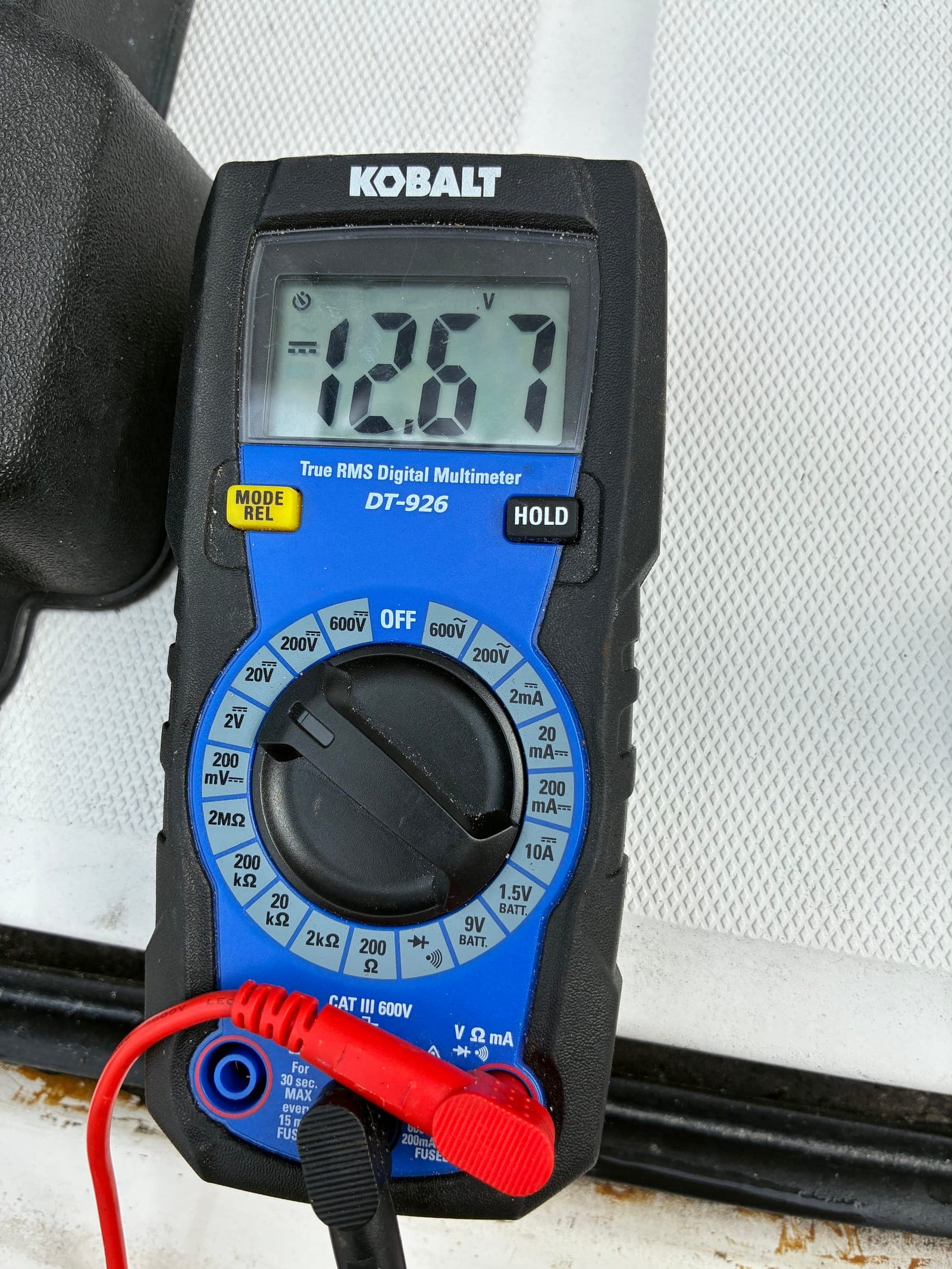
Expert Marine Maintenance
From routine service to major repairs, our team of expert marine technicians handles it all. Full project management so you can enjoy your boat.

Expert Technicians
Certified marine specialists
FourStroke vs. Verado vs. Pro XS: One Brand, Three Rulebooks
"I have a Mercury" narrows things down less than you'd think. The engine family on your cowling changes what your schedule looks like:
| Engine Family | What Changes in the Schedule |
|---|---|
| FourStroke (75–300 hp) | The baseline 20/100/300 chart described above. Mercury advertises no scheduled valve adjustments on the 3.4L V6 and 4.6L V8 platforms, which removes one of the big-ticket items other brands carry at 300+ hours. |
| Verado (supercharged L6) | Baseline chart plus supercharger oil service at 300 hours and closer attention to the belt-driven supercharger hardware. Budget the top of the price range. |
| Verado V10 / V12 | The V10 is naturally aspirated — no supercharger oil line. The V12 600 runs its own book, with routine service around 200-hour intervals. If you're running one, your manual is genuinely different from every other Mercury owner's at the dock. |
| Pro XS | Current Pro XS models are four-stroke platforms and follow the FourStroke chart. But they're sold to run hard, and Mercury's intervals assume recreational duty — heavy tournament use is a reason to tighten intervals rather than stretch them. Older two-stroke OptiMax Pro XS engines follow a different, simpler top-end schedule. |
| SeaPro / commercial | Rated for commercial duty with hour accumulation to match. These engines can hit 300 hours in a season, so the "or three years" clause almost never applies. |
The hour numbers stay similar across most of the lineup; the line items at each interval shift with the powerhead. A service quote for "a Mercury 300" should say whether that's a FourStroke V8 or a Verado, because the correct scope isn't the same.
Where Tampa Bay Salt Water Breaks the Chart
Mercury writes one chart for the whole country. Our engines live in warm salt water 12 months a year, and the chart bends in predictable places.
Start with the clocks. In our experience, weekend boaters here log 50–80 hours a year and frequent boaters 100–200, so frequent boaters hit 100 hours well before the annual reminder and can reach the 300-hour milestone in two years instead of three. Weekend boaters usually hit the calendar first, and that annual service still counts.
The impeller is where the chart bends furthest. Warm, shallow, sediment-heavy water is hard on impeller vanes, and impellers that sit take a set. We've pulled too many that passed an inspection and wouldn't have survived the season, which is why we replace the full water pump assembly at 100 hours instead of waiting for Mercury's 300-hour line.
A few more local adjustments, in the order we repeat them at the dock:
- Flush after every single use. The one habit that does more for your engine than any line on the chart. Fresh water through the cooling system after each salt trip slows the buildup that kills thermostats and pits cooling passages.
- Anodes: every 100 hours, replaced as a set. Shore power, mixed metals on neighboring boats, and warm salt water all accelerate consumption.
- Fuel filters on a six-month calendar. E10 breaks down fast in Florida heat. Low hours don't earn an extension.
Boats on lifts or trailers don't get a pass either. Dry storage protects your hull, but impellers dry out and take a set, fuel still absorbs moisture, and the annual clock keeps running.
None of this means the factory chart is wrong. It means the chart is a floor, not a ceiling, and Tampa Bay boats should run the aggressive end of every interval Mercury publishes.
Reading Your Hours on SmartCraft and VesselView
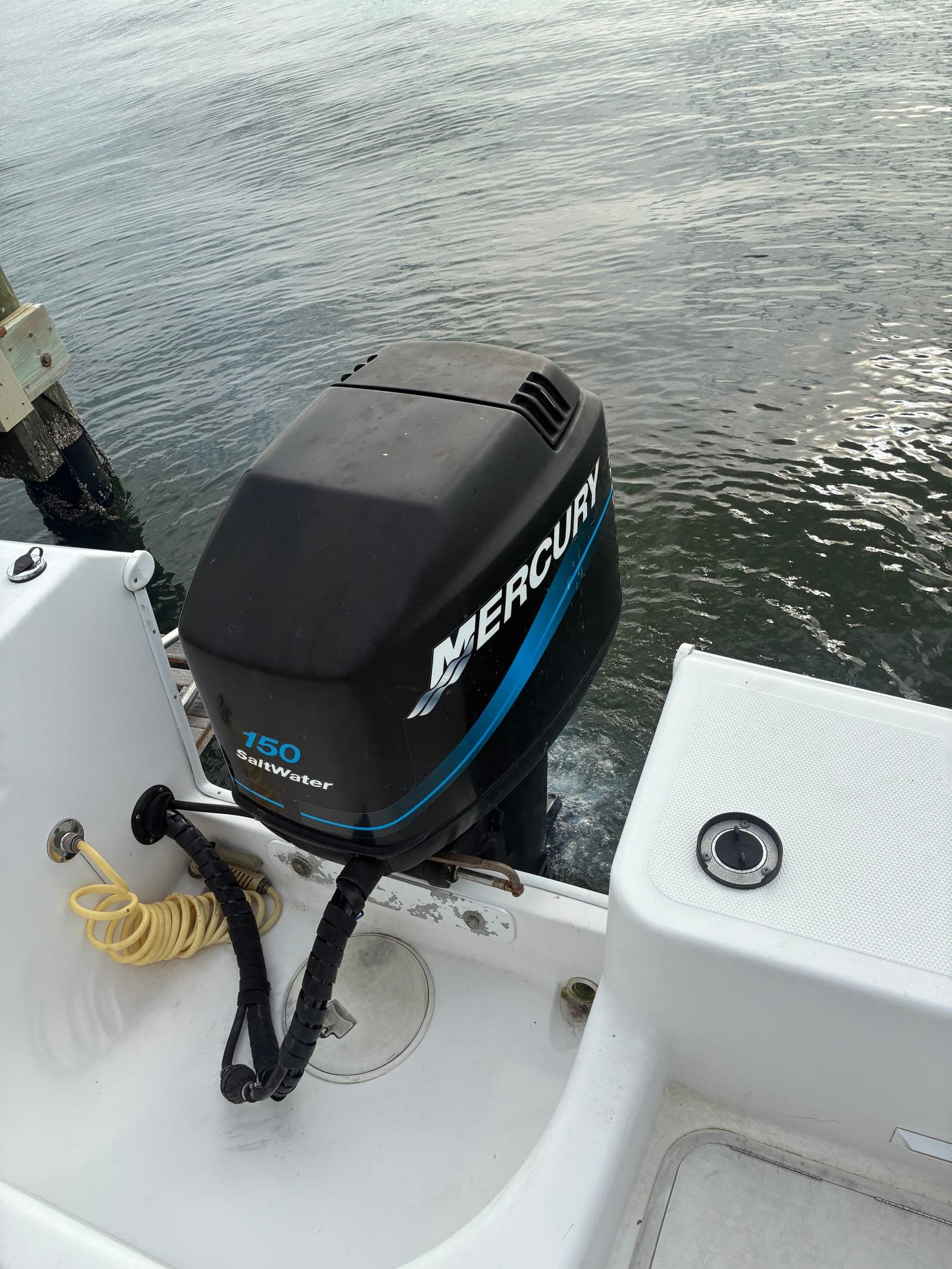
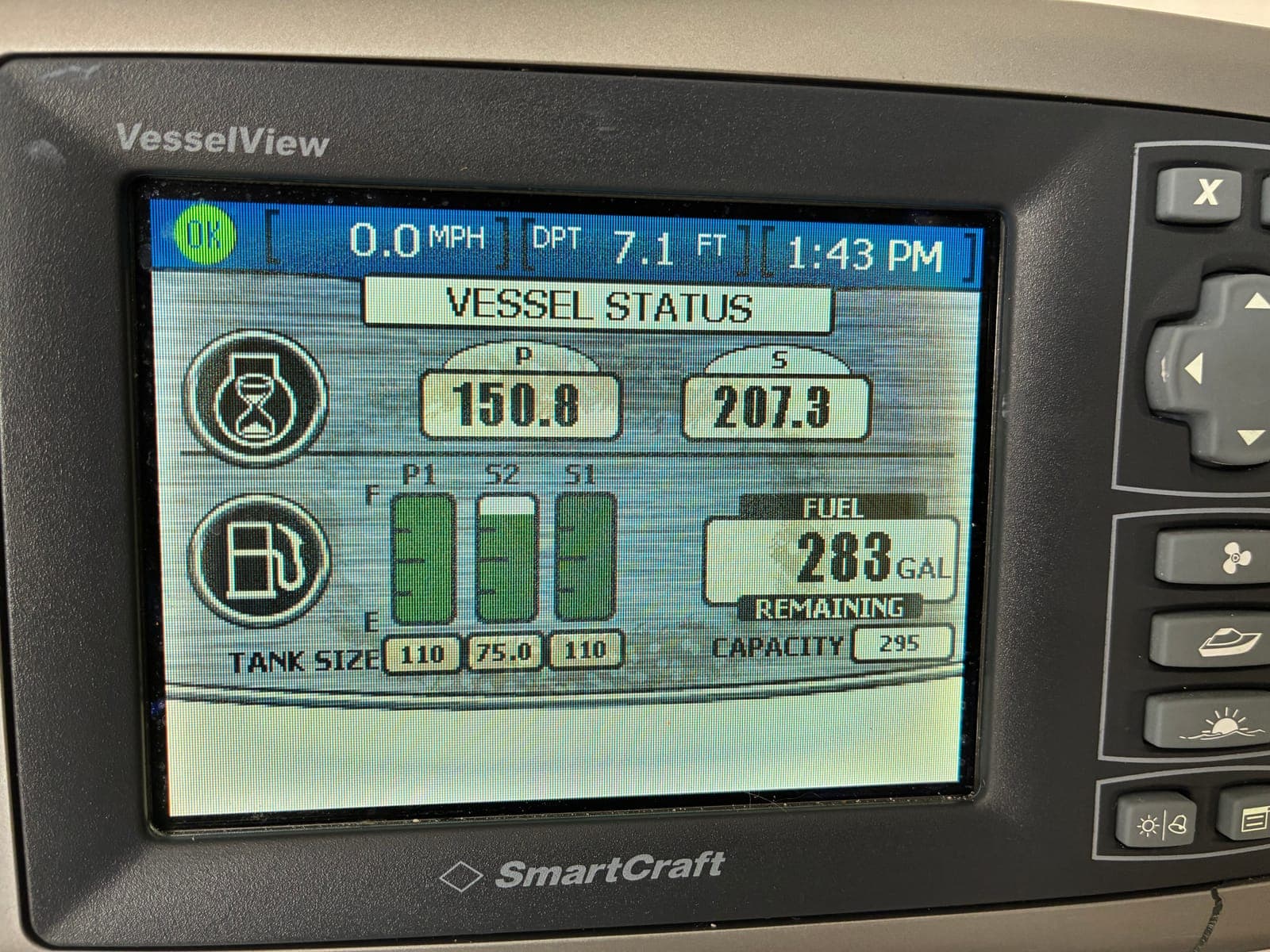
You can't follow an hour-based schedule if you don't know your hours. On most modern Mercurys they're a few button presses away: SmartCraft gauges and VesselView displays read engine hours straight from the ECU, along with the fault codes the diagnostic scan pulls at service time. No VesselView at the helm? A technician can read hours directly from the engine during any visit, and the ECU's number is the one that counts.
Twins almost never match. One engine trolls solo, one starts first, one idles longer at the sandbar. The VesselView screen below came off a twin rig on our route: 150.8 hours on one engine, 207.3 on the other. Those engines are a full service interval apart, and each one gets scheduled on its own clock.
The ECU hours are also the warranty record. When a claim gets reviewed, documented service intervals get compared against what the engine itself logged. A written service report tied to real hour readings — which is how we document every visit — is what makes that comparison work in your favor.
If tracking two clocks per engine across oil, impellers, anodes, and filters sounds like a part-time job, that's the honest pitch for letting someone else carry it. Our vessel management program tracks hours and intervals per engine and gets the boat onto a scheduled route before the interval passes.

$99
per month
Starting price for vessels under 25ft
Never Worry About Your Boat Again
Monthly inspections by USCG-certified captains keep your boat ready to go whenever you are.
Monthly Inspections
Full systems checks every month
Full Diagnostics
Engine, electrical, and navigation systems
Coordination
We schedule and manage all maintenance
Peace of Mind
Your boat is always ready when you are
Frequently Asked Questions
The Bottom Line
The Mercury outboard maintenance schedule comes down to 20, 100, 300 — then adjusting for the engine family on your cowling and the salt water it lives in. Follow the chart to the letter and a Tampa Bay boat still ends up with tired anodes and a marginal impeller, which is why our service scope pulls the critical replacements forward instead of inspecting and hoping.
Whether your Mercury is tied up in a Clearwater slip or on a trailer in St. Pete, we handle the full interval dockside or coordinate pickup and drop-off, and every visit ends with a written report tied to your real ECU hours. Call (727) 607-1050 or visit mobilemarina.co for a free maintenance estimate. We'll keep you on the water.
Related: Outboard Maintenance | Scheduled Engine Service | 100-Hour Service Breakdown | 300-Hour Service Breakdown | Complete Outboard Maintenance Schedule