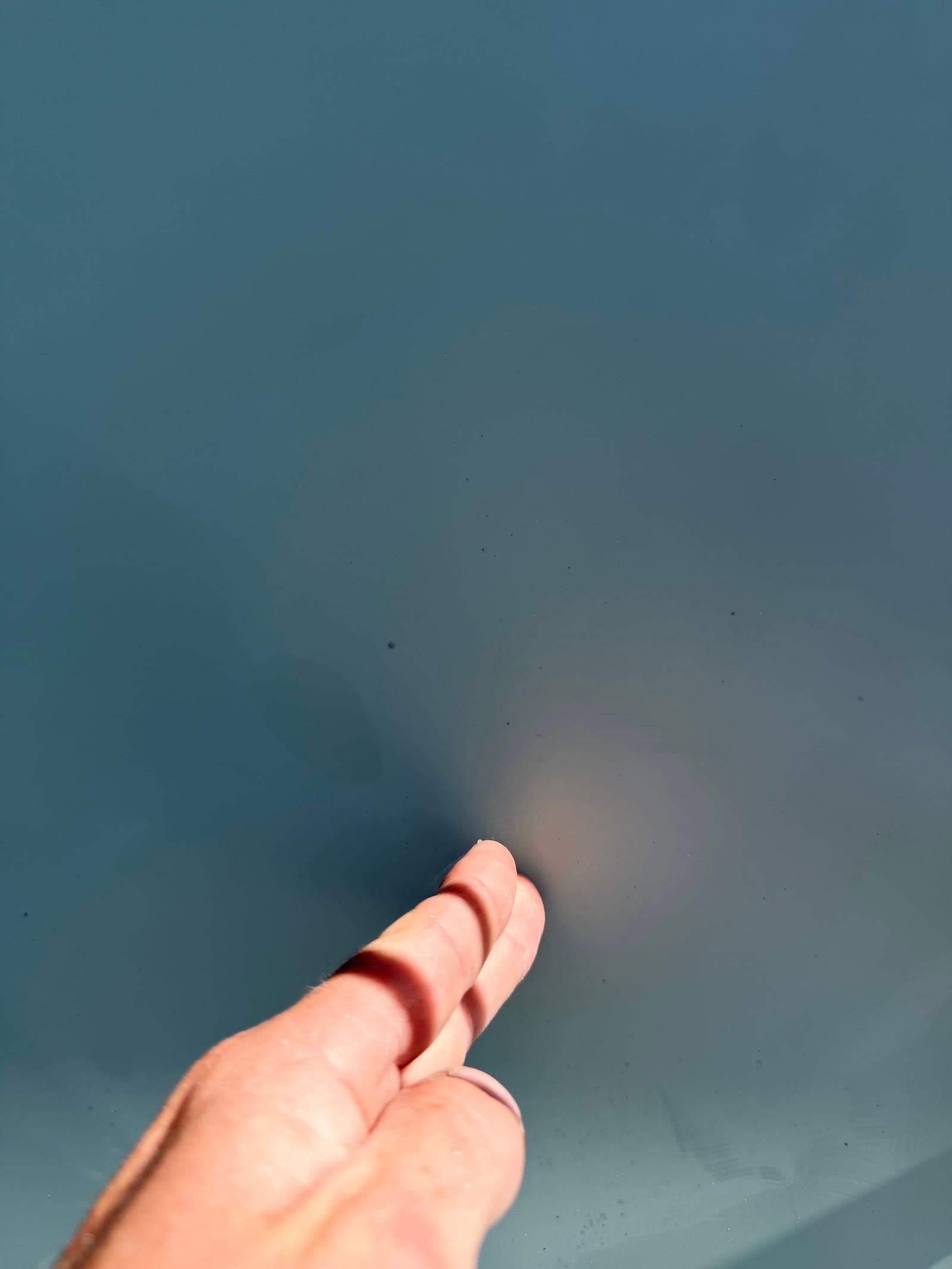
Every boat-care article you've ever read probably says the same thing: apply boat wax once a year and you're good. But walk the docks at Harborage Marina or the municipal pier in Gulfport and count how many boats have chalky, faded gelcoat by August. That "once a year" advice wasn't written for Florida. It was written for boats up north that spend half the year under shrink wrap in a heated storage building. Tampa Bay boats sit in full sun, full salt, 365 days a year. That changes everything.
The reality is simple: wax breaks down in 6 to 10 weeks during a Florida summer and 10 to 12 weeks in winter. Every 8 weeks is the cadence that actually protects gelcoat in this climate. Our team at Mobile Marina sees the difference constantly. Boats on a regular wax schedule hold their shine and color year after year, while boats following the annual advice end up needing aggressive compound work just to get back to baseline. It's not a minor cosmetic thing. Once oxidation sets in, you're not buffing it out with a quick coat of wax anymore.
The difference between maintaining a boat and restoring one comes down to understanding what's actually happening to that wax layer and acting on it before the damage starts.
A note on scope: this guide applies to gelcoat finishes on fiberglass hulls, which covers the vast majority of powerboats and sailboats in our area. Aluminum hulls, painted surfaces, and pontoon boats have different wax needs and degradation rates. If you're not sure what your hull finish is, check the manufacturer's spec sheet or ask us.
Why "Every Year" Is Northern-Magazine Advice (And Why Florida Boats Need More)
If you've ever Googled "how often should I wax my boat," you probably landed on advice from BoatUS or one of the big boating magazines telling you once a year is fine. That advice isn't wrong. It's just written for a different reality. Those publications are headquartered in northern markets where the assumption is six months in the water and six months under shrink wrap. Up there, a boat catches sun for maybe half the year. Down here in Tampa Bay, your boat sees close to double the annual UV exposure — and it's spread across all twelve months, not packed into a single summer. And UV is the single biggest factor that breaks down boat wax.
The Physics Working Against You
What's actually happening to that wax layer on a boat sitting in a Tampa Bay slip:
- Carnauba's wax-to-gelcoat bond starts weakening well below its ~180°F melting point, and a hull baking in July sun gives it plenty of heat to do it. We've measured white gelcoat past 120°F and dark hulls north of 160°F on summer service runs.
- Florida's UV index averages 9–11 from April through October. Northern markets sit at 4–7 during their boating season. That's not a small difference. It's nearly double the UV intensity for nearly double the duration.
- Salt spray carries microscopic abrasives that mechanically wear through the wax layer every time you run across the bay.
Put it all together and a coat of carnauba wax that might hold up 5 or 6 months on a boat stored in New Jersey lasts about 6 to 8 weeks on a Tampa Bay boat that's actually being used.
What the Manufacturers Actually Say
This isn't some controversial opinion. Marine-finish manufacturers like 3M, Meguiar's, and Star brite all publish footnotes in their product guides recommending increased application frequency in tropical climates. Most boat-care content is written for the larger northern audience, so those footnotes don't get surfaced. The advice trickles down as "once a year," and boaters follow it without realizing it was never meant for this climate.
What We Recommend for Tampa Bay
- Peak summer (June–August): Every 6 weeks, especially if your boat sits in an unshaded slip. The combination of direct sun and afternoon thunderstorm salt spray chews through wax fast.
- Spring and fall (March–May, September–November): Every 8 weeks is the sweet spot for most boats in the area.
- Winter (December–February): You can stretch to 10–12 weeks if your boat is on a covered lift or under an awning. UV intensity drops enough to give you some breathing room.
Boats on covered lifts or in covered slips can generally stretch to 10–12 week cycles year-round, since they're shielded from the worst direct UV. The 8-week baseline applies most forcefully to uncovered, full-sun exposure. Similarly, trailer boats stored in a garage or under a carport between trips have dramatically less UV exposure and can often follow a longer cycle.
8 weeks is the baseline interval that works for most boats on Tampa Bay most of the year. It's not about selling more wax. It's about what the conditions here actually demand. Skip it, and you're not just losing shine. You're letting UV start working directly on your gelcoat, which is a much more expensive problem than staying on a wax schedule.
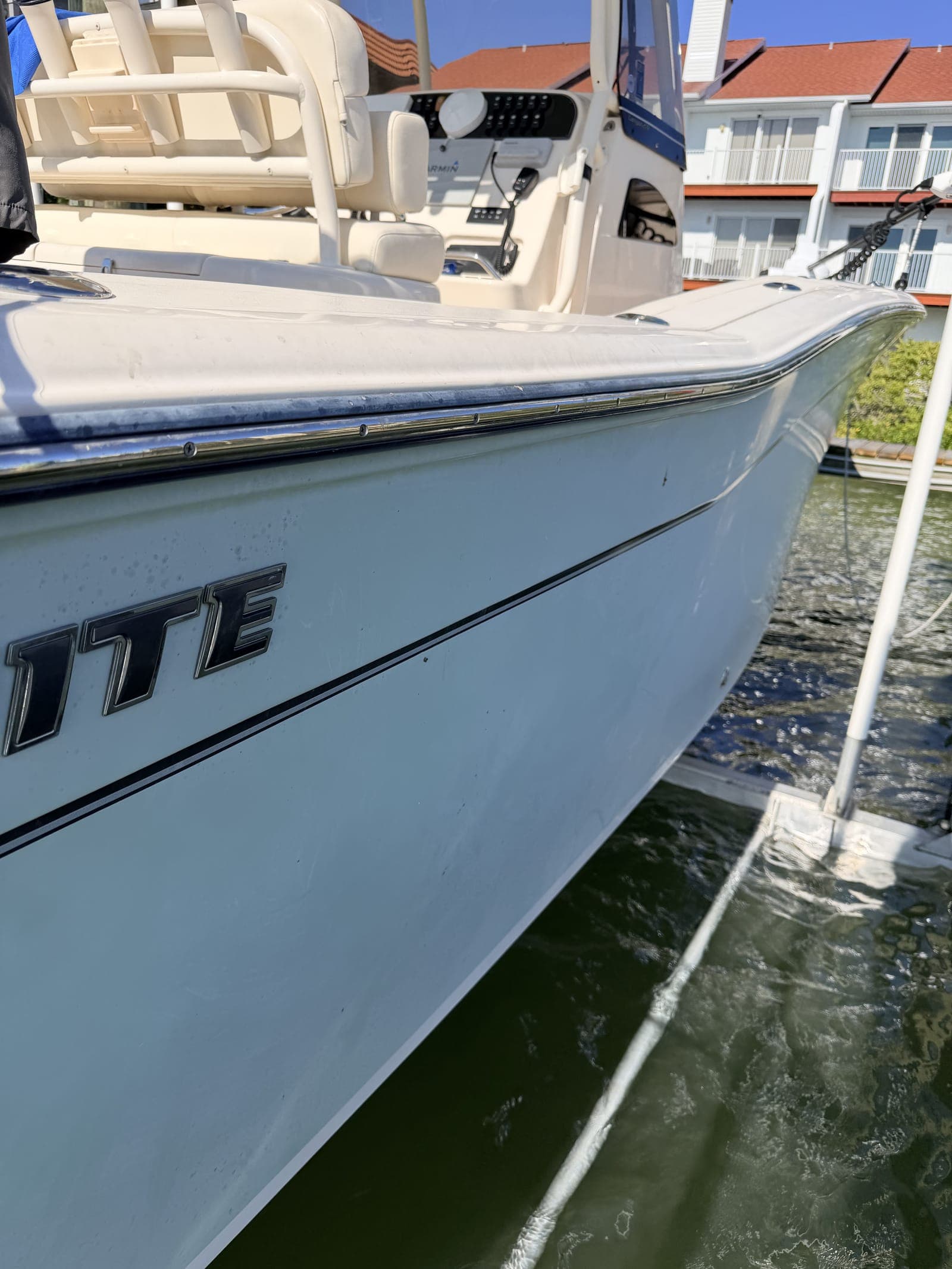
What Florida Actually Does to Your Wax
Most boaters think wax just slowly wears away over time, like brake pads on a car. That's not really what's happening. In Tampa Bay, your boat wax is under a three-front assault: UV, heat, and salt. All three are working at the same time, all year round. Understanding what's actually breaking down the protection helps explain why an 8-week cycle isn't some upsell pitch. It's just the math.
UV Radiation Breaks Down the Wax
Wax is made of long hydrocarbon chains, and UV light breaks those chains apart at the molecular level. In our experience, after 6–8 weeks of full Florida sun a carnauba layer has lost most of its water-beading and UV protection. Polymer sealants hold up a bit longer, around 10–12 weeks, because the synthetic chains resist UV better. But nothing lasts forever when you're parked under the same sun that fades truck dashboards in a single summer.
Heat Cycling Breaks the Bond
Dark hulls sitting in a slip can hit 160°F or higher at noon, then drop to 75°F overnight, then climb right back up the next morning. That constant thermal expansion and contraction weakens the bond between the wax and your gelcoat. Water beading dies first. You'll notice water sheeting instead of beading up, and then the visible gloss goes next. Add in Tampa Bay's summer thunderstorm cycle, where you get blazing sun, a sudden downpour, and then blazing sun again, and you've got a thermal shock pattern that's uniquely hard on any protective coating.
Salt and Abrasive Load
Every wave, every wash-down, every spray of Tampa Bay water carries microscopic salt crystals. Bay salinity runs 25–30 parts per thousand, full marine salinity, and even the brackish stretches around Old Tampa Bay and Hillsborough Bay still hit 15–25 ppt. Each pass of salt spray mechanically wears your wax layer thinner. If you're running through saltwater chop on a regular weekend, the wax at the bow takes 2–3x more abrasive impact than the sides of the hull.
6 weeks of that and there's nothing left between the sun and your gelcoat. The protection window is strong for about 6 weeks, marginal by week 8, and basically gone by week 10. That's why the 8-week cadence works. It catches the wax right before it fails, not after.
Wax vs. Sealant vs. Polymer Coating vs. Ceramic: What to Actually Use
There are four tiers of hull protection, and each one makes sense for a different type of owner. Before we get into the details, here's how they stack up side by side in Florida conditions, not lab conditions, not somewhere up in the Carolinas where the UV is half as intense.
| Protection Type | Cost | Realistic Lifespan in FL | Application Method | Best For |
|---|---|---|---|---|
| Carnauba wax | $15–$40/can | 6–8 weeks | DIY, hand application | Owners who enjoy the process |
| DIY polymer sealant | $25–$60/bottle | 10–12 weeks | DIY or pro, machine-friendly | Stretching time between applications |
| Pro polymer coating | Included in a full polymer-coating detail | Across a full Tampa Bay season | Professional, multi-step | Owners handing off the protection cycle |
| Ceramic coating | $3,500–$10,000+ pro-applied (FL market) | 1–3 years (claimed) | Professional only, specialty shop | High-value boats in exposed slips |
Carnauba wax is what most people picture when they think about boat wax, that warm, deep shine on a freshly buffed hull. Collinite #885 Fleetwax is basically the default among Tampa Bay boaters for good reason, and 3M Marine Ultra Performance Paste Wax is another solid pick. The catch is that at 6 to 8 weeks per cycle in our climate, you're looking at roughly 6 applications a year. At $15–$40 a can plus your labor, that's real time and money even if the per-application cost is low.
DIY polymer sealant is the middle ground that a lot of boaters end up landing on. The synthetic molecules bond chemically to gelcoat instead of just sitting on top of it like carnauba, which is why they hold up longer under our UV. You get 10–12 weeks between applications, and honestly, most people can't tell the difference in finish unless they're standing right next to the hull. Star brite Premium Marine Polish and Collinite #925 (a wax/sealant hybrid) are both worth looking at if you want to cut your maintenance cycles without a major investment.
Pro polymer coating is the step above DIY sealant — and it's what Mobile Marina applies as part of our full polymer-coating detail. We use a professional-grade marine polymer that bonds to the gel coat and cures into a hard, clear UV and salt barrier that lasts across a full season. The difference between a pro coating and a DIY polymer sealant isn't just the chemistry — it's the surface prep underneath it. A pro polymer coating only works if the gel coat is decontaminated and compound-and-polished to baseline first, which is a multi-step process most owners don't want to do themselves. We'll walk through the actual sequence in the Mobile Marina section below.
What about spray wax or quick detailer between full applications? Many boaters use a spray wax after every wash as a maintenance layer, and it does help. A spray sealant top-up between proper wax or polymer applications can extend the effective protection window by a few weeks, but it doesn't substitute for a full hand-applied coat. Think of it as topping off the tank, not filling it. Our basic wash service includes a spray sealant for exactly this reason.
Ceramic coating is a different category entirely. It's an industrial-grade silicon-dioxide layer that bonds at the molecular level. Done right by a specialist, it can last 1 to 3 years in Florida. Done wrong, it crazes, hazes, or peels, and removal gets expensive fast. The pricing reality also surprises a lot of owners: in the Florida market, a properly done ceramic job with name-brand product (Ceramic Pro Marine, Gtechniq, IGL, Starke Thor/Kraken) and the multi-step paint correction it requires runs roughly $3,500–$6,000 for a 25–30 ft boat, $5,500–$9,500 for a 30–38 ft boat, and $8,500–$14,000+ for boats over 40 ft. The "$1,500 ceramic coating" you see advertised online is almost always either coating-only application with no correction underneath, or a small-boat number that doesn't apply to a 30-footer. We don't do ceramic in-house at Mobile Marina — we refer out to a specialist partner because the application is its own trade. Our Tampa Bay boat-detailing guide explains how ceramic compares with recurring wax and polymer-coating cycles.
The simple decision tree: if you want to do it yourself, carnauba is the lowest cost of entry and DIY polymer sealant is the cadence-stretcher. If you'd rather hand off the protection cycle and not think about it for months at a time, a pro polymer coating is the right tier. Ceramic is the long-haul, set-it-and-forget-it option for higher-value boats in sunny exposed slips — but it's a real five-figure decision on most 30-ft-plus boats once you include the correction work it requires, not the $1,500 number that gets repeated online. There's no wrong answer, just the one that matches your boat, your budget, and how you actually spend your weekends.
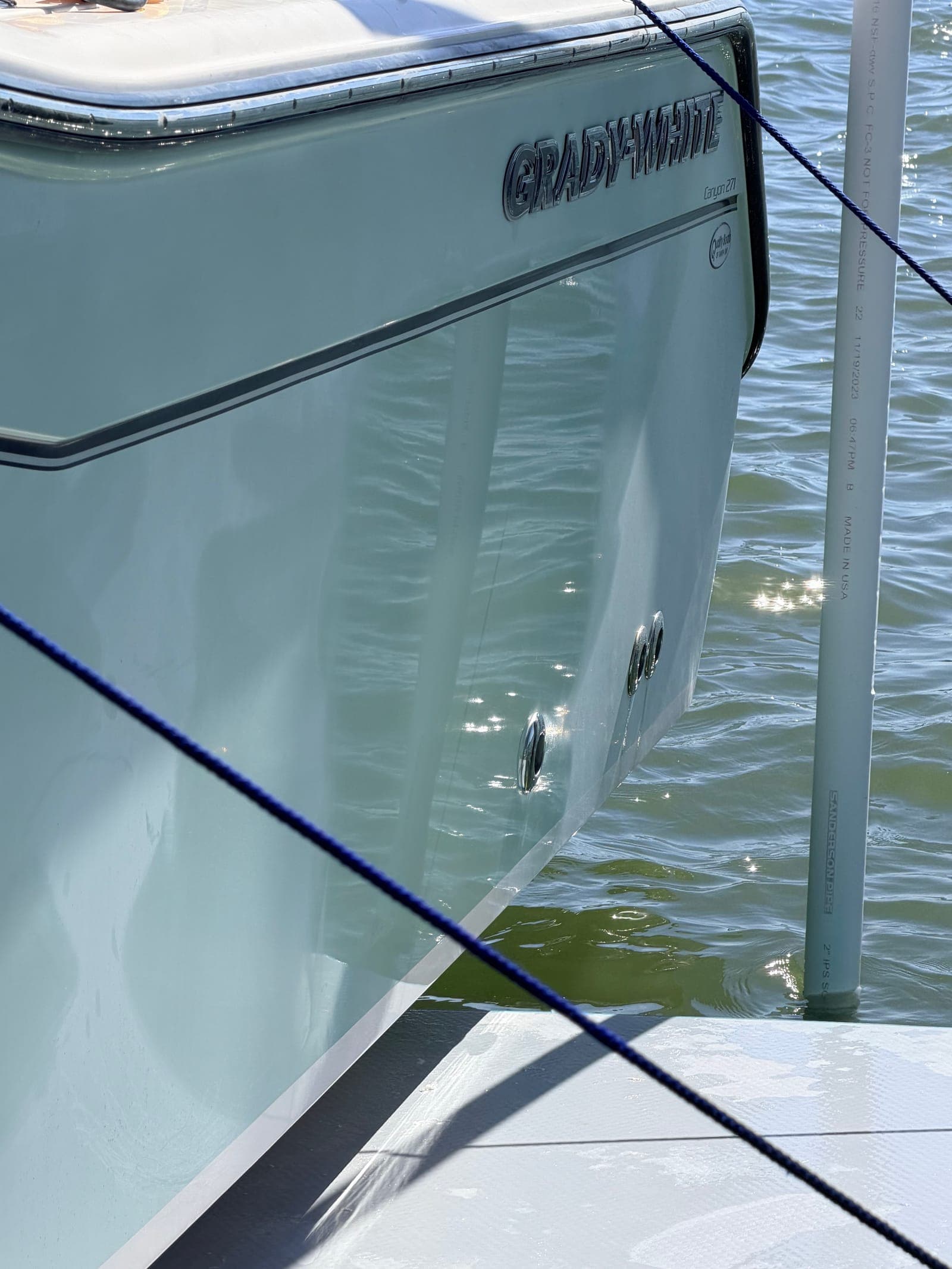
What Skipping Wax Actually Costs (The Compound + Polish Bill)
We have this conversation with boaters all the time, usually after they've already gotten the bad news: "I didn't think skipping a few wax cycles would matter that much." It always matters. And honestly, it drives us a little crazy, because the math is so lopsided. Florida sun doesn't take breaks, and neither does oxidation. What starts as a slightly dull finish in April turns into a chalky, scratched-up mess by December. The bill to fix it climbs fast, and the worst part is it was completely avoidable.
Gelcoat oxidation moves through stages, and each one costs more to reverse. We'll use a 30-foot boat as the benchmark since that's a common size we work on.
| Scenario | What It Takes | Cost Range (30-ft Boat) | Notes |
|---|---|---|---|
| Regular wax maintenance (every 8 weeks) | Polish + wax per cycle | ~$180/year DIY or ~$1,380/year professional | Finish stays protected, water beads properly |
| Moderate oxidation (6–12 months without wax) | Compound + polish + wax, a 2-step correction | $1,800–$3,000 | 2–3x the labor of a standard detail; chalky finish with visible scratches |
| Severe oxidation (1+ years neglected) | Multi-step wet-sand + heavy compound + finishing polish + sealant | $3,500–$5,000+ | Dark gelcoat is especially vulnerable; may involve structural finish loss |
Look at those numbers side by side. Keeping up with boat wax on a regular schedule runs you somewhere around $180 a year if you're doing it yourself. Skip it for a year or more and you're looking at a restoration bill that could hit $3,500 or higher for the same boat. We see this pattern constantly: a boat that hasn't been waxed in 12–18 months comes in for a "quick wax" and needs a full-day compound correction instead. The owner thinks the gelcoat is ruined; usually it isn't, but the correction costs more than two or three years of regular wax maintenance would have. The owners who end up paying the most for their finish are almost always the ones who skipped the cheap maintenance.
There's a deeper problem most people don't think about. Your gelcoat is only 18–30 mils thick from the factory, roughly half a millimeter to just under a millimeter. Every time a detailer has to aggressively compound out severe oxidation, they're removing 2–5 mils of that finite layer. Do 2 or 3 deep restorations over the life of the boat and you've taken meaningful thickness off the hull's protective finish. At that point, you're not restoring. You're running out of gelcoat to work with.
That's why we push the maintenance schedule hard. Prevention is always cheaper than restoration, and it protects something you can't get back. For a fuller breakdown of what professional detailing includes at each level, check out our guide to Boat Detailing Services in Tampa Bay: What's Included, Frequency, and Real Price Ranges.
Expert Marine Maintenance
From routine service to major repairs, our team of expert marine technicians handles it all. Full project management so you can enjoy your boat.
Expert Technicians
Certified marine specialists
How to Wax a Boat Yourself (Step-by-Step, Florida-Specific)
A proper DIY boat wax on a 30-foot center console is a solid 4–6 hours of work. But if you've got the time and a shady spot, doing it yourself saves real money and gives you a chance to inspect every inch of your hull and topsides while you're at it. The process below is tuned for Tampa Bay's sun, salt, and humidity.
Before you start, gather your gear: a foam applicator pad (4-packs run about $8 at any auto-parts store), a stack of microfiber towels (the 8-pack 16x16 at Costco for around $15 is hard to beat), marine-safe boat soap, and your wax of choice. If your boat is over 25 feet, a dual-action polisher will cut your time roughly in half. Just make sure it's a DA, not a rotary. Rotaries spin too aggressively and will burn right through gelcoat if you're not experienced with them.
Phase 1: Prep Work
Wash the entire boat first. Salt, dirt, and bird droppings have to come off before any wax touches the surface. Use a marine-safe soap like Star brite, 303, or Boat Bling Hot Sauce. Rinse thoroughly and dry with a clean microfiber. Skip the dish soap from under the kitchen sink. It strips whatever protective wax layer is still hanging on.
Decontaminate if the surface feels gritty. Run your hand across the gelcoat after washing. If it feels rough or grabby, you've got bonded contaminants, usually salt scale, hard water spots, or exhaust fallout from sitting at the marina. A clay bar or a chemical iron-remover spray takes care of it. You don't need to do this every time, though. Every 2–3 wax cycles is plenty.
Polish if the finish looks dull (optional). If the gelcoat has lost its gloss, a one-step polish like Meguiar's Marine Premium Polish or 3M Finesse-It will bring back the shine before you seal it with wax. If the boat still looks glossy and you're just freshening up the protection, skip this step entirely.
Phase 2: Wax Application
Apply wax in the shade. This is the single most important Florida-specific rule. Wax flashes (dries to a haze) way too fast in direct sun down here, and once it bakes onto the gelcoat, it's miserable to buff off. Wax early morning, late evening, or under a covered slip. If shade isn't an option, work one small panel at a time and have a microfiber chasing your applicator within 30 seconds.
Work in 2x2-foot sections. Apply with a foam pad, wait until the wax hazes over (usually 15–60 seconds depending on the product and humidity), then buff off with a clean microfiber. Flip to a fresh side of the towel as it loads up with residue. Trying to do an entire side of the hull at once is a recipe for baked-on wax and sore arms.
Two thin coats beats one thick coat. This sounds counterintuitive, but thin layers bond more uniformly to the gelcoat and buff off far easier. Apply your first coat, let it cure for about 30 minutes, then lay down coat two.
Phase 3: The Details That Matter
Don't wax the non-skid areas. Wax on a non-skid deck is a genuine slip hazard, especially when it gets wet. Tape off the non-skid, or if you want protection on those surfaces, use a non-skid-specific sealant like Star brite Non-Skid Deck Wax, which is formulated to protect without making the texture slippery.
Check your product's cure time before splashing. Traditional carnauba wax needs a full 12 hours to cure before saltwater hits it. Many modern polymer sealants like Collinite #925 are water-ready in 1–4 hours. Read the back of your bottle. If you're using straight carnauba and you wax in the morning and splash the boat that afternoon, the first wave rolling down the hull undoes half the work you just put in. For boaters on lifts, this is easy. If you're on a trailer, plan accordingly.
That's the honest process. If the idea of spending a full Saturday doing this every 8 weeks doesn't appeal to you, and we wouldn't blame you one bit, the next section covers what it costs to hand this job off to a professional.
When to Just Hire It Out (And What It Costs)
There's a point where doing your own boat wax stops making financial sense, and it's worth being honest about where that line is. If you've got a 22-foot bay boat and a free Saturday morning, DIY is a perfectly good call. You're looking at maybe $180 a year in supplies and 25–30 hours of your time spread across the year. That's reasonable. But once you're north of 30 feet, the math starts tilting the other way fast, because the time commitment scales up while the product costs stay roughly the same.
What the numbers actually look like for a 30-foot boat in Tampa Bay:
| Approach | Annual Cost | Time Commitment | Notes |
|---|---|---|---|
| DIY wax (every 8 weeks) | ~$180 in supplies | 25–30 hours/year | You're doing the work yourself |
| Pro polymer-coating cycle (2x/year) | ~$2,760/year for detail + ~$1,800 for monthly wash = ~$4,500/year | Zero | Pro polymer coating twice a year + monthly wash with spray-sealant top-up |
| Ceramic coating (one-time) | $3,500–$10,000+ (FL market, includes correction) | Zero for 1–3 years | Specialty trade, we don't do this in-house |
The pro polymer-coating cycle is what most of our managed customers actually run. It breaks down to a monthly basic wash at $4–$6/foot (so $120–$180/month for a 30-footer), which includes a spray sealant top-up each visit, plus a full polymer-coating detail twice a year at $46/foot, or $1,380 each. That detail isn't a wipe-and-buff job — it's a multi-step decontamination, two-stage compound and polish, and a professional polymer coating that protects the gel coat across a full Tampa Bay season. If oxidation ever shows up, the next detail cycle catches it, but most boats on a regular program never get there because the protection layer never lapses long enough for UV damage to set in.
The hand-off makes sense in a few specific situations. If your boat is 30 feet or longer, DIY time becomes a real commitment. Full weekends, not Saturday mornings. If you're a snowbird splitting time between Tampa Bay and somewhere up north, nobody's waxing your boat while you're gone and the Florida sun doesn't take days off. And if your boat is valued at $150K or more, the time-versus-money math almost always favors paying someone. That $3,500–$5,000 a year is roughly half a slip fee in Tampa Bay, and for that the owner never has to think about it again.
DIY still makes total sense for smaller boats under 25 feet, for owners who genuinely enjoy the work (and some do, no judgment), or when the budget is tight enough that your time is the cheaper resource. There's also a third path worth mentioning: ceramic coating. Pay anywhere from $3,500 on a smaller boat to $10,000+ on a 40-footer for a properly corrected, name-brand ceramic job, and you can skip the wax or polymer-coating cycle for 1 to 3 years if the application holds up. It's a real five-figure decision on bigger boats once you include the multi-step correction it requires, so don't trust the "$1,500 ceramic coating" numbers floating around online. We don't do ceramic at Mobile Marina, it's a specialty trade, but we'll connect you with a coating partner if that's the direction you want to go. For a broader look at wash, wax, coating, and detailing options, see our Tampa Bay boat-detailing guide.
If you want to talk through what a maintenance program would look like for your boat specifically, give us a call at (727) 607-1050. We'll run the numbers with you honestly, and if DIY is the smarter play for your situation, we'll tell you that too.
How Mobile Marina's Polymer Coating Detail Actually Works
Honestly, calling what we do "boat waxing" undersells the process. When you hand the protection cycle off to us, we don't apply a soft carnauba wax that's gone in six weeks. We apply a professional-grade marine polymer coating that bonds to the gel coat and cures into a hard, clear UV and salt barrier that holds up across a full Tampa Bay season. The application is a multi-step process, not a wipe-and-buff job.
Here's the actual sequence on a Mobile Marina polymer coating detail:
Topside (Everything Above the Waterline)
- Decontamination washdown. Strips salt scale, exhaust soot, and bonded contaminants off the gel coat. The polymer can't bond to dirt.
- Canvas, vinyl, and seat cleaning. Interior soft surfaces get washed; mildew stains pulled from vinyl cushions; cushions treated with Aerospace 303 protectant for UV resistance.
- Eisenglass enclosure cleaned if installed.
- Deep clean of the non-skid and SeaDek. Rust, black streaks, and soot pulled out of the textured surfaces.
- Compartment interiors opened and wiped down, including lid edges, so the dirt you can't see also goes.
- Compound + two-step polish. Every smooth surface gets a two-stage compound and high-speed polish to remove oxidation and restore gloss. We don't polymer-coat over haze; we polish to baseline first.
- Surface prep wash. Final decontamination right before the polymer goes on, so nothing's between the coating and the gel coat.
- Polymer coating applied to the topside gel coat.
- Stainless polish on stanchions, fixtures, and hardware.
- Windows cleaned and treated with Rain-X for water-shedding.
Hull (Below the Rubrail)
Same sequence: decontamination washdown, two-step compound and high-speed polish to remove oxidation, surface prep, and a polymer coating. We dry the hull, pull water stains, rust, exhaust drip, and soot, then start the polish process from a clean slate.
Rubrail
Polished with Collinite metal wax so the trim ages with the same care as the rest of the boat.
The point of all of this is that polymer coating isn't a single step — it's the final step of a careful sequence. The polymer is only as good as the surface underneath it. Skip the decontamination or the two-step compound and polish, and you've sealed oxidation under your protection layer instead of locking in a clean baseline. That's the difference between a "wax job" and a polymer coating detail.
For a fuller breakdown of MM's detailing scope and where the polymer coating detail fits in our service menu, see Boat Detailing Services in Tampa Bay: What's Included, Frequency, and Real Price Ranges.
Between full polymer-coating cycles, our basic wash service keeps the protection topped off — $4–$6/foot on a monthly recurring schedule, or $10–$15/foot as a one-off. Each wash includes a spray sealant that supports the polymer coating between applications. We service both slip-stored and trailer-stored boats; for trailered boats we coordinate pickup and drop-off so the schedule doesn't slip just because you're not at a marina.
A few things we don't touch in this lane, and we're upfront about it: ceramic coating is a different trade with its own controlled-environment requirements — we refer that out to a specialist partner. Same with gel-coat repair, fiberglass restoration, and hull bottom paint. Those belong at a haul-out yard or with a dedicated fiberglass crew.
The reason our scheduled-routes model matters here is that protection depends on consistency. The owners who skip cycles are the ones paying for a full restoration job later. We run routes across St. Pete, Clearwater, Tampa, Tierra Verde, and Gulfport on a published schedule, so the coating doesn't lapse because you forgot or got busy. Every wash and detail gets logged in the Mobile Marina app with photos and notes, so you can pull up your boat's full care history from your phone anytime.
If you've decided you'd rather have us handle it, call (727) 607-1050 or open the app to schedule a polymer coating detail.
Get Fuel Delivered to Your Slip
Download the Mobile Marina app to schedule dockside fuel delivery, manage your vessel, and access all our services from your phone.
Frequently Asked Questions
The Bottom Line
Florida sun doesn't take days off, and your protection schedule shouldn't either. If you're DIY-ing it with wax, an 8-week cycle is the cadence that actually holds up against Tampa Bay UV, heat, and salt. If you'd rather hand it off, stepping up to a pro polymer coating like the polymer-coating detail we run twice a year buys you season-long protection without the every-two-month reapplication grind. Either way, the math is the same: keep the protection layer intact, and you skip the multi-thousand-dollar compound-and-polish restoration down the road. It's the difference between maintaining a boat and restoring one.
Our team works with boaters across St. Pete, Clearwater, Tampa, Tierra Verde, and Gulfport on scheduled detail routes — so the cadence stays consistent and the coating doesn't lapse. For owners who want the full hand-off, we wire the polymer coating cycle into our vessel management program so you're not chasing down appointments or wondering when the last coat went on.
Give us a call and we'll talk through what a wax schedule looks like for your boat — (727) 607-1050, or visit mobilemarina.co to get started.
Related: Boat Detailing | Contact Us | Service Areas | Boat Detailing Services Tampa Bay Whats Included Frequency And Real Price Ranges | Boat Wash Vs Detail How To Choose The Right Level And Skip The Wrong Upsell