Schedule Boat Detailing & Wash
Dockside service across St. Pete, Clearwater, Tampa, Tierra Verde, and Gulfport.
The 4 Tiers of Boat Detailing (And Why Every Shop Names Them Differently)
If you've ever called three detailing shops and gotten three completely different service names for what sounds like the same thing, you're not alone. One shop's "premium detail" is another shop's "basic package." There's no industry-wide naming standard for boat detailing services, which makes comparing quotes a headache. What matters isn't the name on the invoice — it's what's actually being done to your boat.
We break it down into four tiers based on what work is actually performed. Once you understand the hierarchy, you can translate any shop's menu into something that makes sense.
The Tier Map
| Tier | What's Included | Typical Time (25 ft) | Frequency in Tampa Bay |
|---|---|---|---|
| Basic Wash | Soap-and-rinse, salt removal, visible dirt cleared | 60–90 min | Every 2–4 weeks during active use |
| Wash-and-Wax | Basic wash + machine-applied liquid wax or spray sealant | 2–3 hrs | Quarterly (every 8–12 weeks) |
| Full Detail | Compound (cuts oxidation) + polish + wax/sealant + interior clean + metal polish + bilge + canvas | Full day minimum | Annually (semi-annually if heavily oxidized) |
| Ceramic Coating | Decontamination wash + full compound + polish + ceramic coating application | 2–4 days | Every 2–3 years for coating renewal |
A basic wash is maintenance, not detailing. That distinction trips people up. A wash removes what's sitting on the surface — salt, bird mess, dock grime. It doesn't restore anything. If your gelcoat is chalky or faded, a wash won't fix that. It keeps things from getting worse between real detail work, which is why it needs to happen every two to four weeks during the season. Salt air and UV don't take weekends off.
Wash-and-wax sits in the middle ground. You're getting a wash plus a layer of protection, usually a machine-applied liquid wax or spray sealant that gives the gelcoat some UV defense and makes the next wash easier. For boaters who keep their boats in slips year-round, this quarterly cadence is the sweet spot for keeping oxidation from getting a foothold.
A full detail is where the real correction happens. Compounding physically cuts away the damaged outer layer of oxidized gelcoat, and polishing restores the gloss underneath. Add in interior cleaning, metal polish, bilge work, and canvas treatment, and you're looking at a full day minimum on a 25-footer. Boats sitting in uncovered slips without regular wash cycles often need this done twice a year instead of once.
The ceramic coating tier is the most misunderstood. The coating itself is the easy part — it's the prep that takes two to four days. If the surface isn't properly decontaminated, compounded, and polished before the coating goes on, you're just locking in imperfections. A ceramic coating doesn't replace regular washes. You still need a basic wash every two to four weeks. The coating makes those washes faster and more effective, but it's not a set-it-and-forget-it shield.
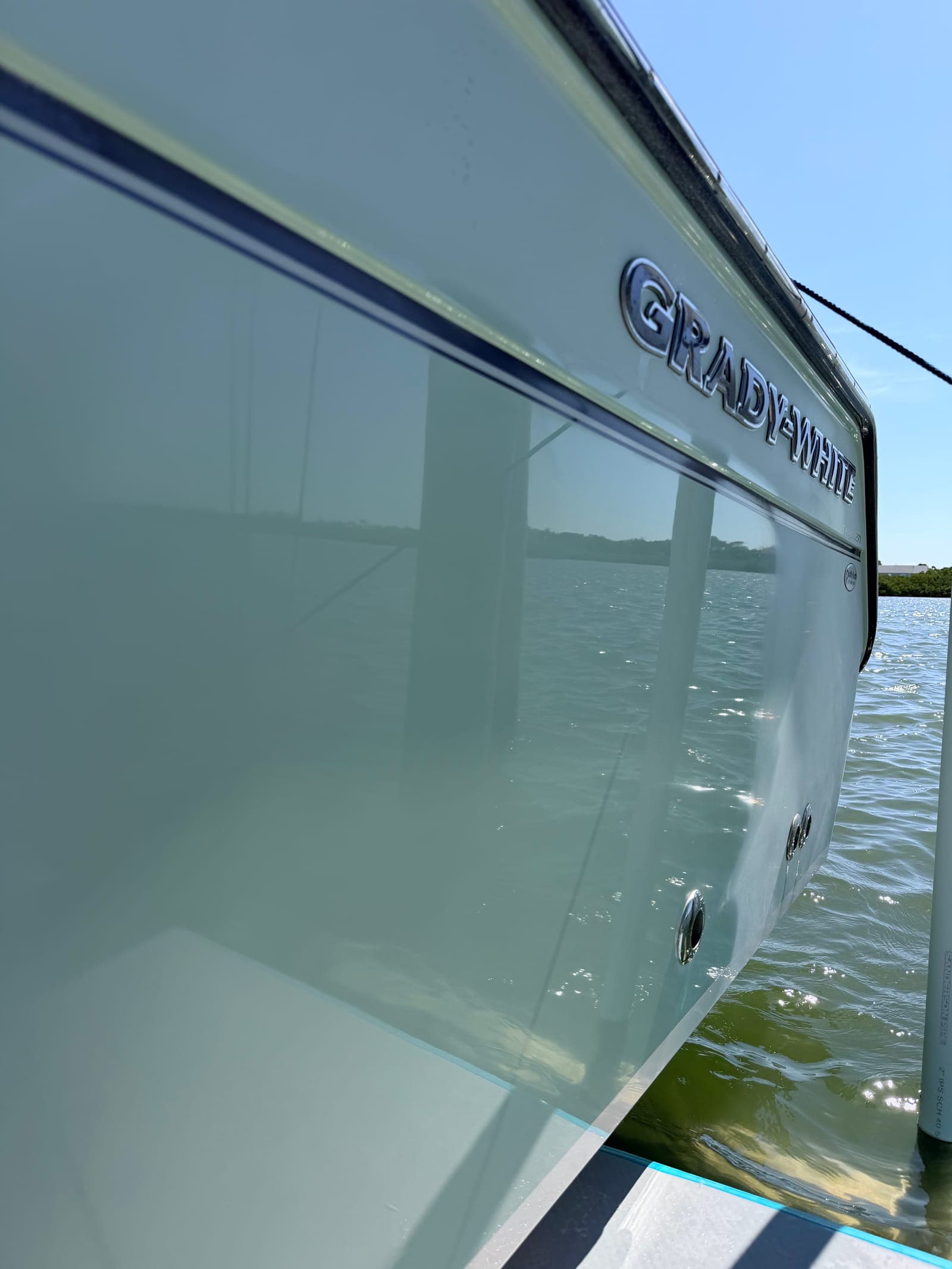
What Full Detailing Actually Includes (Line by Line)
A proper full detail isn't one step — it's a sequence, and each step sets up the next one. Skip a step or do them out of order, and you're either wasting product or creating more work.
It begins with a pre-wash rinse to knock loose dust, salt, and debris before any soap touches the surface. Dragging a wash mitt over a dusty hull is how you get swirl marks baked into your gelcoat under the Florida sun. After the rinse, the wash itself should use pH-neutral marine soap, not whatever's on sale at the auto parts store. Car soap has a different pH balance and can strip wax or damage gelcoat over time.
The Steps That Separate a Real Detail From a Glorified Wash
Once the hull is clean, this is where a real detail earns its money:
- Hull decontamination — an iron-removing product pulls embedded metal particles that salt exposure leaves behind. If you dock anywhere along the Pinellas coast, your hull picks up more than you'd think.
- Compounding and polishing — compounding is what actually cuts through oxidation. Different grades work for different gelcoat conditions, and a good detailer assesses before they start grinding. Polishing follows immediately after, removing the haze that compounding leaves behind and restoring the actual gloss. These two steps are sequential and inseparable. Compound without polish, and your boat looks worse, not better.
- Wax or sealant — the protection layer. In Tampa Bay's UV exposure, expect 2–6 months of life before you need another coat.
- Stainless and aluminum polish — rails, cleats, hardtop supports. Neglect these and pitting starts, which is a lot more expensive to fix than a polish.
- Interior clean — vinyl, canvas, carpet. Mildew moves fast in this humidity, and it's not just cosmetic. On closed-up boats during peak summer, green vinyl is a two-week problem. Tampa Bay interiors need more attention than the interior line item on most detailing quotes suggests.
- Bilge clean — often a separate charge, so ask whether it's in the quote before you sign off.
- The trailer detail (tires, fenders, frame) applies to trailered boats only and is part of the package if you're pulling your boat out at a local ramp.
The detailer should walk the boat with you at handoff. If they don't offer that, it's a red flag.
One thing most detailers won't volunteer: you don't need compounding at every detail. Once a year is typically enough. Compound is abrasive — it works by removing a thin layer of gelcoat to get below the oxidation. Do it every detail and you're literally thinning your gelcoat faster than the sun is. A good detailer will tell you when you actually need compounding and when a polish-and-wax is plenty.
One more thing to watch for — if a detailer starts talking about "3-stage paint correction," that's car-industry language that doesn't translate cleanly to marine gelcoat. Gelcoat isn't automotive clear coat. The process is similar in concept, but the products, pads, and technique are different. A detailer who leans hard on car terminology might be crossing over from auto work without the marine experience to back it up. Engine bay dressing is another one that sounds impressive on a quote but is more of a nice-to-have than a necessity. It won't hurt anything, but if you're watching your budget, that's an easy line item to skip.
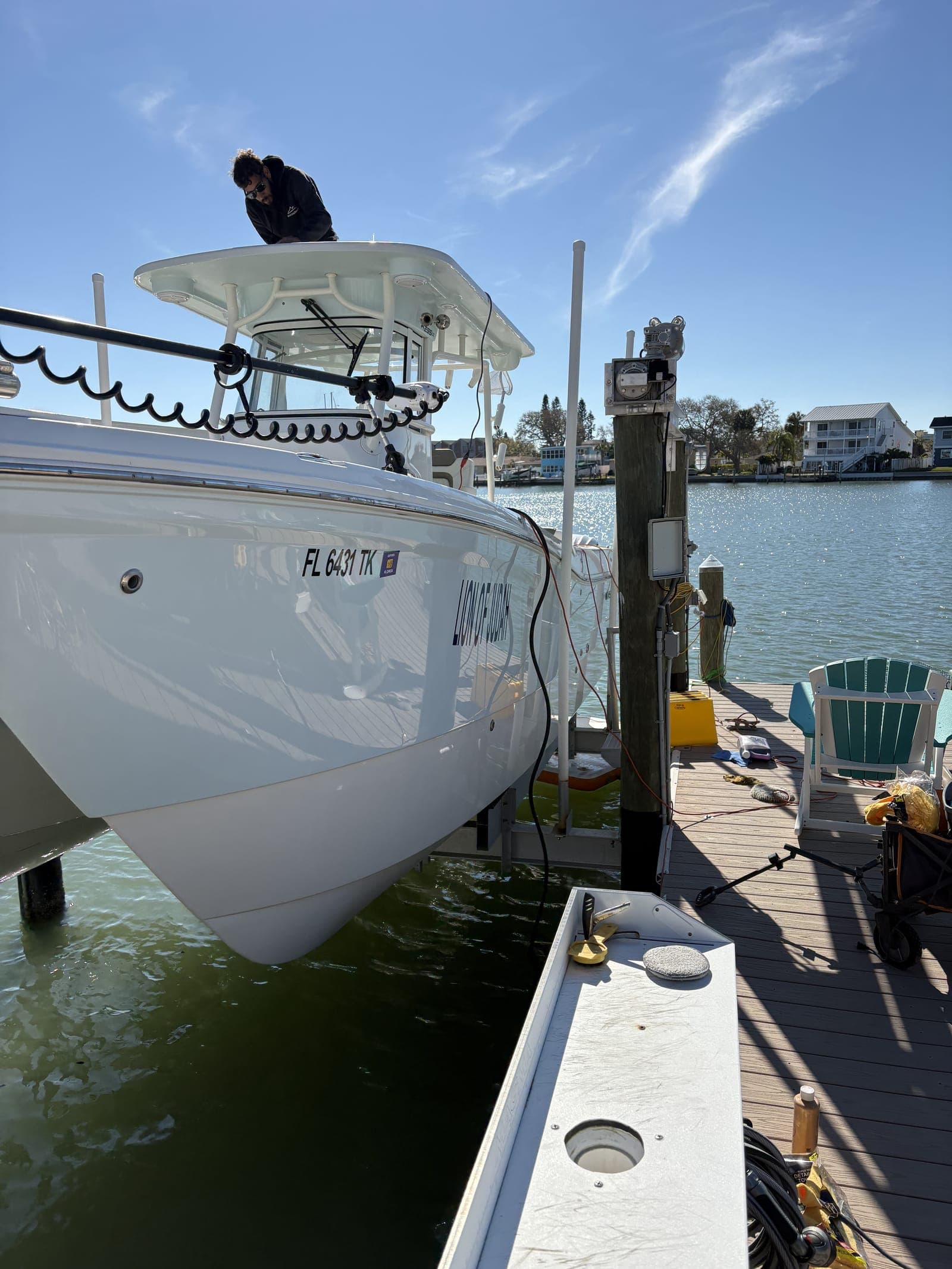
Why Tampa Bay Eats Gelcoat Faster Than Almost Anywhere
Florida gets significantly more high-UV days per year than most Northeast locations. That difference explains why a boat sitting in Tampa Bay ages faster on the outside than one parked in Connecticut. UV radiation is the single biggest driver of gelcoat oxidation. It breaks down the resin at a molecular level, turning that glossy finish chalky and dull. And in this climate, that process never gets a break.
But UV is only part of the story. Salt spray is constant, and it does more than just make your boat look dirty. Salt creates micro-pitting across the gelcoat surface, which exposes more area to the sun and accelerates future oxidation. It's a compounding problem: the rougher the surface gets, the faster it degrades. Then add humidity and heat cycling into the mix. Gelcoat swells and contracts with temperature shifts, and over time that creates micro-cracking you can't even see until it's too late.
Tampa Bay is particularly rough on exteriors compared to other boating regions:
| Factor | Tampa Bay | Northeast / Great Lakes |
|---|---|---|
| High-UV days per year | 220+ | ~120 |
| Salt exposure | Year-round, constant | Seasonal (freshwater in many areas) |
| Humidity cycling | Daily swelling/contracting | Moderate in summer only |
| Winter storage | Boats stay in the water | 4–6 months covered or indoor |
| Wax/sealant schedule | Every 8–12 weeks | Twice a year |
UV-day estimates are approximations based on NOAA solar exposure data for the Tampa and Hartford stations. The threshold used here is a UV index of 6 or higher sustained for a majority of daylight hours.
If you moved down from up north and brought along the "wax it in spring, wax it in fall" routine, your gelcoat is already behind. Boats here never get that winter hibernation period where they're tucked away under a cover in a climate-controlled building. They're sitting in saltwater, baking in UV, 365 days a year.
The practical takeaway for anyone keeping a boat in this market is straightforward: you either commit to wax or sealant every 8–12 weeks, or you invest in a ceramic coating that holds up for two-plus years. There's no middle ground where you skip protection and catch up later. Once oxidation sets in, you're paying for a full compound and polish just to get back to baseline. We cover the exact wax schedule that works here in a separate piece.
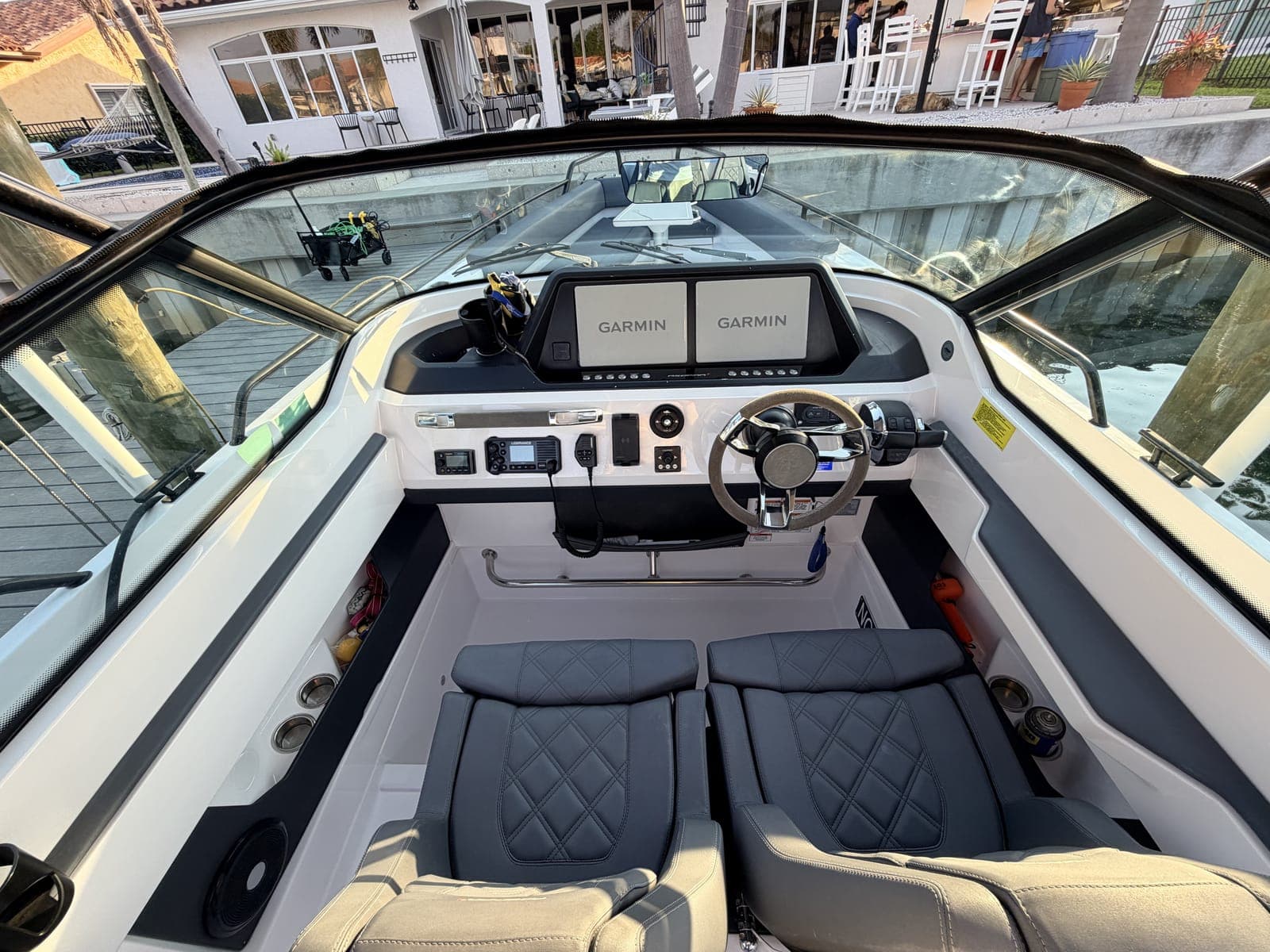
Expert Marine Maintenance
From routine service to major repairs, our team of expert marine technicians handles it all. Full project management so you can enjoy your boat.
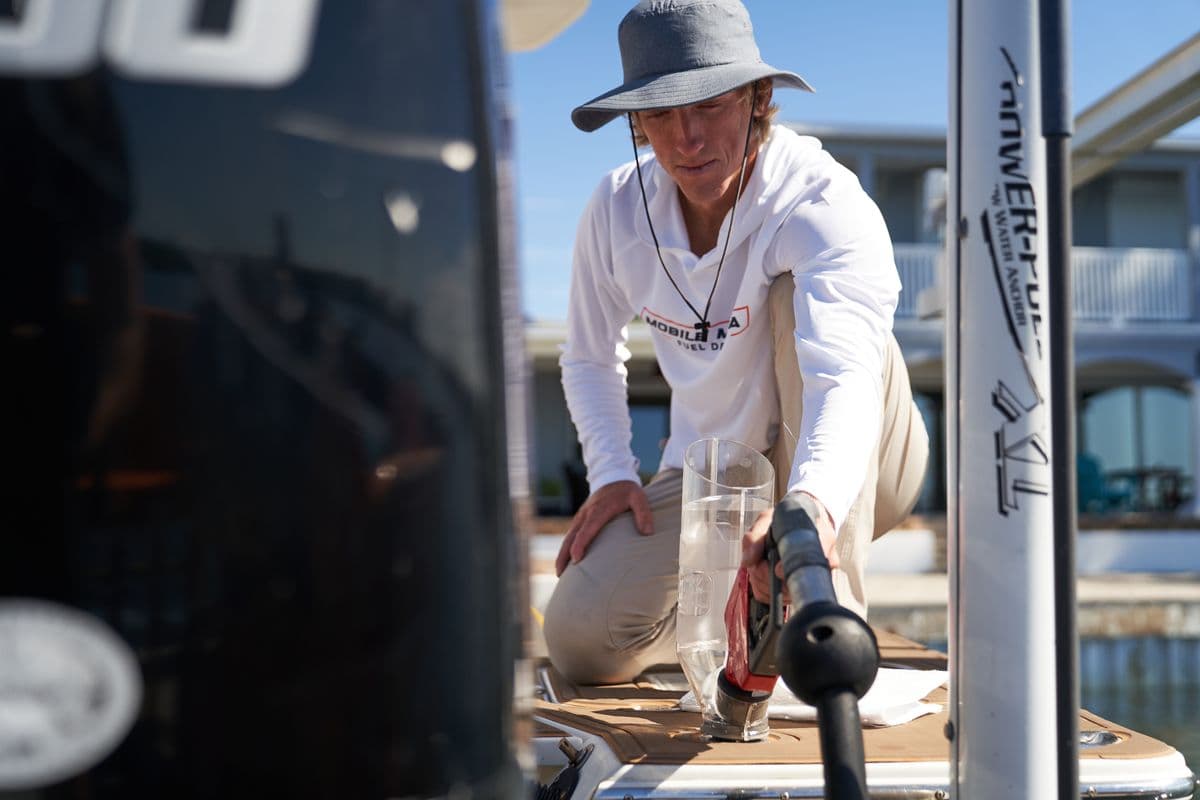
Expert Technicians
Certified marine specialists
How Mobile Marina Approaches Detailing (And Why We Strip the Menu)
We get asked all the time why our menu looks different from every other detailing shop in Tampa Bay. Most shops sell four tiers — basic wash, wash-and-wax, full detail, ceramic coating — because it gives them four price points to convert on. We tried that. It didn't hold up.
What we offer
- Basic wash — soap and rinse, salt off the running gear, exterior decontamination, dry. $4–$6/ft monthly · $10–$15/ft one-off. A 25-footer lands around $100–$150 on a recurring schedule or $250–$375 as a standalone visit, with the specific number flexing on hull condition, layout complexity, and the tech on the job. The whole point is frequency: every 2–4 weeks during active use, monthly minimum in the off-season.
- Full detail — exterior wash, oxidation removal, 1–2 step polish, sealant protection, non-skid treatment, interior deep clean, glass and metal polish. $46/ft up to 30 ft · $51.75/ft for 30–50 ft. Once or twice a year. This is the only time we touch compound and polish — doing it more often than necessary thins gelcoat.
- Metal polishing add-on — stainless rails, towers, aluminum, hand and machine polished to a mirror finish. $9.20/ft. Available on any visit.
That's the whole menu. Three lines.
What we don't quote (and why)
- Wash + wax middle tier. A wax-only visit without the correction step underneath is wasted money — you're sealing in oxidation. Most liquid waxes lose meaningful protection in 6–10 weeks of Tampa Bay heat, faster than you'd realistically schedule another wax visit. The wax/sealant step in a full detail works because it's applied to freshly corrected gelcoat. Stay on a basic-wash cadence between details; do a real full detail when the gelcoat actually needs the polish step. Frequency over upcharge.
- Ceramic coating packages. Ceramic done right is a 48+ hour job — prep is 80% of the work, and the coatings that last 2–3 years need shop-grade environment control. That's a different skill set from rotational dockside detailing. We refer ceramic customers to a coating-specialist partner shop and coordinate scheduling on our end. We'd rather send you to someone who does it right than sell you something we can't back up.
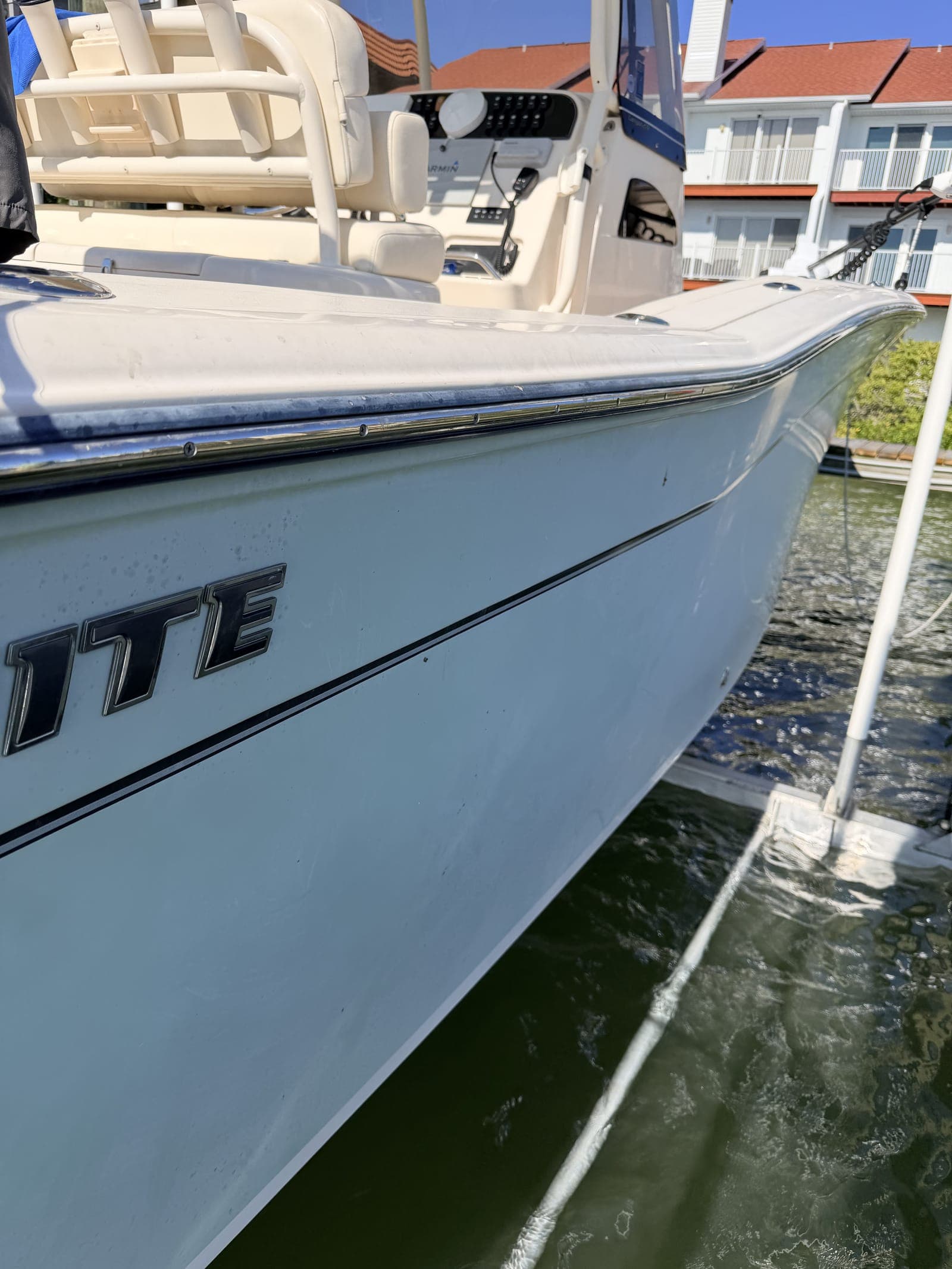
Every middle tier we tested added complexity without protecting the boat better than a frequent wash paired with a real annual detail. If your gelcoat doesn't feel smooth and reflective, you're already past basic-wash territory. Send a photo of the sidewall above the waterline — call us at (727) 607-1050 or shoot it through the app — and we'll tell you which tier you actually need.
Real Tampa Bay Price Ranges (What You're Actually Paying For)
Pricing for boat detailing services varies wildly depending on who you call, the size of your boat, and the current condition of the hull and topside. The ranges below are pulled from what detailers across Florida are actually charging today, alongside our own published rates so you can compare apples to apples. Most shops quote based on boat length, but the real cost driver is condition. A well-maintained 35-footer can be cheaper to detail than a neglected 25-footer with three seasons of oxidation baked on.
| Service | 20–25 ft (Industry) | 26–35 ft (Industry) | 36–45 ft (Industry) | Mobile Marina Rate |
|---|---|---|---|---|
| Basic wash | $80–$150 | $150–$250 | $250–$400 | $10–$15/ft one-off · $4–$6/ft monthly |
| Wash-and-wax | $200–$400 | $400–$700 | $700–$1,100 | Not offered — see why |
| Full detail | $400–$800 | $800–$1,500 | $1,500–$3,000 | $46/ft up to 30 ft · $51.75/ft over 30 ft |
| Ceramic coating | $3,500–$5,500 | $4,500–$8,000 | $7,500–$12,000+ | Contact for quote — coordinated through a coating-specialist partner |
| Metal polishing | Varies by shop | Varies | Varies | $9.20/ft |
| Bilge cleaning | $75–$150 | $150–$250 | $250–$400 | Quoted by condition |
| Canvas / vinyl restoration | $150–$400 | $250–$600 | $400–$900 | Quoted per job |
To put our per-foot pricing in real terms: a 25-foot boat on a monthly wash schedule lands around $100–$150 per wash at $4–$6/ft. That same boat as a one-off wash is roughly $250–$375 at $10–$15/ft — recurring schedules earn the lower end of the range because recurring boats stay cleaner and take less labor each visit. A full detail on a 28-footer comes out to $1,288, and a 38-footer lands at $1,966.50. Need the stainless rails and tower polished on a 32-footer? That's $294.40 for the metal polish add-on, though boats with heavier hardware or specialty metals can run higher.
Light oxidation typically adds 20–30% to the base price. Heavy oxidation — the kind you see on boats that sit uncovered through a full Tampa Bay summer — can double it. Boaters get sticker shock when the quote comes back double because they expected a $500 detail and got quoted $1,000+ once someone actually looks at the gelcoat. Our per-foot rates account for standard wear, but heavy oxidation, unusual hull shapes, and seized hardware can flex the number upward from that baseline.
The industry-standard pricing benchmarks (roughly $12–$15 per foot for a basic wash and $25–$40 per foot for a full detail) line up with what we see shops charging across Tampa Bay. Where we break from that model is on recurring washes — at $4–$6 per foot monthly, we're priced to make regular maintenance the obvious choice over letting grime build up and paying for a bigger job later. If you want to talk specifics for your boat, call us at (727) 607-1050 and we'll walk through what your vessel actually needs.
How Often Should You Detail Your Boat? (The Tampa Bay Schedule)
We get asked this more than any other question, and the answer nobody wants to hear is: more often than you think. Between the UV intensity, salt air rolling in off the Gulf, and humidity that can kick-start mold growth on a closed-up boat in under two weeks, Tampa Bay boats need a different rhythm than something sitting on a freshwater lake up north.
We skip the "wax every six months" recommendation entirely. A wax layer applied in spring is breaking down by mid-summer under this sun. If your gelcoat actually needs protection beyond regular washing, it needs the full treatment: compound or polish to remove oxidation, then a proper sealant. Laying wax over degraded gelcoat doesn't fix the problem underneath. It looks fine for a week.
The Schedule That Actually Works Here
- Basic wash every 2–3 weeks during season, monthly minimum off-season — Salt, bird droppings, and tree sap accumulate fast, especially if you're docked under live oaks or along mangrove-lined slips. Let that sit and it etches into the gelcoat.
- Interior vinyl clean monthly (vacuum + wipe), full clean quarterly — On closed-up boats during peak summer humidity, mold and mildew can start developing in as little as 7–10 days. Close up a boat in July without wiping down the vinyl and you'll open it to green seats.
- Canvas cleaning quarterly — UV, salt, and mildew hit canvas hard from every angle.
- Full detail annually at minimum, semi-annually if you're seeing oxidation — This is the reset. The polish step removes cumulative oxidation and restores gelcoat protection. Boaters who stay on this schedule keep their hulls looking sharp for years longer than those who skip it.
- Ceramic coating renewal every 2–3 years (if applicable) — Lifespan depends on product quality and prep work. We coordinate ceramic coatings through a partner shop — check the pricing table in this article for current ranges.
- Bottom paint every 12–24 months — That's a separate service entirely, and we cover it in depth in our bottom paint article.
The biggest mistake we see? Boaters who do nothing for a year, then pay for a massive correction detail because the oxidation got ahead of them. Staying on a basic wash cadence is the cheapest protection you can buy.

$99
per month
Starting price for vessels under 25ft
Never Worry About Your Boat Again
Monthly inspections by USCG-certified captains keep your boat ready to go whenever you are.
Monthly Inspections
Full systems checks every month
Full Diagnostics
Engine, electrical, and navigation systems
Coordination
We schedule and manage all maintenance
Peace of Mind
Your boat is always ready when you are
What You Can Do Yourself (And What You Shouldn't)
Not every detailing task requires writing a check. Some jobs are fine to knock out on a Saturday morning. Some will cost you way more if you try.
DIY-friendly
- Wash and wipe-down. Soap, a mitt, a hose. 3–6 hours depending on boat size. Budget $50–$200 in supplies. A pro charges $150–$300 for the same scope. The value of a recurring wash service isn't that someone else holds the mitt — it's that it actually happens on schedule instead of getting pushed off until oxidation is already set.
- Canvas spray-down. Right cleaner, soft brush. Easy.
- Simple wax (liquid or spray-on). Spray wax is forgiving. If you can wash the boat, you can wax it. Saves $300–$600+ vs. a shop.
- Stainless polish. Tedious more than difficult. $20–$50 in product vs. $100–$300 for a pro.
Borderline — get a quote before you buy a polisher
- Machine polish. Wrong pad burns gelcoat. Skip unless you've done paint correction on cars or already own a DA polisher and the right pads. A pro runs $400–$800+.
- Bilge cleaning. Doable but messy. Hire out if you don't want to deal with it ($100–$200 for a pro).
Pro only
- Compound + polish correction. Removes material from the gelcoat to cut below the oxidation. Too much pressure or too aggressive a compound blows past the safe removal depth and exposes the print-through pattern underneath. Not a learn-on-your-boat job.
- Ceramic coating. Prep is 80% of the work. Bad prep means a $4,000+ coating that fails in 6 months.
- Heavy oxidation correction. Badly neglected boats need experienced hands and proper equipment.
The single most expensive DIY mistake we see is over-compounding — thinning your gelcoat past the point of no return. The only fix at that point is gelcoat restoration, which runs $100–$300 per square foot. That's a hull-sized bill that started as an afternoon project. Cheaper to hire someone who knows where to stop cutting.
What to Expect From a Real Detailer at Handoff
If a shop drops your boat back off without walking it with you, that is a red flag. A proper handoff is part of the service, not a courtesy. Here's what we deliver on every Mobile Marina full detail:
- Walk-through with the detailer. We walk the boat with you side by side at handoff — what we found, what we corrected, anything we want you to keep an eye on between visits. If a shop won't do this, you should not be writing the check.
- Before-and-after photo and video record. Every detail comes with documented before/after coverage of every section we worked on. You can see exactly what changed, share it with a buyer at survey time, or just have it on file. This is part of the standard service, not an upcharge.
- Specific maintenance recommendations. Wax life estimate based on your slip exposure, anode condition note, canvas state, anything the gelcoat is telling us. Practical, dated, written down.
- No surprise add-ons after the fact. If we find heavier oxidation than the original quote scoped or stuck hardware that needed extra labor, we tell you before we keep going — never on the invoice afterward.
If the job is about cleaning, do it yourself. If the job is about correcting or protecting, at least get a quote first. A basic wash and spray wax every few weeks goes a long way between professional details. If you're not sure where your boat falls, call us at (727) 607-1050 and we'll tell you what actually needs professional attention.
How Dockside Detailing Works (And What Requires the Boat on a Trailer)
The vast majority of detailing work happens above the waterline and can be done at your slip. Wash, wax, polish, interior cleaning, canvas treatment, stainless steel restoration, bilge cleaning — all of it happens dockside without you moving the boat an inch. Of the typical detail checklist, only three items — bottom paint, below-waterline compounding, and hull ceramic coating — require a haul-out. Everything else happens dockside. Our team works across Tampa Bay on scheduled routes, so whether your boat sits at a marina off Boca Ciega Bay or a private dock in Tierra Verde, the process is the same. We show up, we detail, you come back to a clean boat.
The dividing line — literally — is the waterline. Everything above it is fair game dockside. Everything below it needs the boat out of the water. That means bottom paint touch-ups, hull compounding below the waterline, and hull ceramic coating all require a haul-out or the boat on a trailer. The very top edge of the waterline is sometimes reachable from a dinghy, but for any real below-waterline work, the hull needs to be dry.
| Service | Dockside at Your Slip? |
|---|---|
| Wash & dry-down | Yes |
| Compound & polish | Yes (above waterline) |
| Wax or ceramic coating (topsides) | Yes |
| Interior deep clean | Yes |
| Canvas & enclosure cleaning | Yes |
| Stainless steel polish | Yes |
| Bilge cleaning | Yes |
| Bottom paint touch-up | No — haul-out required |
| Below-waterline compound | No — haul-out required |
| Hull ceramic coating | No — haul-out required |
For most boaters, dockside detailing is the most practical option. If you do need below-waterline work, we can coordinate that with a haul-out facility and get you scheduled. To see our full menu, pricing, and how to book, jump to the boat detailing & wash service page. Check our service areas page to confirm coverage at your marina, or take a look at our on-water repair services if your boat needs more than cosmetic attention.
What Good Detailing Does for Resale Value
Two boats, same year, same model, same hours on the engine — but one sells for thousands more than the other. The difference almost always comes down to how the gelcoat and exterior surfaces look during the survey. Buyers and surveyors notice oxidation right away, and it raises questions about what else the previous owner let slide.
The Oxidation Discount Is Real
Visible oxidation often triggers a broader negotiation. Buyers who see cosmetic neglect assume mechanical neglect, and the total discount at the survey stage can reach 10–15% on a boat that's mechanically sound but looks rough. On a $60,000 boat, that's $6,000 to $9,000 knocked off your asking price. Marine surveyors routinely flag oxidation as a condition issue, and brokers in the Tampa Bay market report that cosmetic neglect is one of the most common reasons buyers renegotiate after the initial offer.
Ceramic coating is one part of a maintenance routine that protects resale value. Combined with regular washes and proper care, it helps preserve the gelcoat condition that surveyors and buyers evaluate. The qualitative argument is simple: coating protects gelcoat, good gelcoat preserves value.
- Oxidation and chalking — signals UV neglect and raises surveyor red flags
- Staining around waterlines and scuppers — suggests deferred maintenance across the board
- Faded non-skid and sun-damaged vinyl — makes the boat look older than it is, even with low hours
- A documented detailing history — tells the next owner the boat was cared for and shortens time-on-market
We work with boaters who treat boat detailing services as part of their ownership strategy, not just cosmetics. Regular compounding, wax, and coating work keeps the gelcoat sealed against Tampa Bay's salt air and UV exposure year-round — the same conditions that destroy unprotected surfaces in a couple of seasons.
If you're enrolled in a vessel management program, detailing is already baked into the schedule. Your captain or service coordinator tracks gelcoat condition alongside engine hours, zinc checks, and fluid levels. It's all connected — the boats that hold their value are the ones where nothing gets forgotten. We wrote more about how this ties together in our piece on the benefits of vessel management.
Get Fuel Delivered to Your Slip
Download the Mobile Marina app to schedule dockside fuel delivery, manage your vessel, and access all our services from your phone.

Frequently Asked Questions
The Bottom Line
Detailing isn't just about making your boat look good at the dock — it's about protecting a serious investment from salt, sun, and everything the Gulf throws at it. The boaters we work with across St. Petersburg, Clearwater, and Tampa who stay on a regular wash-and-wax schedule spend less on repairs over time and get more out of every hour on the water.
If you're not sure where your boat stands or what level of detailing it actually needs, we can help you figure that out. Our team coordinates maintenance across Tampa Bay — from fuel delivery to full vessel management — and we'll give you a straight answer about what's worth doing and what's not.
Contact us for a free maintenance estimate at (727) 607-1050 or visit mobilemarina.co to get started. We're on the water in Tierra Verde, Gulfport, and communities throughout Tampa Bay — and we'd rather help you stay ahead of the problem than chase it.
Related: Boat Maintenance Services | On-Water Repairs | Service Areas | Vessel Management | Benefits Of Vessel Management