Schedule On-Water & Dockside Repairs
Dockside service across St. Pete, Clearwater, Tampa, Tierra Verde, and Gulfport.
If your boat stays in Tampa Bay water, the bottom is growing something right now. Warm saltwater, sunlight, and nutrient-rich marina basins create ideal conditions for slime, algae, barnacles, and tube worms. Bottom paint slows that process, but it does not eliminate it.
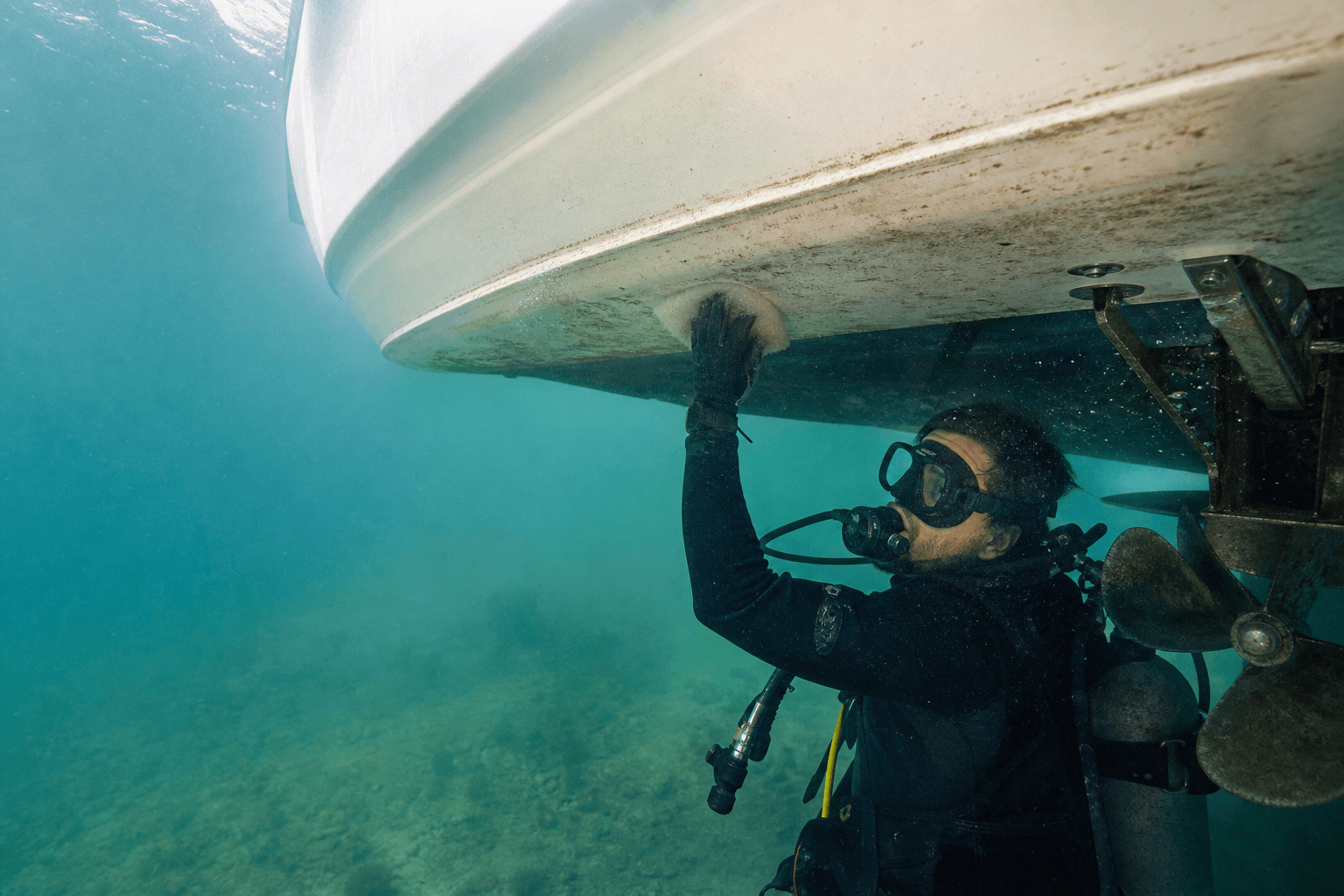
That is where professional boat hull cleaning fits. A diver removes growth before it hardens, checks the coating and underwater hardware, and documents problems that cannot be seen from the dock. Done on the right schedule and with the right tools, cleaning helps preserve performance and can extend the useful life of the antifouling system. Done too aggressively—or postponed until the bottom is heavily fouled—it can shorten paint life and turn a routine cleaning into a haul-out conversation.
For many wet-slipped boats around St. Petersburg, Clearwater, Tampa, Gulfport, and Tierra Verde, the practical schedule is every two or four weeks, depending on the season, paint condition, boat type, slip, and how often the vessel moves.
What Is Included in Underwater Hull Cleaning?
A professional bottom cleaning should be more than a quick pass across the easiest part of the hull. The diver should work methodically and report what was found.
A typical service can include:
- Removing slime and soft marine growth from the underwater hull
- Cleaning the waterline and high-growth areas
- Cleaning the propeller, shaft, rudder, trim tabs, and other running gear
- Clearing accessible intake grates without damaging them
- Inspecting antifouling paint for thin spots, exposed undercoat, or peeling
- Checking sacrificial anodes and replacing them when authorized
- Looking for fishing line, rope, impact damage, loose hardware, or corrosion
- Providing photos or video when the condition needs documentation
The diver is also an early-warning system. A boat can look perfect from the dock while a propeller is wrapped in line, an anode is nearly depleted, or the antifouling coating is coming off on the cleaning pad.
How Often Should a Boat Bottom Be Cleaned in Tampa Bay?
Current local practice generally puts wet-slipped boats on either a two-week or four-week schedule.
In July 2026, our hull-cleaning partner, Gulf & Bay Divers, told us that its managed boats are kept on those two intervals. During the warm-water months, Gulf & Bay considers a two-week schedule close to essential for some vessels because performance can deteriorate quickly once growth gets established. A four-week schedule can work when the paint is healthy, the slip has favorable water movement, and the boat is not developing hard growth between visits.
The right cadence depends on:
- Season and water temperature: growth generally accelerates in warmer months.
- Marina conditions: current, shade, runoff, and local water quality change fouling pressure.
- Paint type and age: a fresh hard coating behaves differently from a thin ablative coating.
- Boat use: regular movement can help some coatings shed growth.
- Hull shape and appendages: shafts, props, tabs, and intakes add time and collect growth differently.
- What the diver found last time: recurring barnacles or rapid rebound justify a shorter interval.
Do not choose the schedule by habit alone. Start with the coating condition and the diver's documentation, then adjust based on what actually grows between visits.
What Boat Hull Cleaning Costs in Tampa Bay
These are Gulf & Bay Divers' July 2026 recurring hull-cleaning rates for Mobile Marina customers:
| Boat and Location | Recurring Rate |
|---|---|
| Powerboat at a residential dock | $4.25 per foot |
| Sailboat at a residential dock | $3.75 per foot |
| Powerboat at a marina | $3.75 per foot |
| Sailboat at a marina | $3.25 per foot |
| Vessels 60–70 feet | $4.75 per foot or hourly |
| Vessels 71 feet and larger | $5.75 per foot or hourly |
The minimum charge is $85 at a marina or $100 at a residential dock. These rates cover a boat maintained on a recurring schedule. Hydraulic lifts, specialty equipment, difficult access, unusual running gear, and heavy fouling are assessed separately before service.
An initial cleaning is $125 per hour because the diver does not yet know how much accumulated growth, paint failure, or underwater hardware needs attention. Once Gulf & Bay brings the bottom to a maintainable baseline, the boat can move to the applicable recurring per-foot rate.
For a 40-foot motor sailor, Mobile Marina's customer price was $172.50 plus tax per cleaning. That job also came with an important operational condition: Gulf & Bay could not perform the cleaning while the boat was anchored because of insurance requirements. The owner needed a transient slip or another suitable dock for roughly half a day.
That is why price-per-foot is only the starting point. A useful quote should confirm the boat type, length, location, slip access, paint condition, cleaning schedule, running gear, lift configuration, and whether the first visit is recurring-rate work or an hourly restoration cleaning.
Expert Marine Maintenance
From routine service to major repairs, our team of expert marine technicians handles it all. Full project management so you can enjoy your boat.
Expert Technicians
Certified marine specialists
The Difference Between a Maintenance Cleaning and a First Cleaning
A recurring cleaning assumes the boat has already been brought to a manageable baseline. The diver is removing fresh slime and early growth before it becomes a scraping job.
An initial cleaning is different. The diver may encounter months of buildup, hard barnacles, fouled props, depleted anodes, fishing line, or paint that fails as soon as it is touched. Quoting that first visit hourly protects both sides: the owner pays for the actual condition, and the diver does not have to rush a neglected bottom to fit a routine price.
Gulf & Bay also provides before-and-after footage after the first cleaning. That documentation establishes the baseline for later visits and gives the owner something more useful than “the bottom looked bad.”
Ask for:
- A clear video pass before cleaning
- Close-ups of hard growth, damaged areas, and running gear
- A second pass after cleaning
- Anode condition and replacement notes
- The diver's assessment of the paint
- A recommended next interval
That record becomes especially valuable when deciding whether the coating can tolerate another season or needs a haul-out.
Cleaning Technique Must Match the Bottom Paint
More aggressive does not mean better.
Ablative antifouling paint is designed to wear away gradually. If a diver uses a pad or scraper that is too aggressive, usable coating comes off with the growth. Hard antifouling paint tolerates cleaning differently, but it can still be damaged by unnecessary scraping.
Before the first visit, tell the diver:
- The paint brand and product, if known
- Whether it is ablative, hard, hybrid, or unknown
- When it was applied
- How many coats were used
- Whether a contrasting signal coat is underneath
- Any problem areas the yard documented
A coating-safe cleaning starts with the least aggressive tool that will remove the growth. If hard barnacles now require scraping across most of the bottom, the conversation has already shifted from routine maintenance toward coating condition.
Do Not Forget Running Gear and Sacrificial Anodes
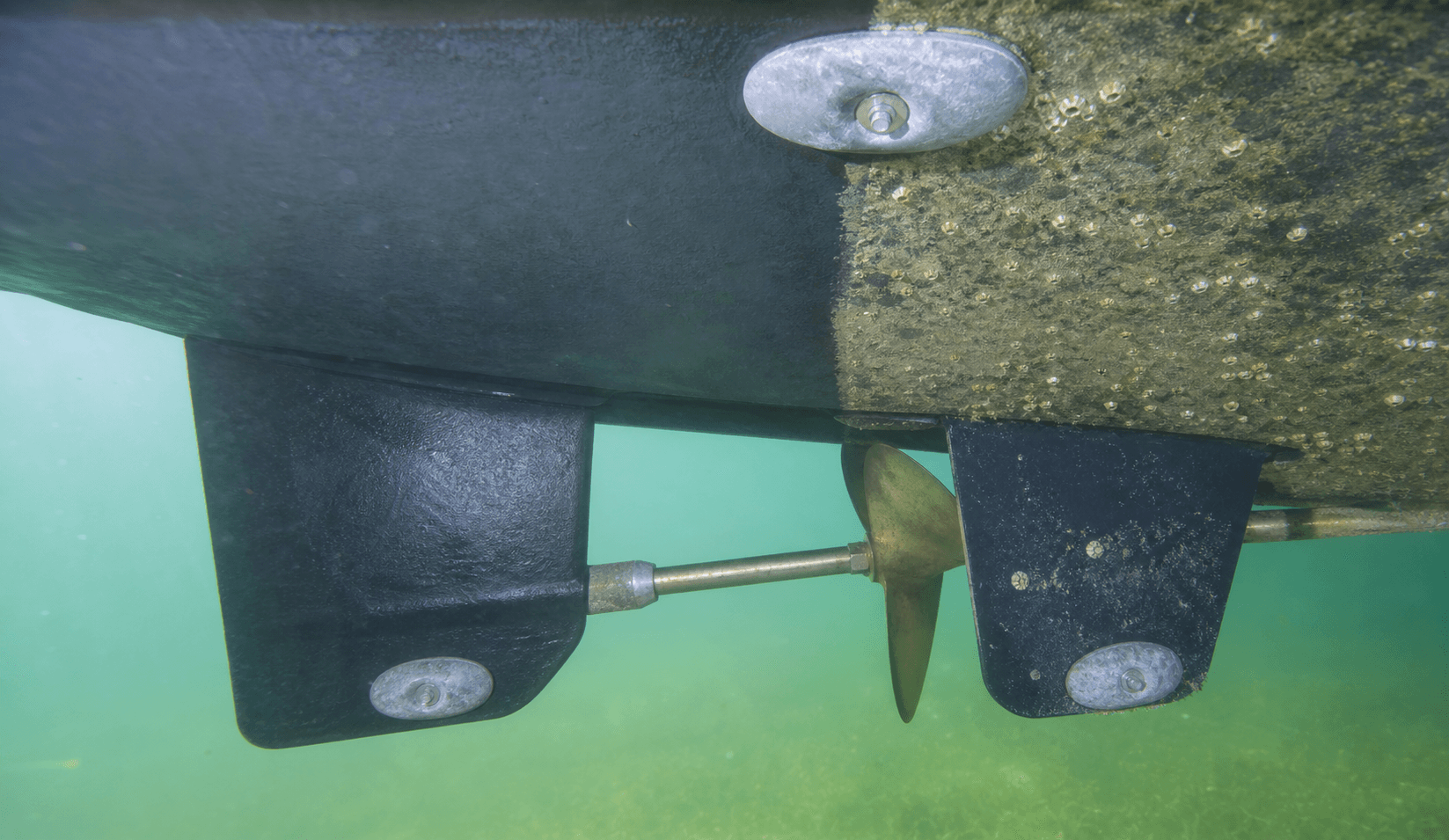
A mostly clean hull can still perform poorly when the propeller, shaft, rudder, trim tabs, or intakes are fouled. Those shapes create turbulence, and small amounts of hard growth can have an outsized effect.
Anodes deserve the same attention. They sacrifice themselves to protect underwater metals from galvanic corrosion, so “worn” is part of their job. The question is how much useful material remains and whether the wear is even.
Gulf & Bay automatically replaces anodes at 40% remaining or below and leaves the spent anodes at the dock for the owner to review. Another Tampa Bay management provider described a similar program using roughly 30% remaining as its replacement point. The exact threshold belongs in the service agreement, but the important part is that it is defined in advance and documented.
Rapid or uneven anode loss can point to a bonding problem, stray current, a neighboring vessel, or an incorrect anode material. Replacing the metal without reporting the pattern misses the larger issue.
When Hull Cleaning Is No Longer Enough
Hull cleaning manages growth between haul-outs. It does not repair failed paint.
Plan a haul-out assessment when:
- The diver reports paint coming off on a soft pad
- A contrasting signal coat is exposed across large areas
- Bare substrate or barrier coat is visible
- Paint is peeling, flaking, or blistering
- Hard growth returns unusually fast after cleaning
- The bottom requires aggressive scraping at every visit
- Speed or fuel economy does not recover after a complete cleaning
- Underwater hardware needs repair rather than inspection
At that point, paying for increasingly aggressive cleanings can be false economy. The remaining paint is no longer controlling growth, and every hard cleaning may remove more of an already depleted system.
Our boat bottom paint guide explains the next step: haul-out, pressure washing, dry inspection, preparation, repairs, coating, and relaunch.
Get Fuel Delivered to Your Slip
Download the Mobile Marina app to schedule dockside fuel delivery, manage your vessel, and access all our services from your phone.

Hull Cleaning vs. Bottom Paint
The two services solve different parts of the same problem.
| Hull Cleaning | Bottom Paint |
|---|---|
| Performed underwater by a diver | Requires haul-out and dry preparation |
| Removes current slime and growth | Creates the antifouling barrier |
| Usually scheduled every 2–4 weeks locally | Commonly planned every 12–24 months |
| Includes inspection of paint, running gear, and anodes | Includes surface prep, coating, and authorized repairs |
| Cannot fix peeling or depleted paint | Resets a failed or worn coating system |
The best maintenance plan connects them. Diver reports help determine when to repaint, and a documented paint job tells the diver which cleaning method to use.
Tampa Bay Service Conditions Matter
The same boat can foul differently after moving marinas. A shaded basin in St. Petersburg may behave differently from a private dock with stronger flow in Tierra Verde. Clearwater's Gulf access, Gulfport's Boca Ciega Bay conditions, and protected Tampa canals each create their own mix of water movement, salinity, runoff, and sunlight.
Access matters too. Residential docks can require gate instructions, parking coordination, lift details, or information about pets. Marina work may require contractor registration, proof of insurance, parking instructions, and permission from the dockmaster. Boats at anchor may not be serviceable under a dive company's insurance policy.
When requesting a quote, provide:
- Vessel make, type, and length
- Marina, dock, and slip—or the residential address
- Power or sail
- Paint type and application date, if known
- Propulsion and running-gear details
- Lift, gate, parking, and access information
- Known damage or heavy-fouling concerns
That information makes the first visit safer and the price more accurate.
Frequently Asked Questions
Build Hull Cleaning Into the Maintenance Plan
The goal is not to buy the most frequent cleaning possible. It is to keep growth manageable, protect the paint, monitor the hardware, and know when the underwater condition changes.
Mobile Marina coordinates hull cleaning with Gulf & Bay Divers alongside boat maintenance, vessel management, and partner-yard haul-outs across St. Petersburg, Clearwater, Tampa, Gulfport, Tierra Verde, and surrounding Tampa Bay communities. We collect the vessel details, coordinate access, and keep the documentation with the rest of the boat's service history.
Request a hull-cleaning quote or review our Tampa Bay service areas. If the diver is already reporting worn paint or rapid growth, start with the bottom-paint cost and lifespan guide.
Related: Boat Bottom Paint in Tampa Bay | Boat Maintenance Cost Guide | Mobile Boat Repair