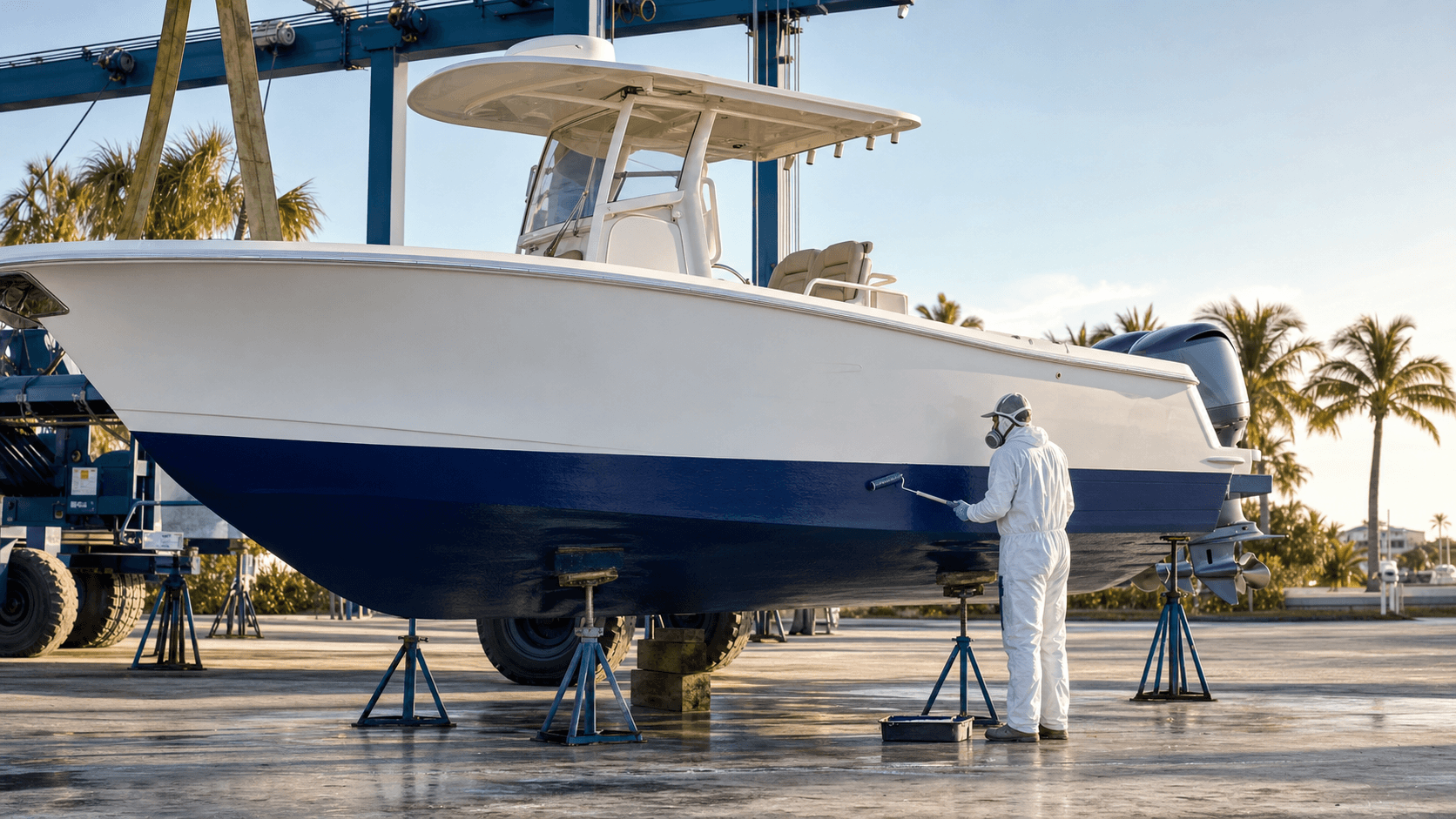
If your boat stays in Tampa Bay water, bottom paint is not cosmetic. It is the antifouling barrier that slows the slime, algae, barnacles, and other growth trying to turn the hull into habitat. Let that growth build and the boat gets slower, burns more fuel, and becomes harder to clean. Leave a failing coating in place long enough and the next haul-out can become a removal-and-repair job instead of a straightforward repaint.
For most wet-slipped boats around St. Petersburg, Clearwater, Tampa, Tierra Verde, and Gulfport, boat bottom paint lasts about 12–24 months. That is a planning range, not a timer. The right interval depends on the paint, how often the boat moves, the slip, diver-cleaning habits, and what the hull looks like now.
This guide explains how to read those signs, what a Tampa Bay bottom job actually involves, which paint type fits which boat, and how to compare quotes without getting fooled by a low number that leaves out half the work.
What Bottom Paint Actually Does
Antifouling bottom paint contains active ingredients that discourage marine organisms from attaching to the submerged hull. Some coatings slowly wear away and continually expose fresh active material. Others keep a harder surface while the biocide releases over time.
The goal is not to make growth impossible. In warm Florida water, no coating earns that promise. The goal is to keep growth manageable so routine use and proper in-water cleaning can remove it before it becomes a performance problem.
Bottom paint also does not replace a barrier coat. Antifouling controls growth; an epoxy barrier system helps protect the underlying laminate from water intrusion. If a yard finds blistering, exposed fiberglass, or a failed barrier layer during prep, that repair belongs in a separate line item.
How Long Bottom Paint Lasts in Tampa Bay
Most local owners should inspect the coating at least annually and budget for repainting every 12–24 months. Boats that live in the water year-round tend to land toward the shorter end. A frequently used boat with a well-matched ablative coating may make it toward the longer end because movement helps the coating shed.
Five variables matter more than the calendar:
- Water temperature and nutrient load. Warm, productive water supports faster growth.
- How often the boat moves. Some ablative paints need water movement to expose fresh coating.
- Slip conditions. Current, shade, runoff, and nearby growth can make two marinas age paint differently.
- Cleaning technique. Aggressive scrubbing can remove usable ablative paint early.
- Coating compatibility and preparation. Even premium paint fails when applied over a contaminated or incompatible surface.
A trailer-stored boat that only spends weekends in the water may not need conventional antifouling paint at all. A boat that already has a painted bottom and regularly rubs against trailer bunks or lift supports is a different case: the coating has to tolerate that contact, and the blocked areas need to be accessible during prep. Before adding or replacing a coating, compare the boat’s actual use and storage with the manufacturer’s immersion, abrasion, and launch-window requirements.
Seven Signs It Is Time to Repaint
Do not wait for the hull to look like a reef. These are the earlier signals:
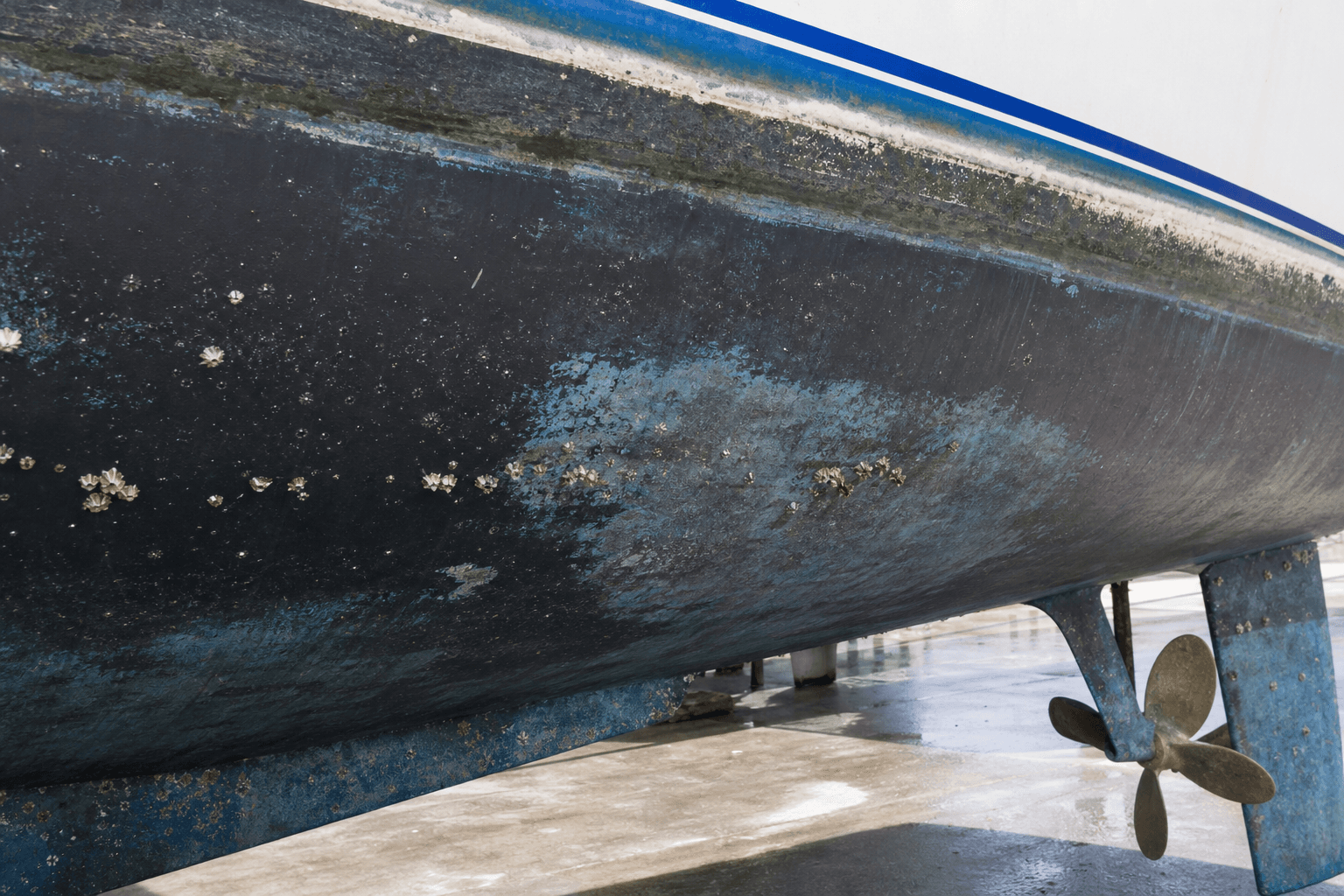
- Growth returns quickly after cleaning. If slime or barnacles rebound faster than they did last season, the active coating may be depleted.
- The signal coat is showing. Many yards apply a contrasting first coat. When that color appears through the finish coat, usable thickness is disappearing.
- Large patchy or bare areas appear. Isolated wear at the bow and leading edges is normal. Broad exposure is not.
- Paint flakes or peels. That points to an adhesion or compatibility problem. Painting over it only traps the failure underneath.
- The boat loses speed at the same RPM. Fouling increases drag. Compare clean-hull performance before blaming the engines.
- Fuel burn rises without another explanation. A rough hull forces the engines to work harder.
- Your diver reports hard growth or coating coming off on the pad. Ask for photos and specific locations, not just “bottom needs paint.”
A haul-out inspection is the deciding step. Photos taken while the hull is still wet can hide chalking, cracks, and thin spots, so inspect again after pressure washing and drying.
We have also seen owners ask whether streaks in a tinted bottom can simply be washed away. Sometimes they can—but the cleaning can remove the last tinted layer and expose the older coats underneath. That is a coating-condition decision, not just a detailing decision.
Expert Marine Maintenance
From routine service to major repairs, our team of expert marine technicians handles it all. Full project management so you can enjoy your boat.
Expert Technicians
Certified marine specialists
What Boat Bottom Paint Costs in Tampa Bay
Here is a real number from our own work: in 2026, Mobile Marina quoted $4,025 for the haul-out, fiberglass-blister repair, and bottom paint on a 1982 23-foot sailboat. That works out to roughly $175 per foot, but calling it a $175-per-foot paint job would be misleading. The number bundled three scopes: getting the boat out of the water, repairing the hull, and coating the bottom.
That is the problem with most price-per-foot comparisons. One yard may be quoting paint over a sound, already-prepared surface. Another may include travel-lift time, pressure washing, blocking, blister repair, sanding, materials, stand moves, and relaunch. Both numbers can be honest and still be nowhere close to comparable.
For budgeting, ask for an itemized package rather than multiplying the boat length by a number found online. Local yard rates, hull condition, paint choice, beam, draft, and access can move the total substantially.
A second real quote from our 2026 correspondence came to $115 per foot, or $2,645 plus transport and tax for a 23-foot lift-stored boat. That job called for a specialized tintable coating designed to tolerate repeated contact with a trailer or lift. The paint itself was about $400 per gallon, and the boat needed transport to a partner yard, hydraulic lifting, and jack stands so the entire bottom—including the support areas—could be reached. At the time, the first available yard opening was three to four weeks away.
| Scope | What Changes the Price |
|---|---|
| Haul, pressure wash, and block | Boat length, beam, weight, yard minimums |
| Light prep and recoat | Paint condition, compatibility, number of coats |
| Heavy sanding or stripping | Peeling layers, unknown coating history, buildup |
| Barrier-coat repair | Blisters, exposed laminate, moisture findings |
| Running gear and metal protection | Shafts, props, tabs, drives, transducers |
| Paint and supplies | Ablative vs. hard coating, color, required film thickness |
The cheapest quote often assumes the easiest possible hull. Ask what happens if the pressure washer exposes peeling paint, how additional prep is authorized, and whether the quoted paint quantity meets the manufacturer’s coverage requirement.
A real 23-foot sailboat bottom-job timeline
The same project is a useful example of what actually happens between “we need bottom paint” and getting the boat back into its slip.
- The first estimate was intentionally built as an all-in punch list, with items the owners could remove or adjust after inspection.
- Hull oxidation above the waterline was quoted separately at $2,645 for wet sanding, decontaminating wash, two compound passes, and polymer coating. The owners approved the broader work but held that oxidation item pending a detailer’s assessment.
- The bottom package included haul-out, fiberglass-blister repair, and bottom paint for $4,025.
- We told the owners to plan on about one week from haul-out through repair and repainting, subject to partner-yard availability and what the dry hull revealed.
- While the boat was out, the scope also considered the thru-hull, zincs/anodes, and other repairs that made sense to address before relaunch.
- When the yard finished the bottom job, our team coordinated the boat’s return and towed it back to its St. Pete Municipal Marina slip. Other work, including new lines and an engine installation, continued separately at the dock.
That last point matters. A bottom job is rarely an isolated can-of-paint purchase. The owner is making decisions about what to approve now, what needs a closer assessment, what belongs to the partner yard, and what the dockside team can finish after the boat comes home.
Ablative vs. Hard Bottom Paint
The best product depends on how the boat is stored and used. “Most expensive” is not a selection method.
Ablative paint
Ablative coatings gradually wear away, exposing fresh antifouling material. They are a common fit for recreational boats that move regularly and may spend part of the year out of the water. Because the coating sacrifices itself, buildup can be easier to manage over repeated service cycles.
The tradeoff is cleaning sensitivity. A diver using an aggressive pad can shorten the coating’s life, and a boat that rarely moves may not get the same self-polishing benefit.
Hard antifouling paint
Hard coatings cure to a durable surface and suit faster boats, frequently used vessels, and hulls that receive regular cleaning. They do not wear away in the same fashion, so old layers can accumulate and eventually require heavier removal.
Some hard paints also have strict launch windows. If the boat sits ashore too long after application, the yard may need to scuff or recoat it before launch.
Hybrid and metal-safe coatings
Hybrid products try to combine a harder finish with controlled polishing. Aluminum hulls, outdrives, trim tabs, and other underwater metals require products specifically approved for those materials. A copper-heavy hull paint on incompatible metal can create corrosion problems. The paint maker’s written compatibility chart should settle the decision.
Boats stored on lifts or trailers add another requirement: abrasion at bunks and supports. In one Mobile Marina project, the recommended coating was selected specifically because it could tolerate repeated launching and retrieval and could be tinted to match the hull. The storage method changed both the product and the price.
What Happens During a Proper Bottom Job
A professional bottom-paint job is mostly preparation. Rolling on color is the fast part.
- Haul and pressure wash. Growth is removed before it dries into a harder shell.
- Dry inspection. The yard maps peeling, blisters, damage, bare areas, and previous repairs. This is also where an optional “while we are out” item becomes a real recommendation or gets deferred.
- Identify the existing coating. When the old paint is unknown, a tie coat or removal may be safer than guessing.
- Sand and feather. Loose edges come off and the remaining surface is prepared for adhesion.
- Repair as authorized. Blisters, laminate damage, and failed barrier coat are documented separately.
- Mask and protect hardware. Transducers, anodes, shafts, props, and drives are handled according to their materials.
- Apply the specified coats. High-wear areas such as the bow, waterline, rudders, and leading edges often receive an extra coat.
- Observe recoat and launch windows. Temperature and humidity affect cure time.
- Move the stands and finish blocked areas. No boat should leave with uncoated support patches.
- Document the job and return plan. Keep product name, color, batch information, coat count, completion date, and photos for the next service. Confirm who is relaunching, towing, or moving the boat back to its slip.
Bottom painting requires a haul-out or trailer. It cannot be performed properly at the slip. Mobile Marina can help inspect the boat, document symptoms, and coordinate work that needs a partner yard while keeping the rest of your boat maintenance organized.
How to Compare Bottom-Paint Quotes
Put competing quotes side by side and check the scope line by line:
- Is haul-out, pressure washing, blocking, and relaunch included?
- What exact paint and how many coats are specified?
- Is an extra coat included at the waterline and leading edges?
- Does prep mean a light scuff, full sanding, or removal of loose paint?
- How are blisters and barrier-coat repairs approved?
- Are running gear, trim tabs, transducers, and outdrives included or excluded?
- Are environmental, shop-supply, and lay-day fees listed?
- Will you receive completion photos and the coating details?
If one quote is dramatically lower, it usually has a smaller scope. That is not automatically bad, but it should be obvious before the boat is hanging in the travel lift.
Get Fuel Delivered to Your Slip
Download the Mobile Marina app to schedule dockside fuel delivery, manage your vessel, and access all our services from your phone.

How to Make Bottom Paint Last Longer
Use the boat. Regular movement helps many coatings stay cleaner. Keep a baseline of speed, RPM, and fuel burn so drag shows up as data instead of a vague feeling.
Schedule in-water cleaning based on actual growth, not an automatic aggressive scrub. Tell the diver which paint is on the hull and when it was applied. A soft cleaning performed early is easier on the coating than waiting for hard growth.
Have the bottom photographed during cleaning and at every haul-out. Focus on the bow, waterline, chines, keel, tabs, transducers, and running gear. Those repeatable photos make it much easier to tell normal wear from a coating failure.
Finally, fix the source of peeling before adding another coat. A new layer cannot rescue poor adhesion underneath it.
Frequently Asked Questions
The Bottom Line
Bottom paint is one of those jobs where timing saves money. Recoat while the existing system is still sound and the yard may only need routine preparation. Wait until layers are peeling, hard growth is established, or the barrier coat is exposed, and the labor climbs quickly.
If your boat is slowing down, the diver is finding hard growth, or you simply do not know what coating is on the hull, start with an inspection and good photos. Mobile Marina can help you document the condition, coordinate haul-out work, and keep the other maintenance around it from falling through the cracks.
Explore Mobile Marina maintenance services, review our boat detailing options, or contact the team to plan the next service. We will help you stay ahead of the hull so you can spend more time on the water.
Related: Boat Detailing Services in Tampa Bay | Boat Maintenance Cost Guide | On-Water Repairs