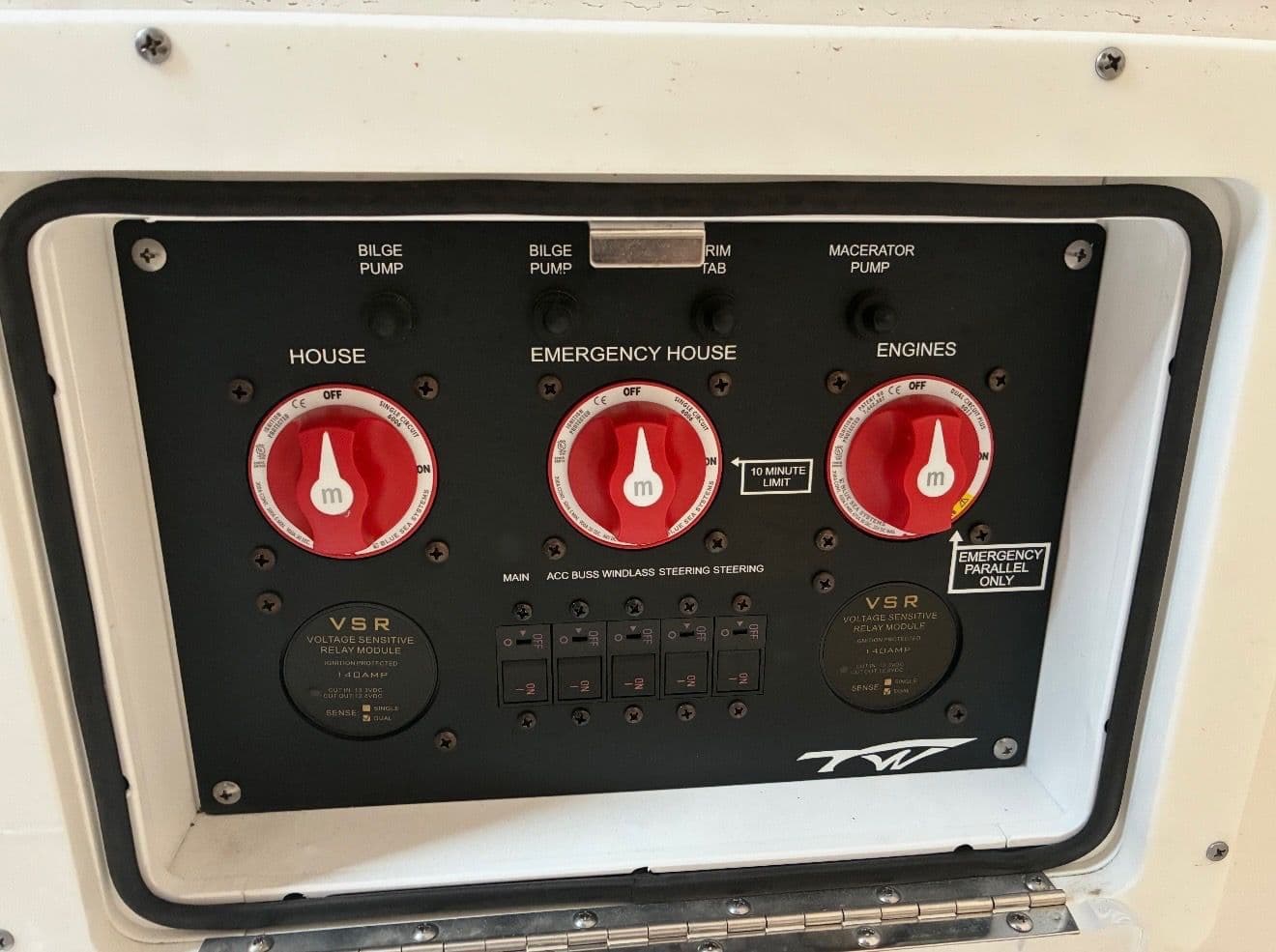
If you walked past this 27' Tidewater at its slip in St. Petersburg, you wouldn't see anything wrong. The boat looked clean. Shore power was hooked up. Every switch on the panel was flipped to OFF, exactly the way you'd leave them if you were trying to do everything right.
But something was draining the batteries anyway.
Over the next three months, our team made six scheduled visits to this boat. Each one had a clear goal: replace the failed batteries, build out a proper charging setup, test the system under real conditions, then trace and resolve a voltage leak the team suspected was hiding deeper in the wiring. By the end, we'd replaced six batteries, installed a second charger, rewired the shore connection, added a high-water alarm, diagnosed and replaced three failed battery switches, and resolved a bilge pump float switch issue caught during the final walkthrough.
Marine electrical systems are layered and often poorly documented from the factory. A complete diagnosis on a boat like this is rarely a single-visit job — not because anything is wrong, but because good electrical work builds from confirmed facts. You establish a baseline, test, verify, and move to the next layer.
This is the full timeline, shared as a case study for other boat owners who might recognize pieces of it in their own slips. We're publishing it with the customer's permission and with their name kept out of it, because the point isn't who — it's how we work through problems like this so you don't have to.
December 26: The Pre-Trip Emergency
The call came in on a Friday afternoon. The owner had an outing scheduled for Sunday and his batteries were dead. Every hour mattered.
Our technician was on the boat the same afternoon. He load-tested every battery — all six Group 24 AGMs — and confirmed what the owner suspected: they were finished. Not one borderline, not two to swap. All six.
The problem was sourcing. Our wholesale supplier couldn't fulfill the order by Saturday, so our technician drove to two separate retail locations and secured the batteries himself. Saturday morning all six were installed, connections cleaned, and terminals sprayed with Corrosion-X. He tested every house component and the trolling motor feed. Everything worked.
The owner made the Sunday trip.
Before leaving, our technician also raised a possibility worth checking: given how fast the batteries had drawn down, a bilge pump cycling on its own was one of the likely culprits. The owner checked and confirmed that wasn't the case. With that ruled out, we closed the emergency visit on the battery replacement and turned our attention to the bigger picture.
What We Flagged Before Leaving
Our technician also documented something important on the way out: the boat's only battery charger was dedicated to the trolling motor bank. The three batteries under the leaning post — Port, Starboard, and House — had no way to recharge except by running the engines.
That's a real gap. A boat that doesn't get run weekly has no way to replenish what time and cold weather take out of the batteries. We recommended adding a second charger to cover the underseat bank and walked the owner through the options so he could make an informed decision on scope and timing.
January 29: Establishing a Baseline
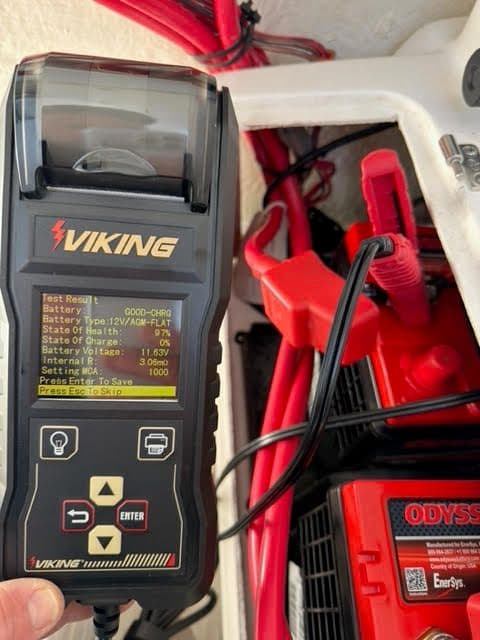
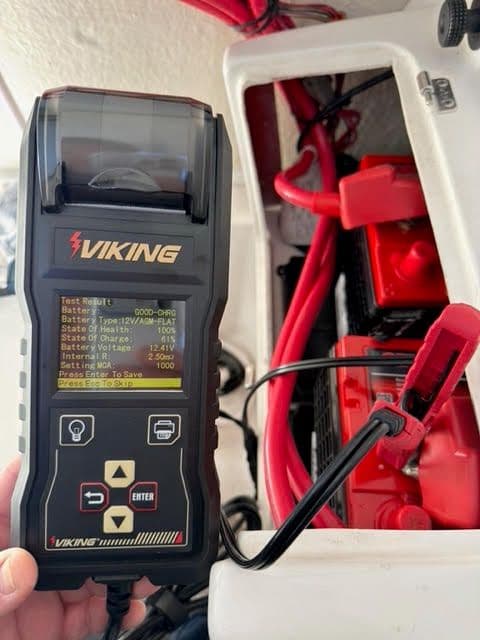
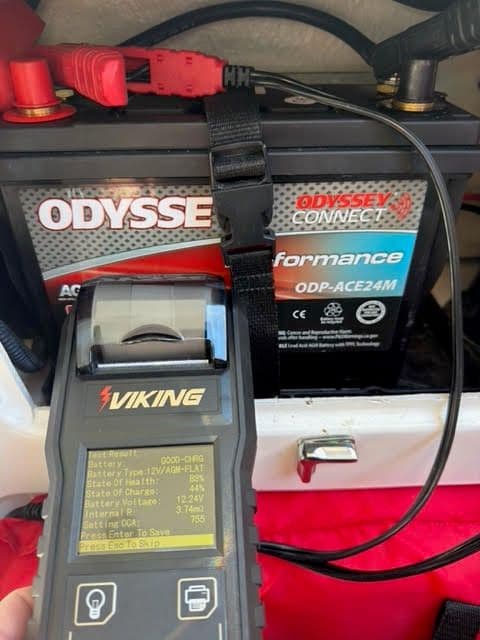
A month later, we were back on the boat testing the three underseat batteries. The news was mostly good: Port, Starboard, and House all showing good health on our Viking battery tester. Charge levels varied, but health was fine.
Two things we documented on this visit:
The Port battery was throwing an error code, and the Starboard was showing no charge. That pattern is consistent with a factory wiring error — specifically, the Port and Starboard connections potentially being crossed at the motor from the original rigging. We flagged it for a deeper inspection on a later visit.
With no charger for the underseat bank, three scenarios could explain the charge drop: cold weather loss, no engine runs to replenish, or a bad cell in the starboard battery (still under warranty if needed).
We put the Starboard on a 24-hour trickle charge to narrow it down. The battery held, which confirmed the cells were healthy and isolated the root cause: charging infrastructure, not battery health. That gave the owner a clear recommendation backed by data, and he scheduled the charger installation.
February 5: Building Out the Charging System
In one scheduled trip, the team completed three upgrades:
- Installed a second battery charger dedicated to the Port, Starboard, and House banks under the leaning post
- Rewired the shore power inlet so a single exterior hull connection powers both chargers, keeping the owner's dock routine to one plug
- Added a High Water Alarm in the bilge, adding another layer of early warning to the boat's monitoring
Clean, tested, and fully documented for the owner. Two chargers, one plug, and a more complete picture of the boat's electrical health than it had before we started.
March 2: A New Data Point
The owner called to report the batteries were drained again. The team went back out and began a systematic check of the full charging circuit.
The first finding came quickly: the shore power outlet the chargers were plugged into was wired through the boat lift's master switch. When the lift was turned off, both chargers lost power. That's an unusual factory configuration and not something visible from the boat itself — but with the circuit identified, the team documented it and the owner was able to adjust his routine to keep shore power active between trips.
The second finding came from a broader test of the full electrical system: a breaker was carrying voltage with the battery switches turned off. That's a clear sign of a parasitic draw in the factory wiring — current bypassing the switches on a circuit that was supposed to be dead — and it needed to be traced and resolved.
This work was outside the original scope of the charger installation, so our captain called the owner, explained what the test results showed, outlined the diagnostic steps needed to confirm the source, and provided an estimate. The owner approved, and the team moved into the next phase with a clear plan.
March 3: Tracing the Voltage Leak
Switches off. Meter out. The team worked outward from the panel.
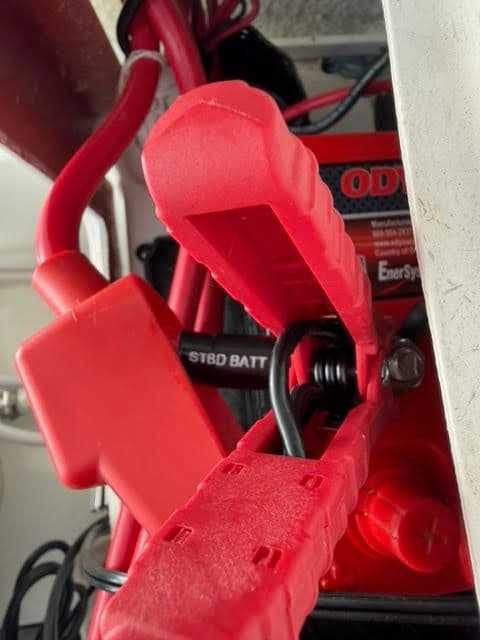
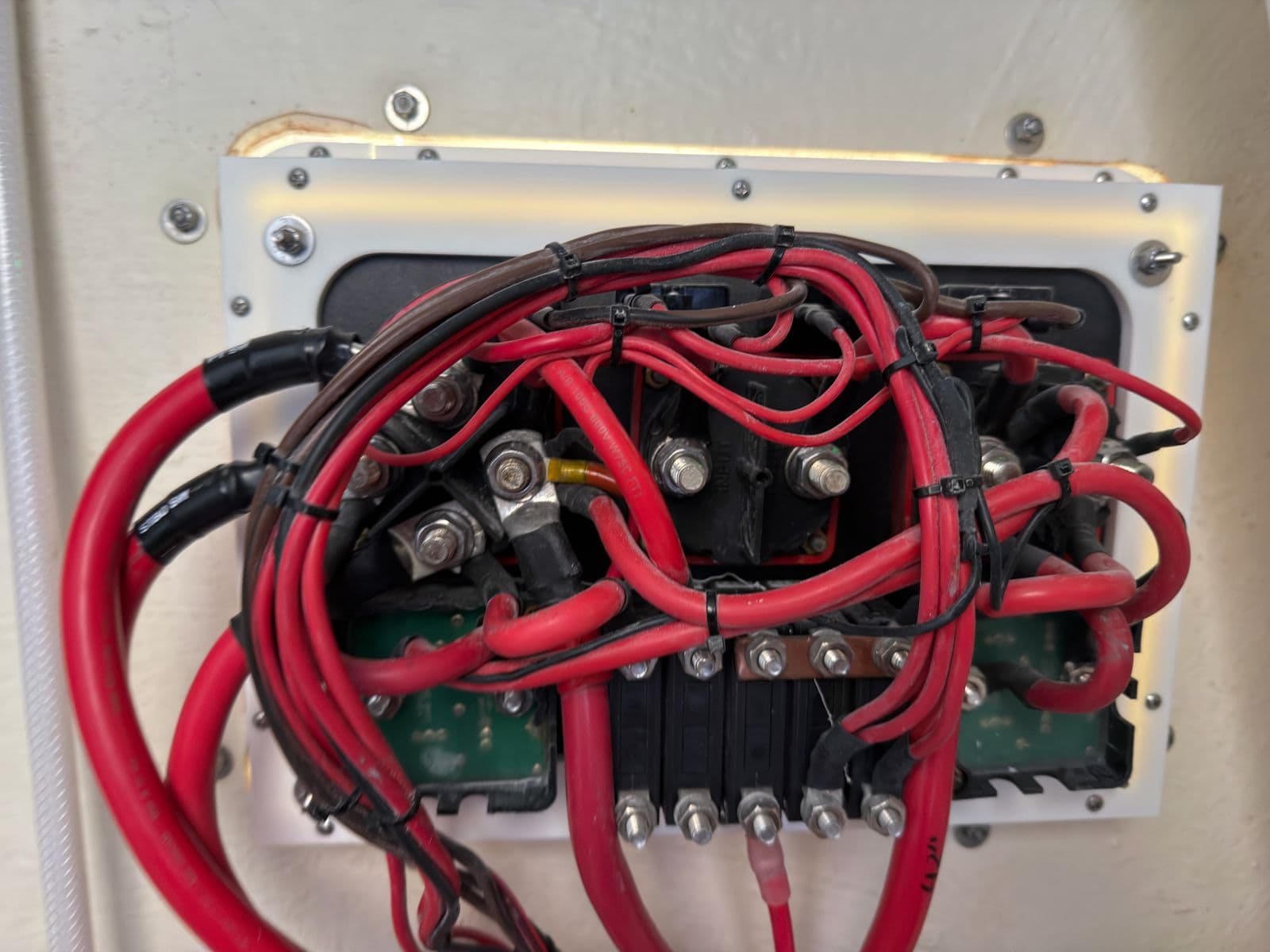
Meter on the starboard engine post: 12.98 volts. Meter on the power cable running to the outboard: 12.98 volts. The current wasn't coming from a stuck accessory or a short in the engine harness — it was passing right through the battery switch itself, as if the switch didn't exist.
That's a failed switch. Not worn, not corroded — failed in a way that doesn't show from the front of the panel. The knob said OFF. The internals said otherwise.
And it wasn't just one switch. Once the team traced the path, they confirmed that the starboard bank was being drained through the faulty switch and then pulling off the house bank to make up the difference. One bad part was slowly killing two batteries at once.
We shot video of the voltage readings and sent them to the owner so he could see the diagnostic for himself. When we recommend a repair, we want the customer to understand exactly what the evidence is showing.
March 6: The Fix, Plus One More Finding
Three battery switches replaced:
- 1× Blue Sea 6011 Mini Dual Circuit Plus Selector — the 4-position main selector
- 2× Blue Sea 6006 Mini ON/OFF switches — the house and emergency banks
While we were in there, the crew did what we do on every electrical job: pulled every battery cable connection, cleaned the terminals, and sprayed them down with Corrosion-X. Saltwater boats live and die by the quality of the connection — a loose or corroded terminal will cost you more than a bad switch ever will.
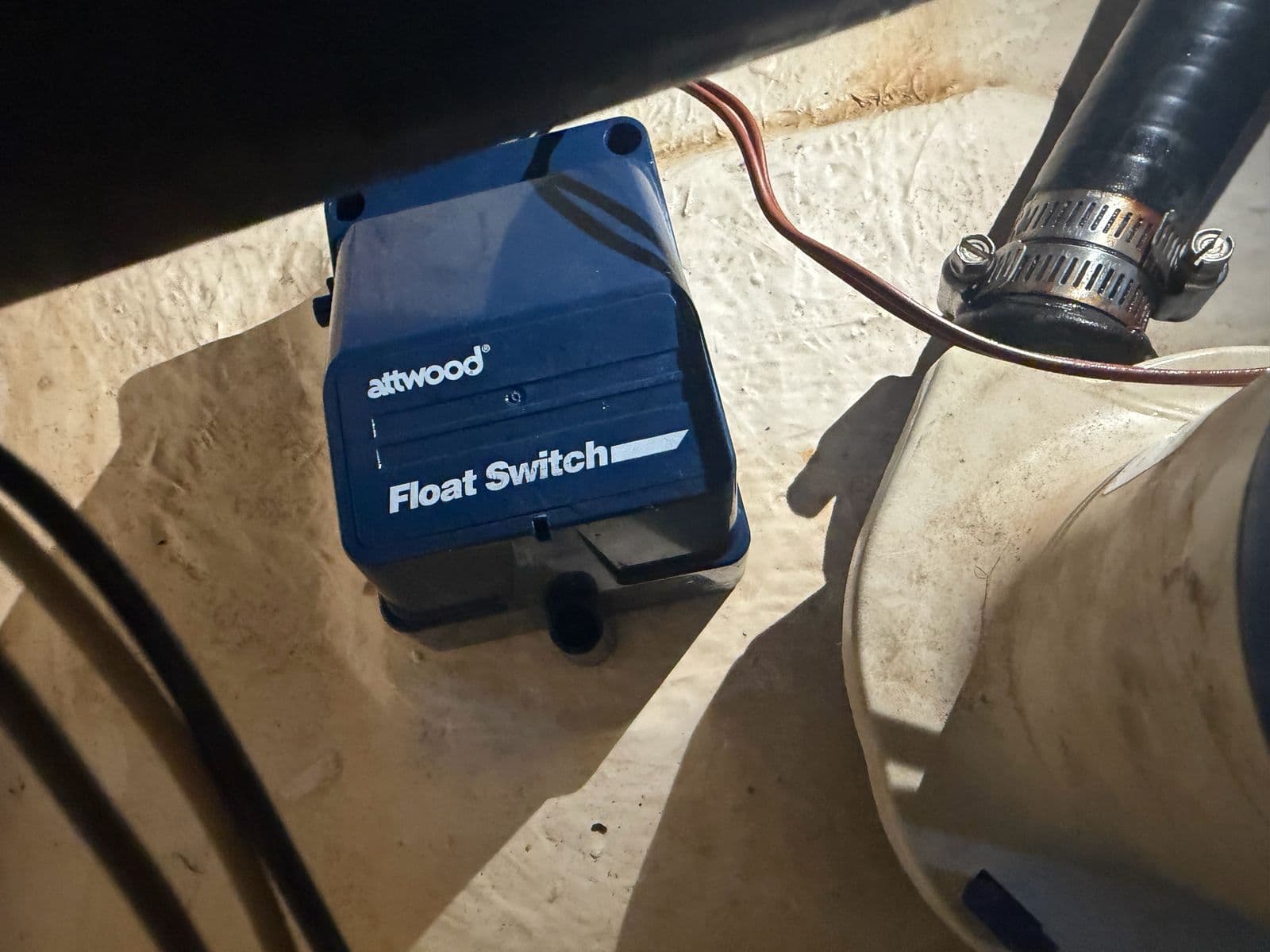
After the switches were reconnected and tested, the team did a full walkthrough of the boat's other systems while they had it open. That's where we found the next item to handle: the Attwood Automatic Float Switch on the primary bilge pump was not cycling properly. Stain lines in the bilge confirmed water had been pooling above the pump at some point, a clear indicator the switch wasn't doing its job.
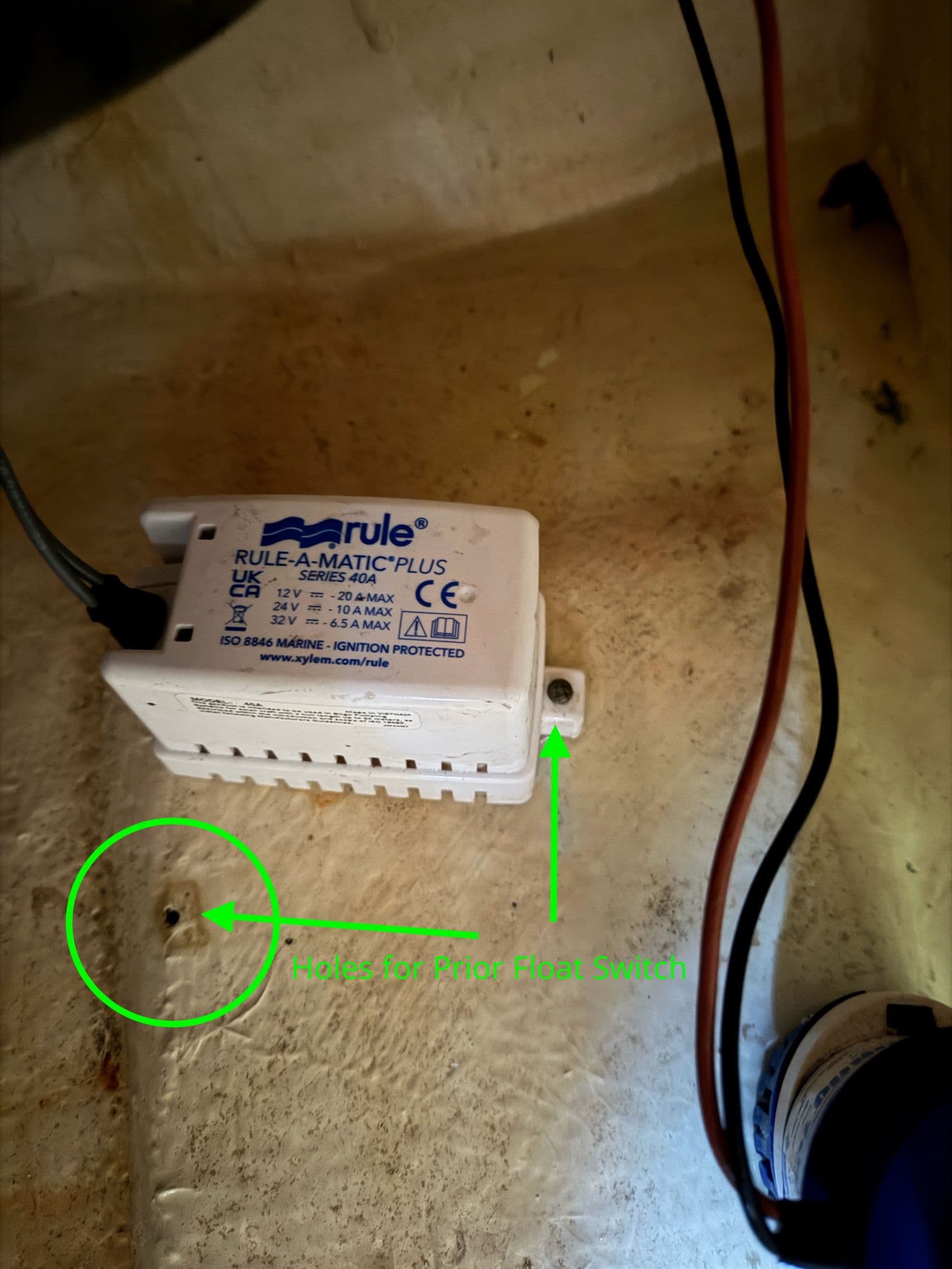
Worth noting: the boat had two float switches — one Attwood, one Rule-A-Matic Plus. The mismatch suggested an earlier repair had replaced only one of them, which is a common situation on boats that have been serviced by multiple shops over the years.
We ordered a new Rule-A-Matic in the version without the debris cage, which is the more reliable configuration for this application, and scheduled a return trip. Accessing the bilge on this boat required removing the caulked panel on the transom, so we planned the visit accordingly.
March 16: Closing the Job
When the team pulled the old float switch, they found debris inside it — material that had accumulated in the cage from the earlier repair. The pump itself was healthy and mechanically sound; the switch just needed replacement. We cleared the debris, installed the new cage-free Rule-A-Matic, tested the cycle, and verified everything was operating correctly.
That closed the job. By the end of three months and six visits, the owner had a fully documented electrical system: new batteries, a proper dual-charger setup, a rewired shore inlet, a high-water alarm, three replaced battery switches, confirmed wiring on every circuit we tested, and a working bilge pump with a reliable float switch.
What This Case Study Teaches
A few takeaways worth sharing with other boat owners:
- "Just a bad battery" almost never means just a bad battery. A battery is downstream of everything on a boat. When one fails, the useful question is always what drained it, and the answer is usually further up the chain. Replacing batteries without investigating the cause tends to produce the same result a few months later.
- Charging infrastructure matters more than battery brand. Even the best AGMs will fail early if they aren't receiving a reliable charge. On boats that don't get run weekly, a properly configured charging system is the difference between a battery bank that lasts five years and one that lasts six months.
- Factory wiring holds surprises. Shore outlets fed through lift switches, crossed engine connections, breakers still carrying voltage in the "off" position — none of this is documented anywhere except in the original installer's memory. Part of professional marine service is expecting those surprises and testing for them systematically.
- Voltage testing is the only reliable answer. A switch labeled OFF can still carry voltage if it has failed internally. The only way to know for sure is to test it with a meter, which is exactly why routine electrical checks are part of a thorough inspection.
- A consistent service team is worth more than any single repair. The reason this diagnosis came together cleanly is that the same team was tracking the boat across every visit, with documented findings at each step. When service history lives in one place and the same people are running the tests, the picture fills in quickly.
The Signs Your Boat Might Be Doing the Same Thing
If anything in this case study sounds familiar, it's worth a closer look. These are the quiet signals of a parasitic draw, and they're more common than most owners realize:
- Batteries that die even though the switches are OFF. This is usually not "just old batteries." Something is pulling power when nothing should be — and it isn't always an accessory. Sometimes it's the switch itself.
- A shore charger that runs hotter than it should, or cycles constantly. It's working overtime to make up for a drain somewhere downstream.
- One bank that always dies first. There's usually a reason one battery is working harder than the others. Finding that reason early can save the whole bank.
- Switches older than 8–10 years on a saltwater boat. The contact surfaces inside corrode slowly and invisibly. A voltmeter will tell you the truth the panel label can't.
If you're comfortable with a multimeter, you can start troubleshooting some of this on your own — it's a good skill to have. If electrical diagnosis isn't something you want to take on, that's what a scheduled captain visit is for. Either way, the earlier you find it, the less it costs in batteries, time, and missed trips.

$99
per month
Starting price for vessels under 25ft
Never Worry About Your Boat Again
Monthly inspections by USCG-certified captains keep your boat ready to go whenever you are.
Monthly Inspections
Full systems checks every month
Full Diagnostics
Engine, electrical, and navigation systems
Coordination
We schedule and manage all maintenance
Peace of Mind
Your boat is always ready when you are
How We Help Owners Get Ahead of Jobs Like This
The goal of our monthly management program is to find issues like the ones in this case study early, document them clearly, and give owners a plan for how to address them on their own schedule.
Here's how it works. A USCG Master Captain walks your boat on the same week every month and runs a 24-point checklist covering electrical, bilge, fuel, engine, and safety systems. Every finding is documented with photos and written up with a recommendation. When something needs a repair, you get a heads-up and an estimate in advance, not a surprise phone call from the dock. When it's a quick fix, we handle it as part of the visit.
Every item in this story — the battery health, the charging gap, the shore-power wiring, the voltage leak on the switches, the float switch — is exactly the kind of thing a monthly visit is built to catch. The system works because the same team is looking at the same boat, with a consistent record, month after month.
That consistency is what makes marine electrical work predictable instead of stressful. It's the difference between wondering if your boat is okay and knowing it is.
The Timeline at a Glance
- Dec 26, 2025 — Emergency battery replacement. All six Group 24 AGMs load-tested and replaced. Connections cleaned and treated. Sunday trip preserved.
- Jan 29, 2026 — Underseat bank tested. Batteries confirmed healthy via trickle charge. Charging-infrastructure gap identified as the root cause.
- Jan 30, 2026 — Estimate provided for second battery charger installation.
- Feb 5, 2026 — Second charger installed. Shore inlet rewired to a single connection. High-water alarm added.
- Mar 2, 2026 — Follow-up diagnostic. Shore outlet found to be controlled by lift switch. Parasitic voltage identified on a breaker with switches off.
- Mar 3, 2026 — Parasitic draw traced to faulty battery switches. 12.98V on the starboard engine post with all switches off.
- Mar 6, 2026 — Three battery switches replaced. Full cable cleaning and Corrosion-X treatment. Bilge float switch flagged for replacement.
- Mar 16, 2026 — New Rule-A-Matic float switch installed and verified. Job complete.
The Spec Sheet
For the boat nerds who want the full rundown:
- Vessel: 27' Tidewater, twin outboard, St. Petersburg, FL
- Service window: December 26, 2025 – March 16, 2026 (six scheduled visits)
- Primary issue: Parasitic voltage leak through failed e-Series battery selector switches, compounded by a charging-infrastructure gap and a lift-switch wiring configuration on the shore power inlet
- Diagnosed by: USCG Master Captain and marine electrical technician, working from documented findings on each visit
- Batteries: 6× Group 24 AGM replaced (Dec 26), plus 1× Starboard replaced under warranty testing
- Charging: Second dedicated charger installed for Port/Starboard/House bank; shore inlet rewired to single-connection
- Switches replaced: Blue Sea 6011 Mini Dual Circuit Plus Selector (×1), Blue Sea 6006 Mini ON/OFF (×2)
- Additional work: High-water alarm added, full battery terminal cleaning, Corrosion-X treatment on all connections, Attwood float switch replaced with cage-free Rule-A-Matic Plus